menu
top sales
  • Author:
    Franco

    In his new book, grandmaster Zenon Franco deeply analyzes the 69 instructive victories of the 11th world champion Robert Fischer. The book is not overloaded with options, the emphasis – with detailed explanations in a move-by-move style, creating an ideal platform for learning chess. In the "reference" At points in each game, the reader is offered test questions, which helps both the practical study of key techniques of the chess game and the reliable assimilation of acquired knowledge. Questions and answers engage the reader in the learning process and help him track his growth in chess strength. The appendix provides a critical analysis of the unsatisfactory translation of Robert Fisher's famous book “My 60 Memorable Games.”

    23.33 $
  • Magnetic road chess: folding board-case made of artificial leather, tablet-figures with a convex image. Wallet size 19x22 cm. The playing field is 15.5 x 15.5 cm. Cell 2x2 cm.

    51.72 $
  • Author:
    Tal

    21.67 $
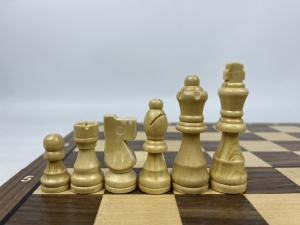
  • Chess was invented in the 5th century AD in India and spread throughout the world. The uniqueness of this game is that it still covers the minds of everyone - from young to old! Chess combines elements of science and sports. They develop logic, perseverance, attentiveness, analytical thinking and memory.  Checkers is a fun, dynamic and relatively simple game. Every country in the world has it. It is comparatively easier to find a partner here than in chess. Backgammon – one of the oldest known board games. It is known that it came to us from the East. First, you need to master the basic techniques, so that later you can boldly apply various tricks during the game.  Cage length: 4.5 cm. King height: 8.8cm King base diameter: 2.8 cm The length and width of the field when unfolded: 44 X 44 cm. Material: wood Country of origin: China.

    84.48 $
  • Author:
    Galkin

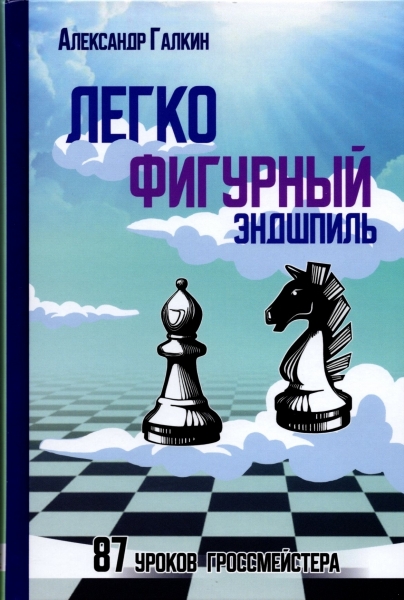
    The book by grandmaster and experienced coach Alexander Galkin is  the final link in a series of publications by the author, directed  to study the classical endgame using examples of modern games   grandmasters. This time the subject of the study – light piece endgames. Clarification of the methodology for working on this stage of the game, as well as the main features and methods of playing such endings. Examples  taken from the practice of modern grandmasters and dated back to 2020-2023. The author offers the reader the most recent and unique information. The material is structured in such a way that the reader can get the maximum  benefit from studying the examples offered by the author  queen endings and its  other derivatives. The book is aimed at advanced chess players, is useful for coaches and can be recommended to a wide range of chess fans

    18.33 $
  • Author:
    Yanvarev

    Igor Yanvarev "Tactical Mastery of a Chess Player. Volume 2. Basics of Calculation Techniques". Andrey Elkov Publishing House, Moscow, 2025 - 392 p. Before you is the second book from the three-volume work by International Master I.K. Yanvarev, a famous trainer, author of the fundamental work "The Old Indian Played by Tigran Petrosian" (2010), which received recognition from readers and was republished abroad. The three-volume work is united by a common idea - tactics and combinations in chess. In fact, this is a turnkey textbook, it explains everything from scratch to an advanced level. The second volume is devoted to the basics of calculation techniques, such topics as the tactical "spectrum" of a position, concentration of attention, inclusion of imagination are considered, the "tree of variations" is interpreted in a new way, the practical component is emphasized - the economy of calculation. A separate chapter allows the reader to assess their ability to calculate variations and outline ways to eliminate weaknesses. Each chapter ends with a large number of carefully selected examples for independent solution. Unlike other similar publications, the author examines chess tactics as a single whole, in combination with strategy and elements of psychology. It is based on the original author's methodology, which has proven itself well when working with chess players of various qualifications. Excellently selected examples, a clear logical structure and consistency in the presentation simplify the understanding of the material. For a wide range of chess fans.

    19.00 $
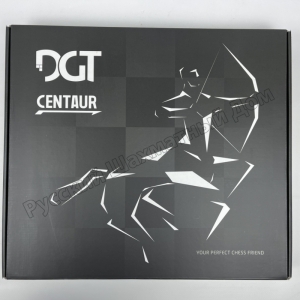
  • Made in Holland. Chess computer "Centaur" easy to use. You can easily install any language. Using the touch panel  40x40 cm (cell size 48 x 48 mm) you can easily move the figures. The sensors will record strokes. The board has a capacious rechargeable internal battery. The uniqueness of the computer is that it quickly adapts to  your playing strength (from beginner to grandmaster) so that you have the right opponent. Centaur will help you analyze the game so as not to make the same mistakes and improve your chess skill. Please note, computer is not compatible to connect to your PC or online chess. The set includes USB cable and DGT electronic chess pieces . Height of the king is 86mm.  

    1553.60 $
  • Author:
    Chernyshov

    The authors continue to study typical opening and middlegame positions. Royal Fortress No. 2 has pawns on squares f7, g6, h7 (or f2, g3, h2), and they are usually joined by another defender – bishop on g7 (g2). This formation is called fianchetto, it is found in many popular openings, such as the Catalan Opening, King's Indian Defense, Grunfeld Defense and a number of others.  The authors analyze in detail the techniques of attack, defense and counterattack. Most examples – from the creativity of modern chess players (for example, a separate chapter is dedicated to the strongest Russian grandmaster Ian Nepomniachtchi); they are complemented by parts that have become a classical heritage. The book contains about 300 positions for independent solution, so it is not only a textbook, but also a solid problem book. Grandmaster Konstantin Chernyshov, head of the Interregional Grandmaster School in Kostroma, and his daughter International Master Natalya Kareva – experienced coaches, whose students include grandmasters and masters, champions of Russia and Europe among juniors.  The book is addressed to young chess players and their mentors. 

    20.00 $
  • Author:
    Fine

    In the vast ocean of chess literature there are relatively few books about the endgame, and only a few of them can be considered true chess classics. And the most outstanding among the classics — Reuben Fine's book "Basic Chess Endings". Reuben Fine (1914−1993) was for a long time one of the best chess players in the world. As an author, Fine showed himself to be an excellent analyst who understood the full depth and peculiarities of the endgame. Having studied various types of standard positions, Fine established useful rules for practical play and proved himself to be an experienced teacher who, using skillfully chosen examples, was able to teach the reader all the necessary lessons and introduce him to the basic ideas of the endgame. Many generations of chess players in different countries of the world keep copies of “Basic Chess Endings”. For example, Mikhail Botvinnik considered Fine's work the most worthy of all that had ever been written on endgame theory.

    35.00 $
  • Author:
    Gezalyan

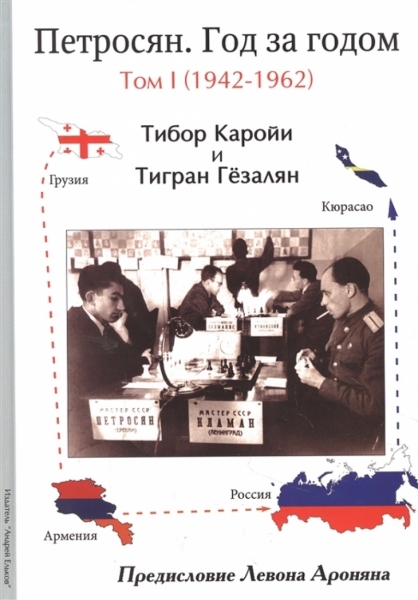
    International Master Tibor Karolyi and FIDE Master Tigran Gozalyan have prepared a major work (in two volumes) about the life and work of the 9th world chess champion Tigran Petrosyan (he held the title from 1963 to 1969).  Volume II (1963-1984) tells about Petrosyan's victory in the 1963 world title match over Mikhail Botvinnik, about the grandiose two-match confrontation with Boris Spassky in 1966 and 1969, about all his candidates' matches after losing the title – against Bobby Fischer, Viktor Korchnoi and other world-class opponents. All tournaments and matches of the second half of Petrosian's chess career are presented, up to his last performances in 1983. The authors subjected 175 complete games and fragments to an in-depth analysis (using modern computers). Not all of them have been deeply studied and commented on before, but even then the book provides a significantly improved analysis. Among Petrosyan’s opponents – world champions and contenders Kasparov, Karpov, Fischer, Spassky, Tal, Smyslov, Botvinnik, Korchnoi and Bronstein, as well as Timman, Larsen, Reshevsky, Belyavsky, Polugaevsky, Portisch, Romanishin and many others. Special attention is paid to his coaches – Alexey Suetin and Igor Zaitsev. 

    50.00 $
  • more

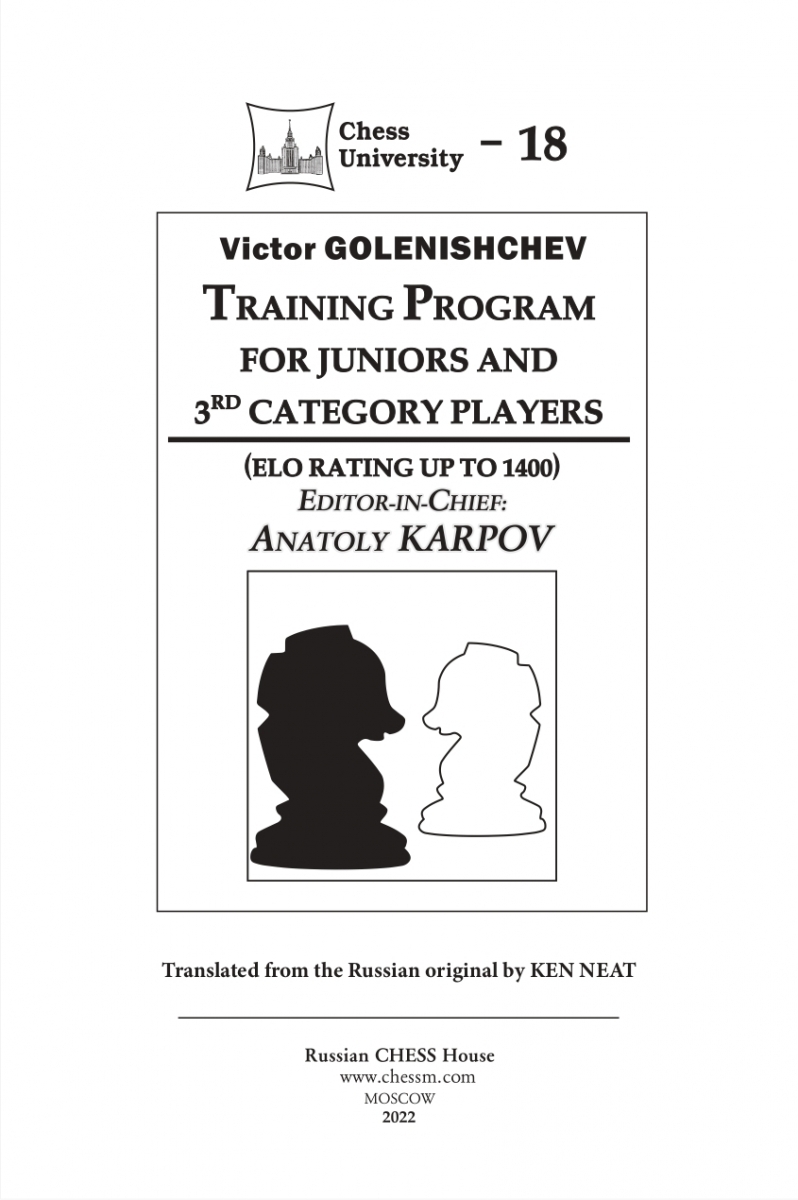
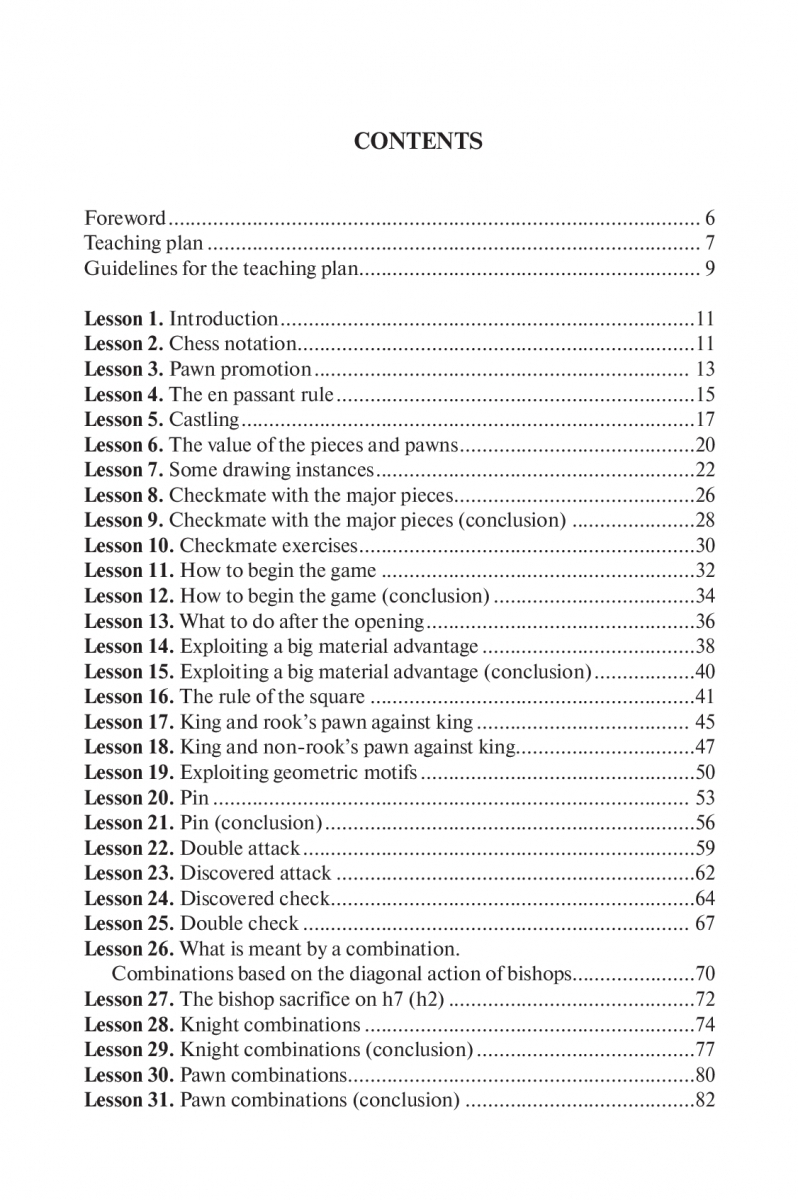
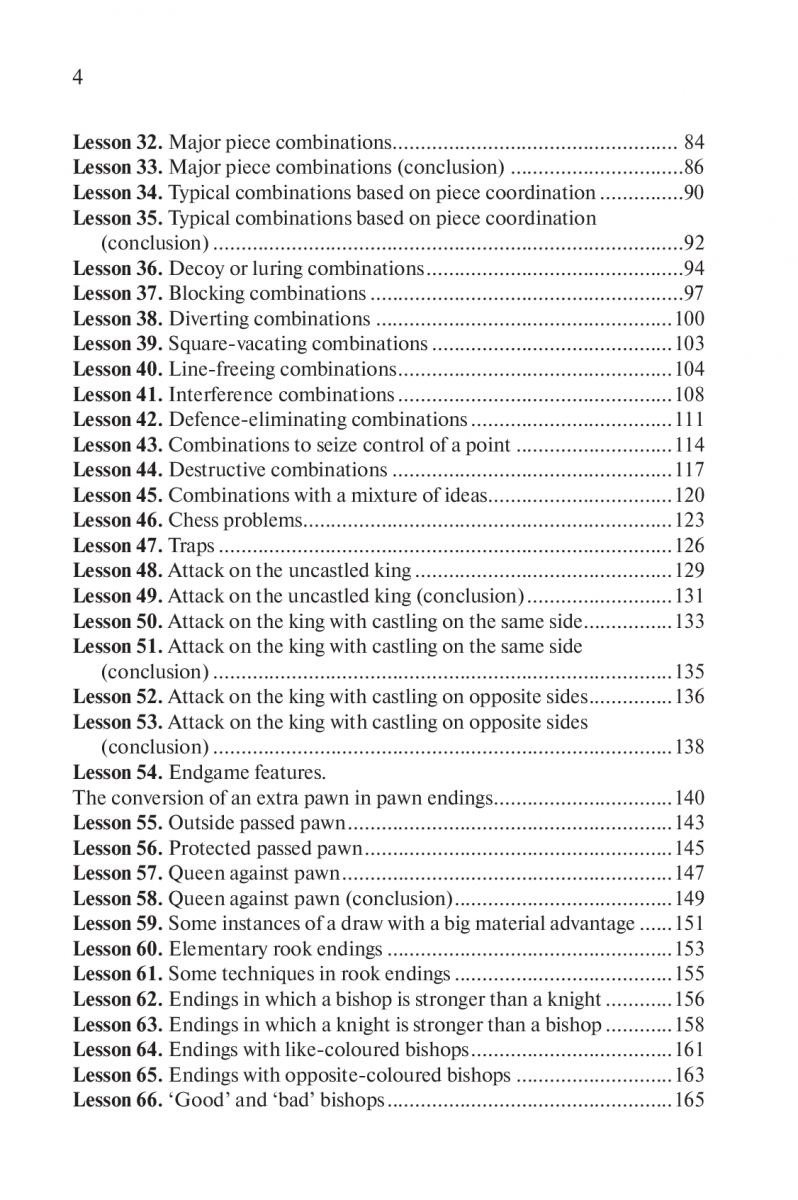
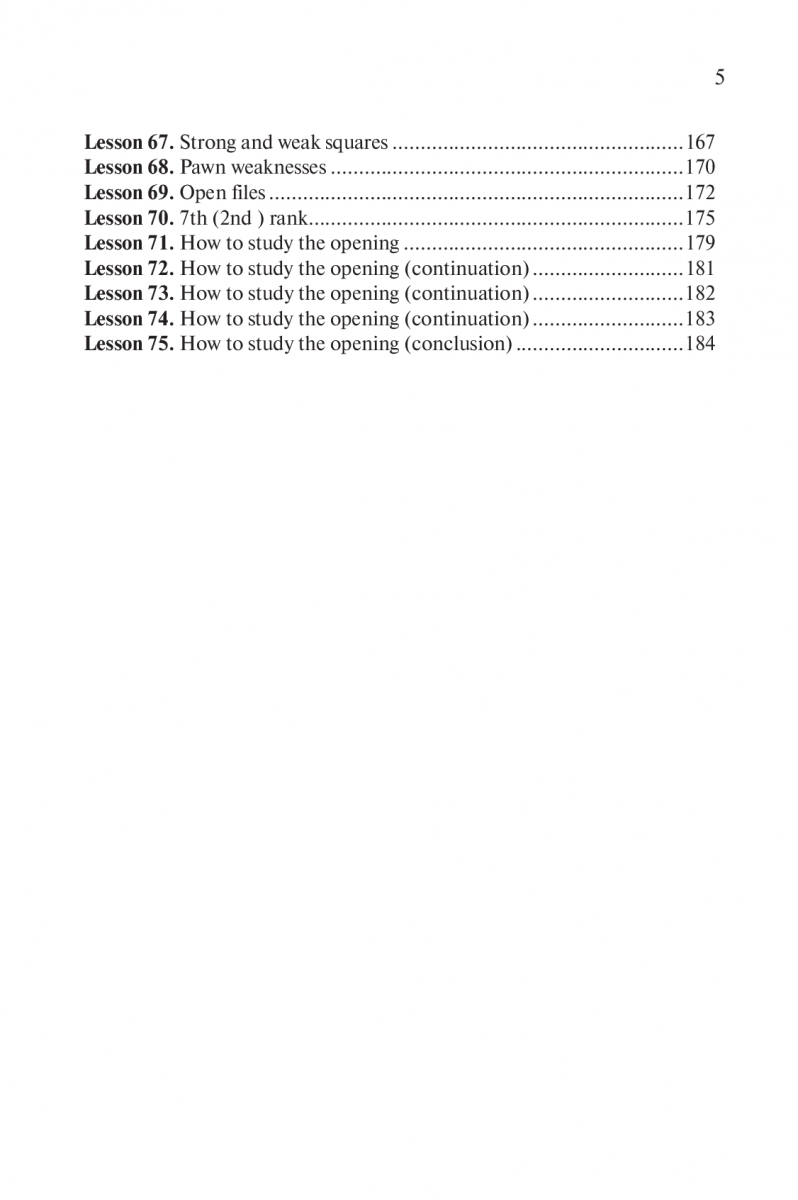
Training program for juniors and 3rd category players (ELO rating up to 1400)
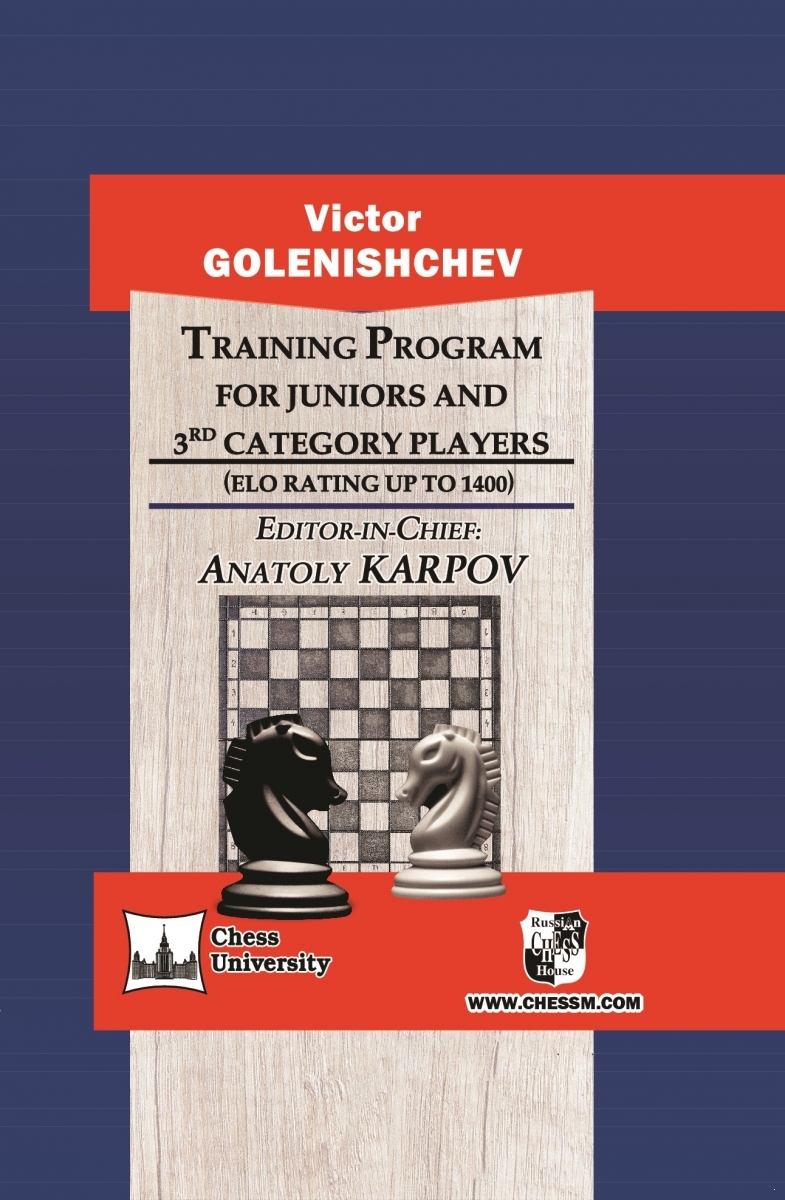
Publisher: Russian CHESS House

paper book

22.8 $

RUB

e-book

11.39 $

RUB
Go to

Description:

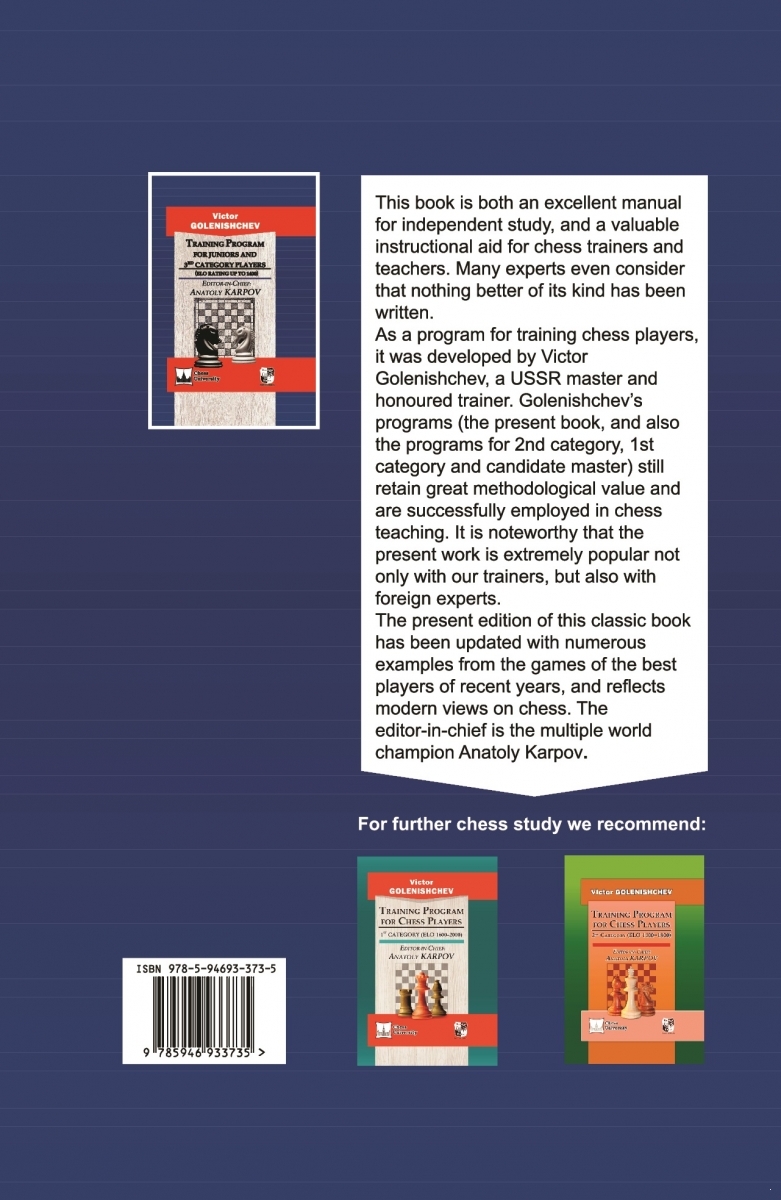
This book is both an excellent manual for independent study, and
a valuable instructional aid for chess trainers and teachers. Many
experts even consider that nothing better of its kind has been written.
As a program for training chess players, it was developed by Victor
Golenishchev, a USSR master and honoured trainer. Golenishchev’s
programs (the present book, and also the programs for 2nd category,
1st category and candidate master) still retain great methodological
value and are successfully employed in chess teaching. It is noteworthy
that the present work is extremely popular not only with our
trainers, but also with foreign experts. The present edition of this
classic book has been updated with numerous examples from the
games of the best players of recent years, and reflects modern views
on chess. The editor-in-chief is the multiple world champion Anatoly
Karpov.


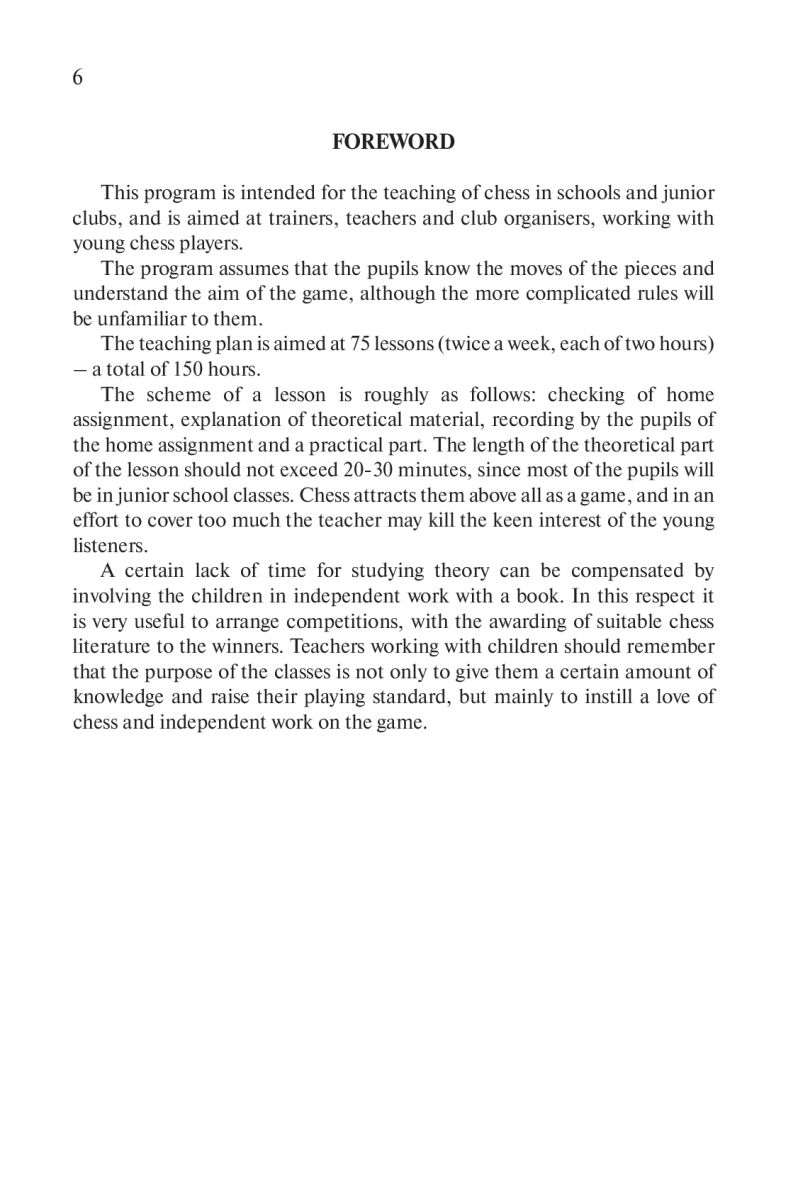
This program is intended for the teaching of chess in schools and junior
clubs, and is aimed at trainers, teachers and club organisers, working with
young chess players.
The program assumes that the pupils know the moves of the pieces and
understand the aim of the game, although the more complicated rules will
be unfamiliar to them.
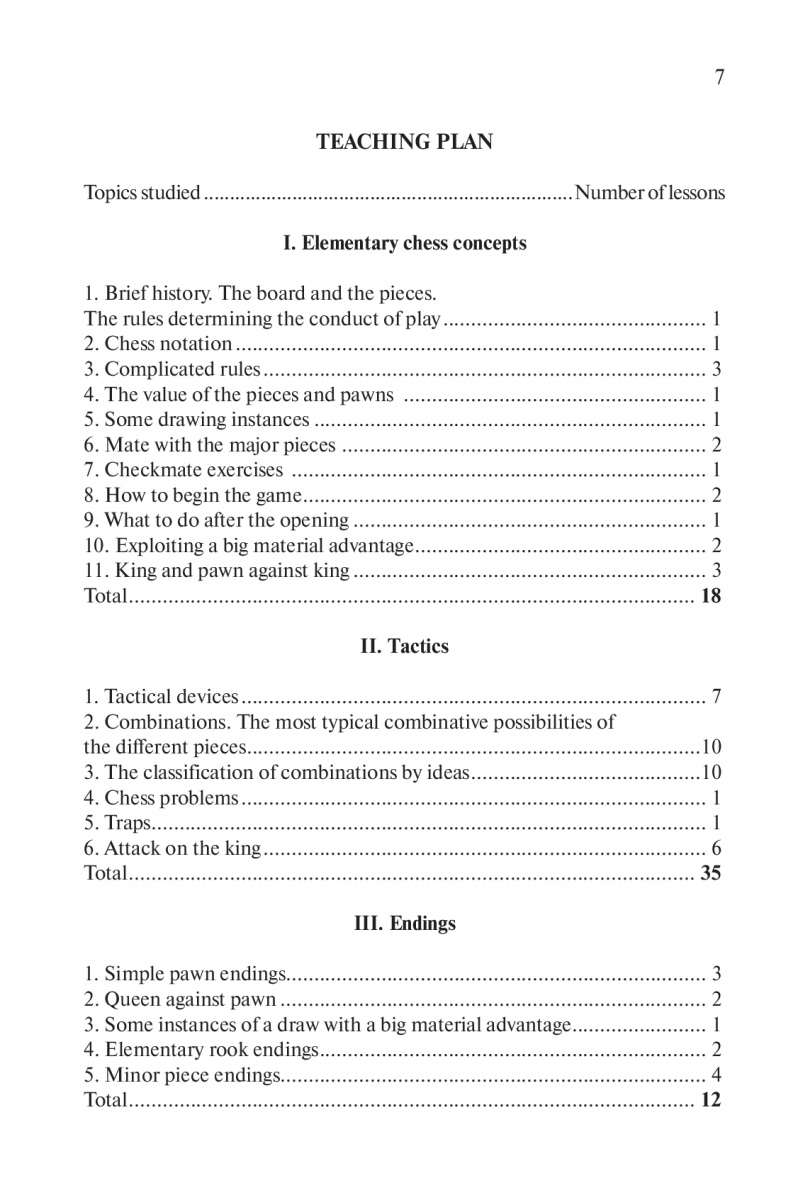
The teaching plan is aimed at 75 lessons (twice a week, each of two hours)
– a total of 150 hours.
The scheme of a lesson is roughly as follows: checking of home
assignment, explanation of theoretical material, recording by the pupils of
the home assignment and a practical part. The length of the theoretical part
of the lesson should not exceed 20-30 minutes, since most of the pupils will
be in junior school classes. Chess attracts them above all as a game, and in an
effort to cover too much the teacher may kill the keen interest of the young
listeners.

Fragment 1

Fragment 2


To leave comments, sign in or register on the site.
There are no comments on this record yet.