menu
top sales
  • Author:
    Ezhov

    Grandmaster Carlos Torre – like a chess comet; his genius flashed dazzlingly and quickly went out in the chess firmament! He – the author of the most famous “mill” in the history of chess, the 2nd world champion Emanuel Lasker fell into its merciless millstones. The authors spoke about the life and work of the Mexican genius (the book contains 25 commentated games by K. Torre). Torre’s book “How a Chess Player is Formed” is presented, an essay by international master Yaroslav Prizant about Torre’s attack in modern practice. In the section "Play like Torre" – 36 instructive examples from his practice to solve. Finally, there is an interview with Carlos Torre, conducted by Gabriel Velasco in 1977. Working with the book will give readers not only aesthetic pleasure, but will also help improve their skills.

    18.33 $
  • Author:
    Golenishchev

    Like other titles in the Training Program for Chess Players series, this volume is both an excellent textbook for independent study and a powerful training aid for chess coaches. In the view of many experts, no better work of this kind has ever been written. coach and Master of Sport. Golenishchev's programs are still considered. critically important and are successfully employed in chess schools. His teaching methods remain popular in Russia and around the world. Supervised by Editor-in-Chief and former Karpov, this new edition of Golenishchev's classic work is updated to include important games from the recent high-level chess competitions, reflecting modern approaches to the game. OPENING Fragment 1 OPENING Fragment 2

    30.00 $
  • Author:
    Blokh

    The answer book of an international grandmaster and an experienced coach (among whose students is A. Grischuk) Bloch's Maxim contains over 1200 combinations from practical games and specially compiled examples. All tasks are characterized by intense struggle, in which the goal is achieved by single moves. The book is intended for both young and adult amateurs, and for masters. The arrangement of examples by topic allows you to use the book not only as a task book, but also as a textbook. Of particular interest are over two hundred specially compiled by the author overstressed positions in which white wins the only way during the course of white, and black wins during the course of black. These examples, as well as over 50 fragments from the parties of the author and his students, are published for the first time.

    21.67 $
  • Author:
    Gezalyan

    International Master Tibor Karolyi and FIDE Master Tigran Gozalyan have prepared a major work (in two volumes) about the life and work of the 9th world chess champion Tigran Petrosyan (he held the title from 1963 to 1969).  Volume II (1963-1984) tells about Petrosyan's victory in the 1963 world title match over Mikhail Botvinnik, about the grandiose two-match confrontation with Boris Spassky in 1966 and 1969, about all his candidates' matches after losing the title – against Bobby Fischer, Viktor Korchnoi and other world-class opponents. All tournaments and matches of the second half of Petrosian's chess career are presented, up to his last performances in 1983. The authors subjected 175 complete games and fragments to an in-depth analysis (using modern computers). Not all of them have been deeply studied and commented on before, but even then the book provides a significantly improved analysis. Among Petrosyan’s opponents – world champions and contenders Kasparov, Karpov, Fischer, Spassky, Tal, Smyslov, Botvinnik, Korchnoi and Bronstein, as well as Timman, Larsen, Reshevsky, Belyavsky, Polugaevsky, Portisch, Romanishin and many others. Special attention is paid to his coaches – Alexey Suetin and Igor Zaitsev. 

    50.00 $
  • Author:
    Kalinichenko

    The vast majority of opening guides are written for adult readers. This book is also devoted to the theory but it is junior. The structure of the book is simple and attractive: openings are examined using examples from actual games, each of which is presented in the form of a lesson with its own name. Several such lessons form an opening theme, and the examination of each theme concludes with exercises. In each opening, attention is drawn to its characteristic tactical and strategic ideas of combinations for independent solution strictly corresponds to the opening theme. Written in clear and easy language, the book is furnished with a large number of diagrams. Colored explanatory arrows on the diagrams and the selection of individual pages with a colored background make the book easier to understand. Regular work solve two problems: deepen the student's knowledge and develop his tactical vision, thus improving his skill and results.

    28.80 $
  • Author:
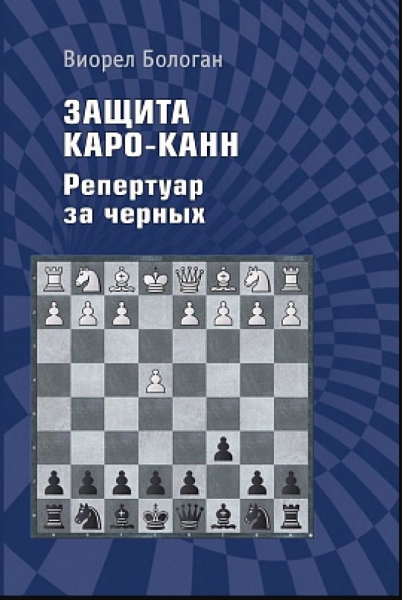
    Bologan

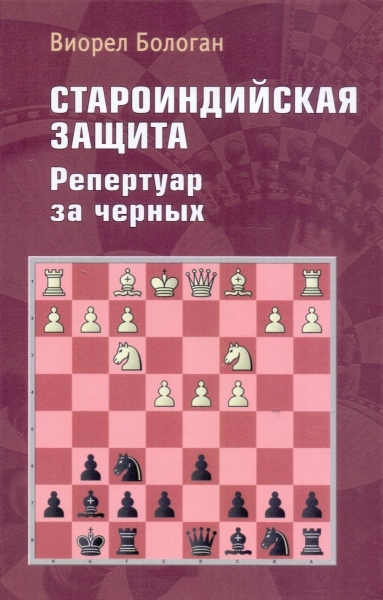
    «The idea of continuing the autobiographical book “Steps” has been in the air almost since the moment it was written. Despite the bullet point at the end of the book in the form of a victory over Magnus Carlsen, my chess career continued for another full 14 years, and the subsequent stormy socio-political career is only gaining momentum.” (V. Bologan).  The book contains 75 games commented in detail and a number of fragments. A frank story about the life and professional path, about cooperation with the leading grandmasters and coaches of the world (among them - A. Karpov, G. Kasparov, Yu. Polgar, Zhu Chen, R. Ponomarev, A. Shirov, A. Morozevich, A. Onischuk, A. Ryazantsev, E. Inarkiev, M. Al-Mudakhka, M. Dvoretsky, M. Podgaets, V. Chebanenko, Z. Lanka and others), about political activities in the Parliament of Moldova and about work in FIDE are complemented by numerous photographs.   For a wide range of chess lovers.

    36.67 $
  • A limited edition of the most famous electronic chess clock. Design & quot; under the tree & quot ;. Released for the 25th anniversary of the DGT. & Nbsp; These watches are used in all major tournaments, world championships and World Cups, World Chess Olympiads. Installation of any time controls, including Fisher and Bronstein controls (with added time). & Nbsp;

    237.50 $
  • Author:
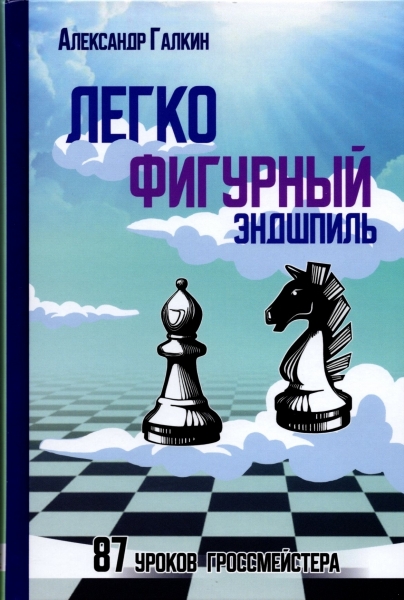
    Galkin

    16.67 $
  • Author:
    Vysotsky

    20.00 $
  • Author:
    Bezgodov

    The youngest first–grader in the USSR, the world champion among young men, a participant in the candidates tournament at the age of 19 - Boris Spassky's rise was rapid. And then fate gave the brilliant chess player a test of strength: he stumbled twice at the decisive moment and remained beyond the threshold of interzonal tournaments ... Only ten years after his first great success, Spassky managed to pass all the qualifying tests and earn the right to a match for the crown, but he failed to defeat the Iron Tigran Petrosian the first time. It took three more years of super–efforts: by Sisyphus he rose again to the foot of Olympus and did not miss a second chance - in 1969 he became the Tenth king of chess! An essay about the life of Boris Vasilyevich and his sporting path full of ups and downs was written by Dmitry Oleynikov, Candidate of Historical Sciences, curator of the Chess Museum of the Chess Federation of Russia. 70 beautiful and instructive games of Spassky were commented on by the champion of Russia in 1993, the famous author and theorist grandmaster Alexey Bezgodov, as well as grandmaster Dmitry Kryakvin and FIDE master Steve Giddins. The preface was written by the 14th world champion Vladimir Kramnik. For a wide range of chess fans.

    21.67 $
  • more

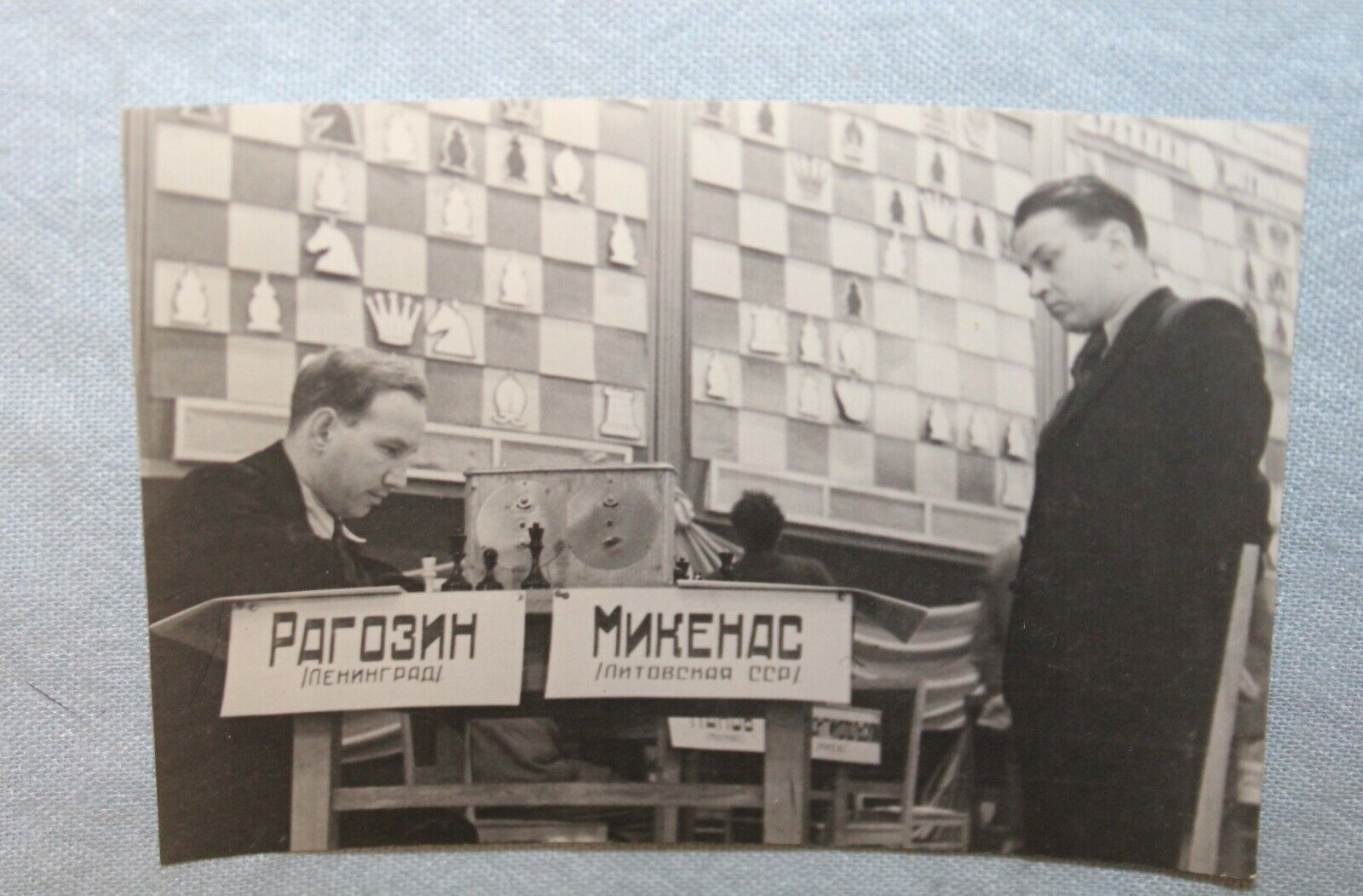
Soviet Chess Photo: 12th USSR Chess Championship: Ragozin - Mikenas. 1940

  • Year of issue: 1940

35 $

RUB

Description:

ORIGINAL SOVIET CHESS PHOTO FROM 12TH USSR CHESS CHAMPIONSHIP IN 1940 YEAR.


SIZE OF THE PHOTO – 8,5 cm x 5,5 cm

12TH SOVIET CHESS CHAMPIONSHIP:


This is a photograph from the famous 12th Soviet Chess Championship held in the Grand Hall of the Moscow Conservatory from September 4th through October 3rd, 1940. The 12th Soviet Chess Championship was truly a battle of the titans. Outstanding players such as Mikhail Botvinnik, Paul Keres, Vasily Smyslov, Alexander Kotov, Isaac Boleslavsky, Igor Bondarevsky, and Andre Lilienthal took part. This so-called "absolute championship" is rightfully considered one of the strongest USSR chess championships ever held. Here’s an excerpt from Mikhail Botvinnik’s memoirs. "It was a tough tournament. There were many participants and very few off-days. The Grand Hall of the Conservatory has excellent acoustics. The spectators behaved impudently, made a great deal of noise, and clapped all the time. The excellent acoustics only made matters worse. Supposedly, Sergei Prokofiev applauded Keres vigorously after the latter won a game. The other people in his box reprimanded him,, and then the composer remarked, "I have every right to express my feelings." Would my friend Mr. Prokofiev be happy if he were playing a trio and spectators applauding the violinist’s performance drowned out his piano piece? Chess players are in a worse position, though. A pianist can afford to play a few false notes amid booming applause, something a chess player isn’t allowed to do." The results of the 12th Soviet Chess Championship were truly sensational, since two young players, Andre Lilienthal and Igor Bondarevsky, came in first and second, respectively, leaving grandmasters Mikhail Botvinnik and Paul Keres, the tournament favorites, far behind. The unprecedented hype surrounding this tournament matched its historical significance. After all, the unofficial right to contend for the world championship crown, as well as the prestigious title of USSR champion were on the line. "The most difficult and most monumental tournament in which I’ve ever taken part has come to a close," Andre Lilienthal wrote. "I have no reason to be displeased with myself. First off, my win over Botvinnik himself wasn’t too bad. Secondly, I snatched what seemed to be an irrevocably lost point from Bondarevsky in the last round. Thirdly, I managed not to lose a single game. Fourthly, I wound up in the wonderful young company of Bondarevsky and Smyslov at the top of the leaderboard. A decisive match for the title of USSR champion is up next. I have to prepare thoroughly for it, which, first and foremost, means getting some much needed rest." Three months after the tournament was completed, on January 14th, 1991, the Soviet Committee on Physical Culture and Sports issued an order approving the tournament results and awarding Bondarevsky and Lilienthal, the tournament winners, grandmaster titles; however, this order was missing a key point, since it did not mention any sort of match between the two victors. That strange inconsistency came to light a month later when it was decided - through a behind-the-scenes power struggle - that one more tournament for the title of absolute USSR champion would be held, a tournament Mikhail Botvinnik won.


PK7


To leave comments, sign in or register on the site.
There are no comments on this record yet.