menu
top sales
  • Author:
    Getmanchuk

    16.67 $
  • Author:
    Franco

    In his new book, grandmaster Zenon Franco deeply analyzes the 69 instructive victories of the 11th world champion Robert Fischer. The book is not overloaded with options, the emphasis – with detailed explanations in a move-by-move style, creating an ideal platform for learning chess. In the "reference" At points in each game, the reader is offered test questions, which helps both the practical study of key techniques of the chess game and the reliable assimilation of acquired knowledge. Questions and answers engage the reader in the learning process and help him track his growth in chess strength. The appendix provides a critical analysis of the unsatisfactory translation of Robert Fisher's famous book “My 60 Memorable Games.”

    23.33 $
  • Author:
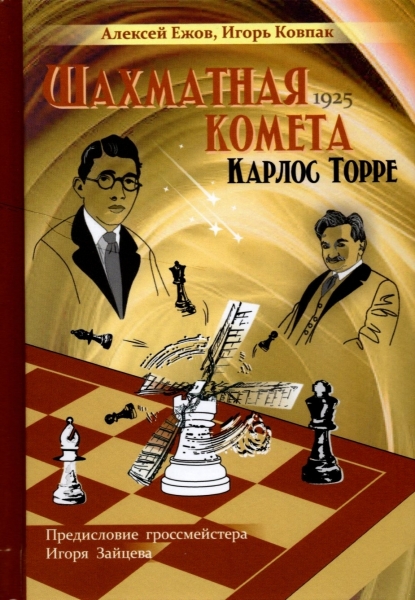
    Ezhov

    Grandmaster Carlos Torre – like a chess comet; his genius flashed dazzlingly and quickly went out in the chess firmament! He – the author of the most famous “mill” in the history of chess, the 2nd world champion Emanuel Lasker fell into its merciless millstones. The authors spoke about the life and work of the Mexican genius (the book contains 25 commentated games by K. Torre). Torre’s book “How a Chess Player is Formed” is presented, an essay by international master Yaroslav Prizant about Torre’s attack in modern practice. In the section "Play like Torre" – 36 instructive examples from his practice to solve. Finally, there is an interview with Carlos Torre, conducted by Gabriel Velasco in 1977. Working with the book will give readers not only aesthetic pleasure, but will also help improve their skills.

    18.33 $
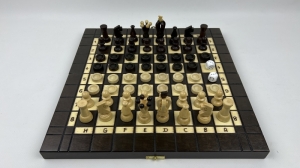
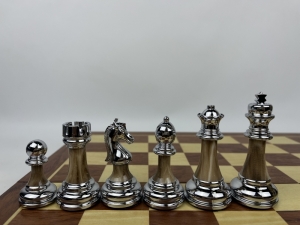
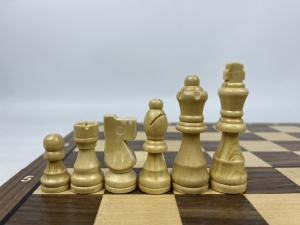
  • The size of the board when folded is 46x23x5 cm. The size of the board when unfolded is 35x35 cm. Cage size is 4.6x4.6 cm  The height of the king is 10 cm. The diameter of the base is 3 cm. Pawn height 5.5 cm. Base diameter 2.8 cm. Weight 1380 g. ART 123 Manufacturer Poland

    183.15 $
  • Author:
    Bezgodov

    The youngest first–grader in the USSR, the world champion among young men, a participant in the candidates tournament at the age of 19 - Boris Spassky's rise was rapid. And then fate gave the brilliant chess player a test of strength: he stumbled twice at the decisive moment and remained beyond the threshold of interzonal tournaments ... Only ten years after his first great success, Spassky managed to pass all the qualifying tests and earn the right to a match for the crown, but he failed to defeat the Iron Tigran Petrosian the first time. It took three more years of super–efforts: by Sisyphus he rose again to the foot of Olympus and did not miss a second chance - in 1969 he became the Tenth king of chess! An essay about the life of Boris Vasilyevich and his sporting path full of ups and downs was written by Dmitry Oleynikov, Candidate of Historical Sciences, curator of the Chess Museum of the Chess Federation of Russia. 70 beautiful and instructive games of Spassky were commented on by the champion of Russia in 1993, the famous author and theorist grandmaster Alexey Bezgodov, as well as grandmaster Dmitry Kryakvin and FIDE master Steve Giddins. The preface was written by the 14th world champion Vladimir Kramnik. For a wide range of chess fans.

    21.67 $
  • Author:
    Kalinichenko

    The vast majority of opening guides are written for adult readers. This book is also devoted to the theory but it is junior. The structure of the book is simple and attractive: openings are examined using examples from actual games, each of which is presented in the form of a lesson with its own name. Several such lessons form an opening theme, and the examination of each theme concludes with exercises. In each opening, attention is drawn to its characteristic tactical and strategic ideas of combinations for independent solution strictly corresponds to the opening theme. Written in clear and easy language, the book is furnished with a large number of diagrams. Colored explanatory arrows on the diagrams and the selection of individual pages with a colored background make the book easier to understand. Regular work solve two problems: deepen the student's knowledge and develop his tactical vision, thus improving his skill and results.

    28.80 $
  • Author:
    Zhuravlev

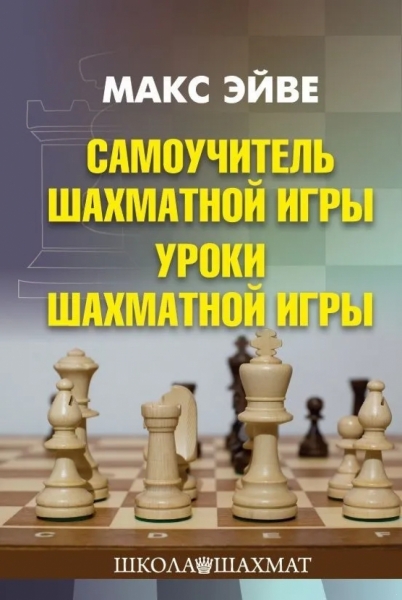
    This tutorial is addressed to those who want to learn to play chess on their own and improve further. The lesson-based method of presentation, as well as numerous exercises, contribute to the consistent assimilation of the rules and laws that form the basis of the chess game. The book contains extensive educational material, which is presented to the reader in accordance with modern pedagogical principles. The purpose of this manual is to train chess players of the III category (rating up to 1800). The textbook can also be used for classes in groups - it covers the material of existing programs of the first year of study in children's and youth chess schools.

    23.33 $
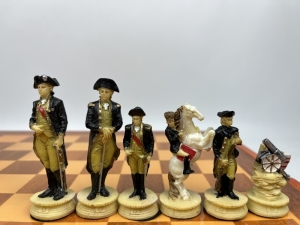
  • The size of the board when folded is 35x17.5 cm. The size of the board when unfolded is 35x35 cm. Cage size is 3x3 cm  King height 6.6 cm. Base diameter 2.2 cm. Pawn height 3.1 cm. Base diameter 2 cm. Backgammon - checker 2.1 cm. Weight 830 g. Includes backgammon chips and dice Chess board and backgammon chips can be used to play checkers Manufacturer Poland

    148.00 $
  • Author:
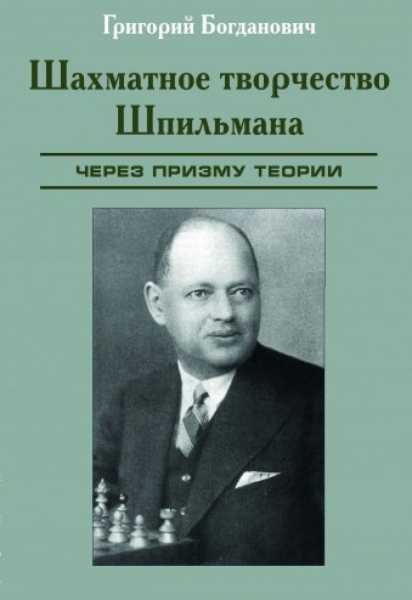
    Bogdanovich

    50.00 $
  • Author:
    Kasparov

    41.67 $
  • more

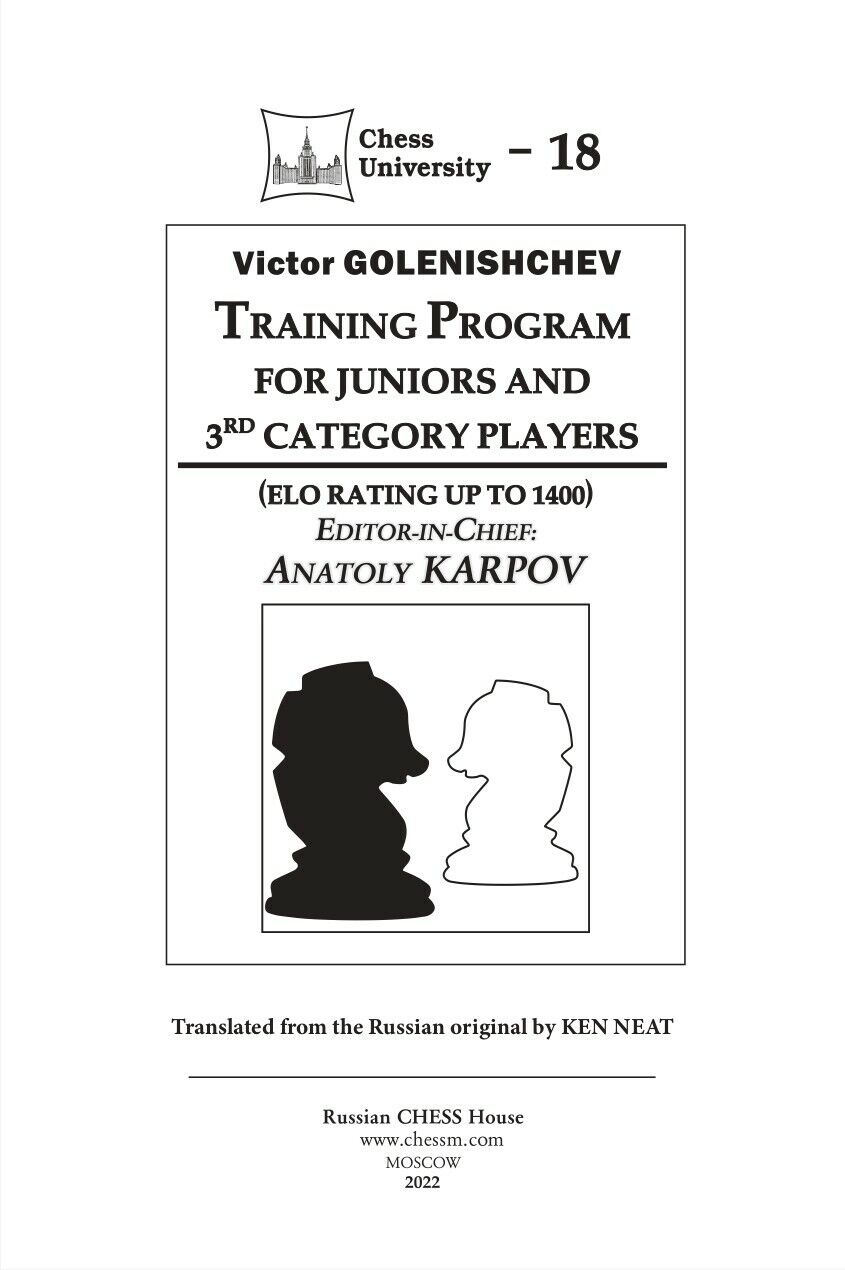
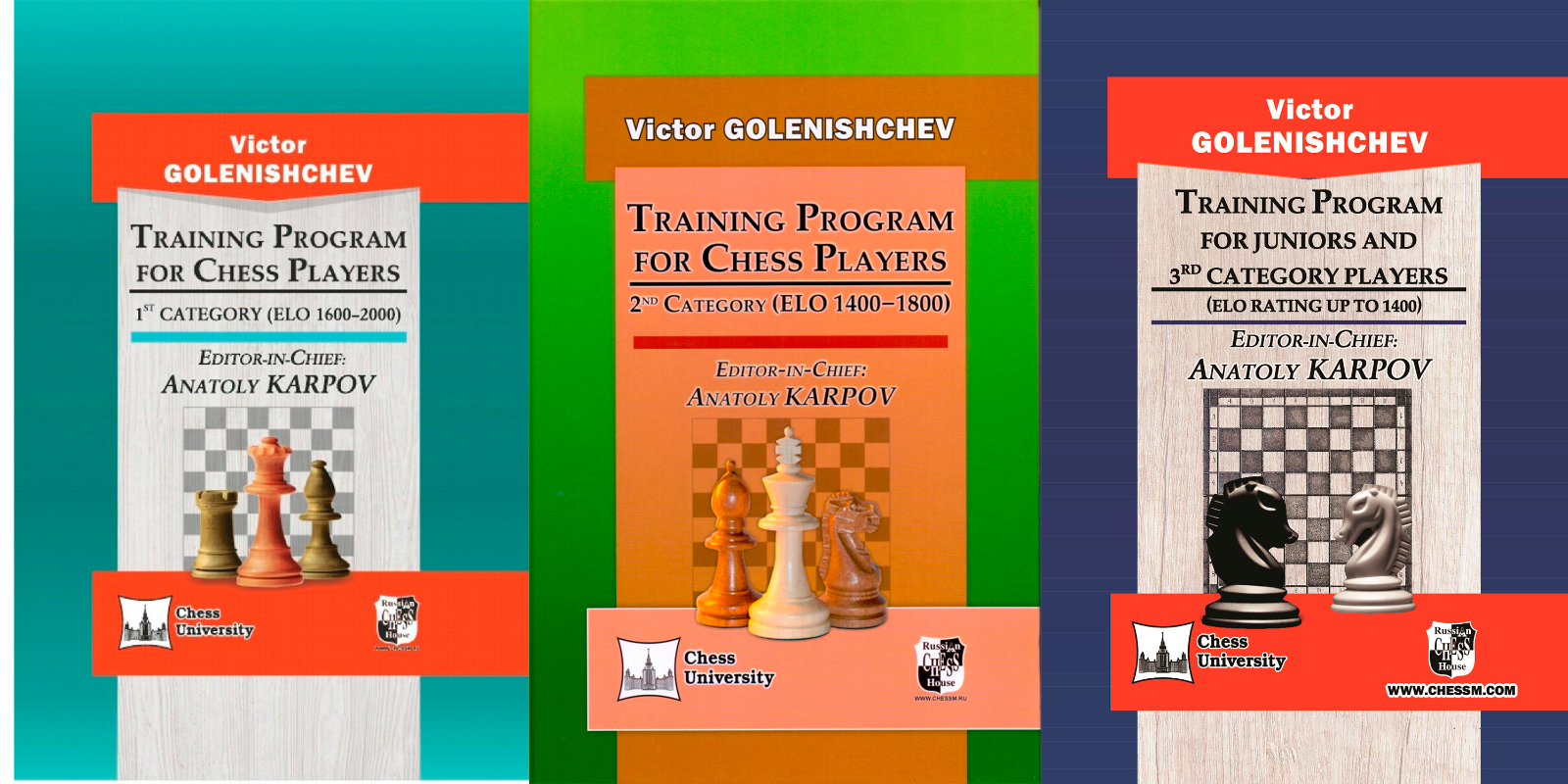
Training Program For Chess Players.1,2,3 category. Golenishchev.Editor: A.Karpov
60 $

RUB

Description:

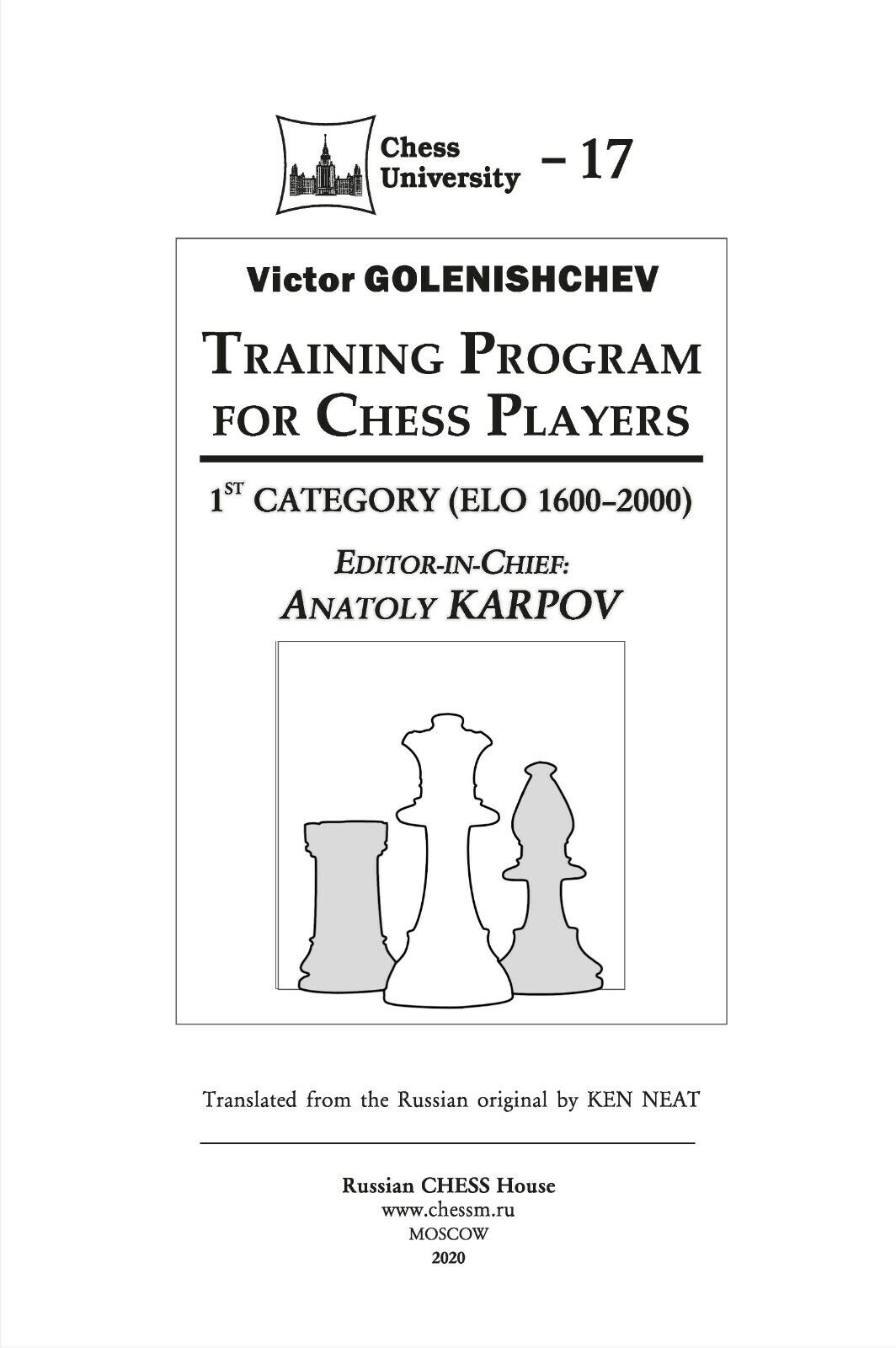
3 VOLUMES by Golenishchev: Training Program for Chess Players: 1st, 2nd and 3rd Categories

Publisher: Russian CHESS House
Author(s): Golenishchev
Title: Training Program for Chess Players: 1nd Category (elo 1600−2000)
Year of issue: 2020
Language: English
Size: Normal
Pages: 256
Binding: Hardcover
DateOfIssue: 2020

Like other titles in the Training Program for Chess Players series, 
this volume is both an excellent textbook for independent study and a powerful 
teaching aid for chess coaches. In the view of many experts, no better work of this 
kind has ever been written.

The series was designed as a self-contained training program by Victor Golenishchev, 
a distinguished Soviet chesscoach and Master of Sport. Golenishchev’s programs are 
still considered critically important and are successfully employed in chess schools. 
His teaching methods remain popular in Russia and around the world.

Supervised by Editor-in-Chief and former World Chess Champion Anatoly Karpov, 
this new edition of Golenishchev’s classic work is updated to include important games 
from recent high-level chess competitions, reflecting modern approaches to the game.

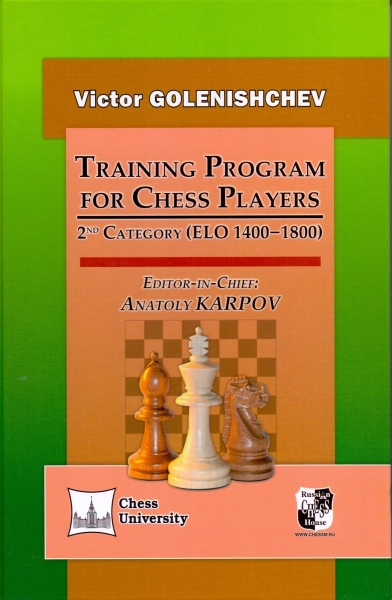
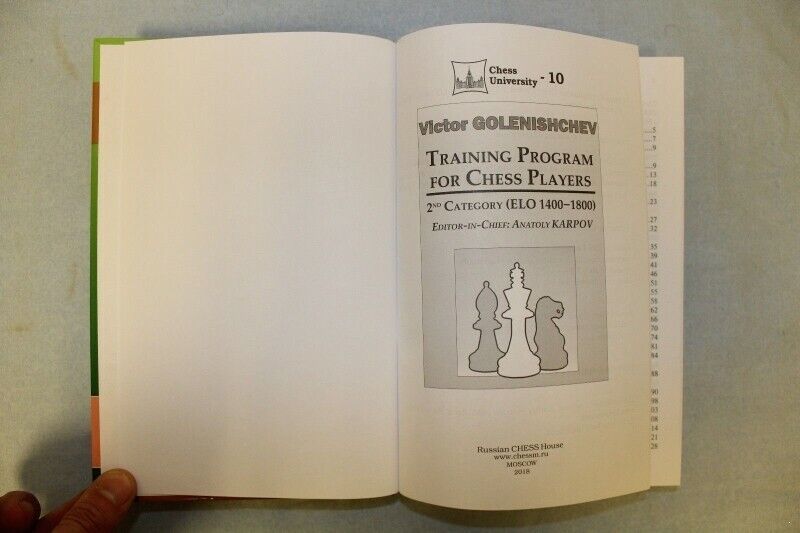
Title: Training Program For Chess Players II Category (ELO 1400-1800)
Author: Victor Golenishchev
Editor-in-Cheif: Anatoly Karpov
Published: Russian Chess House, Moscow, 2018
Language: English
Binding: Hardcover
Pages: 320

This book is equally and excellent textbook for independent work, and a valuable methodological guide for coaches and teachers of chess. Many experts even believe that nothing better in this way is still not created. As a training program for chess players it was developed by the honored coach of the USSR, master of sports of the USSR Victor Golenishchev. V. Golenishchev's programs (IV-III grades, II category, I category and candidate master) still retain great methodological value and are successfully used in chess pedagogy. It is noteworthy that this technique is extremely popular not only among our coaches, but also among foreign specialists. 
This edition of this classic book is supplemented by examples from the works of the best chess players of recent years and reflects modern views on chess. 
Under the General edition of the multiple world champion Anatoly Karpov.

Title: Training Program For Chess Players III Category (ELO up to 1400)
Author: Victor Golenishchev
Editor-in-Cheif: Anatoly Karpov
Published: Russian Chess House, Moscow, 2022
Language: English
Binding: Hardcover
Pages: 185

This program is intended for the teaching of chess in schools and junior
clubs, and is aimed at trainers, teachers and club organisers, working with
young chess players.
The program assume that the pupils know the moves of the pieces and
understand the aim of the game, although the more complicated rules will
be unfamiliar to them.
The teaching plan is aimed at 75 lessons (twice a week, each of two hours)
– a total of 150 hours.
The scheme of a lesson is roughly as follows: checking of home
assignment, explanation of theoretical material, recording by the pupils of
the home assignment and a practical part. The length of the theoretical part
of the lesson should not exceed 20-30 minutes, since most of the pupils will
be in junior school classes. Chess attracts them above all as a game, and in an
effort to cover too much the teacher may kill the keen interest of the young
listeners.


Brand New

To leave comments, sign in or register on the site.
There are no comments on this record yet.