menu
top sales
  • Author:
    Galkin

    16.67 $
  • Author:
    Bezgodov

    The youngest first–grader in the USSR, the world champion among young men, a participant in the candidates tournament at the age of 19 - Boris Spassky's rise was rapid. And then fate gave the brilliant chess player a test of strength: he stumbled twice at the decisive moment and remained beyond the threshold of interzonal tournaments ... Only ten years after his first great success, Spassky managed to pass all the qualifying tests and earn the right to a match for the crown, but he failed to defeat the Iron Tigran Petrosian the first time. It took three more years of super–efforts: by Sisyphus he rose again to the foot of Olympus and did not miss a second chance - in 1969 he became the Tenth king of chess! An essay about the life of Boris Vasilyevich and his sporting path full of ups and downs was written by Dmitry Oleynikov, Candidate of Historical Sciences, curator of the Chess Museum of the Chess Federation of Russia. 70 beautiful and instructive games of Spassky were commented on by the champion of Russia in 1993, the famous author and theorist grandmaster Alexey Bezgodov, as well as grandmaster Dmitry Kryakvin and FIDE master Steve Giddins. The preface was written by the 14th world champion Vladimir Kramnik. For a wide range of chess fans.

    21.67 $
  • Author:
    Getmanchuk

    16.67 $
  • Author:
    Gezalyan

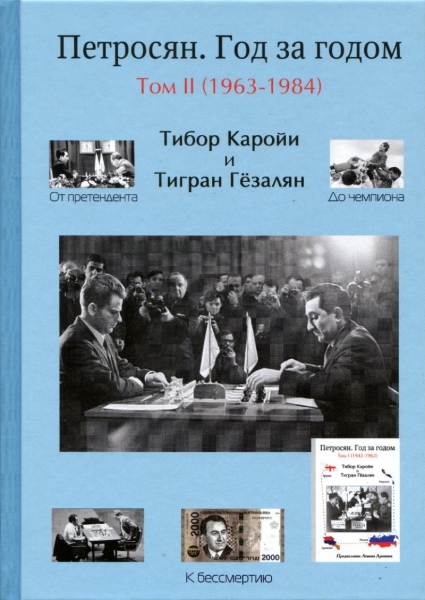
    International Master Tibor Karolyi and FIDE Master Tigran Gozalyan have prepared a major work (in two volumes) about the life and work of the 9th world chess champion Tigran Petrosyan (he held the title from 1963 to 1969).  Volume II (1963-1984) tells about Petrosyan's victory in the 1963 world title match over Mikhail Botvinnik, about the grandiose two-match confrontation with Boris Spassky in 1966 and 1969, about all his candidates' matches after losing the title – against Bobby Fischer, Viktor Korchnoi and other world-class opponents. All tournaments and matches of the second half of Petrosian's chess career are presented, up to his last performances in 1983. The authors subjected 175 complete games and fragments to an in-depth analysis (using modern computers). Not all of them have been deeply studied and commented on before, but even then the book provides a significantly improved analysis. Among Petrosyan’s opponents – world champions and contenders Kasparov, Karpov, Fischer, Spassky, Tal, Smyslov, Botvinnik, Korchnoi and Bronstein, as well as Timman, Larsen, Reshevsky, Belyavsky, Polugaevsky, Portisch, Romanishin and many others. Special attention is paid to his coaches – Alexey Suetin and Igor Zaitsev. 

    50.00 $
  • Author:
    Karoii

    50.00 $
  • Author:
    Kostrov

    Hundreds of thousands of novice chess players have held in their hands the solution books of “1000 chess problems” for the 1st, 2nd and 3rd years of study. These collections became winners of the “Chess Vseobuch of Russia” competition. We decided to combine our three books into one so that the future grandmaster would have more opportunities for improvement and choice of material. It will also be easier for students and coaches to regulate the speed of the material. In the first parts of our book, novice chess players will get acquainted with all possible types of checkmates. Then, future grandmasters will learn to deliver magnificent double blows with a queen and a knight, promote a pawn to a queen. Studying according to this solution book, you will also master the pin, learn to cover yourself from the enemy's pieces, block the enemy's forces, destroy the most reliable fortresses, distract and entice his royal majesty and much more. Work with the book as with a textbook, and do not forget to write down the solutions under each diagram! The correct solutions are at the end of the book. For the widest range of chess fans.

    15.75 $
  • Author:
    Ezhov

    Grandmaster Carlos Torre – like a chess comet; his genius flashed dazzlingly and quickly went out in the chess firmament! He – the author of the most famous “mill” in the history of chess, the 2nd world champion Emanuel Lasker fell into its merciless millstones. The authors spoke about the life and work of the Mexican genius (the book contains 25 commentated games by K. Torre). Torre’s book “How a Chess Player is Formed” is presented, an essay by international master Yaroslav Prizant about Torre’s attack in modern practice. In the section "Play like Torre" – 36 instructive examples from his practice to solve. Finally, there is an interview with Carlos Torre, conducted by Gabriel Velasco in 1977. Working with the book will give readers not only aesthetic pleasure, but will also help improve their skills.

    18.33 $
  • Author:
    Golenishchev

    Like other titles in the Training Program for Chess Players series, this volume is both an excellent textbook for independent study and a powerful training aid for chess coaches. In the view of many experts, no better work of this kind has ever been written. coach and Master of Sport. Golenishchev's programs are still considered. critically important and are successfully employed in chess schools. His teaching methods remain popular in Russia and around the world. Supervised by Editor-in-Chief and former Karpov, this new edition of Golenishchev's classic work is updated to include important games from the recent high-level chess competitions, reflecting modern approaches to the game. OPENING Fragment 1 OPENING Fragment 2

    30.00 $
  • Made in Holland. Chess computer "Centaur" easy to use. You can easily install any language. Using the touch panel  40x40 cm (cell size 48 x 48 mm) you can easily move the figures. The sensors will record strokes. The board has a capacious rechargeable internal battery. The uniqueness of the computer is that it quickly adapts to  your playing strength (from beginner to grandmaster) so that you have the right opponent. Centaur will help you analyze the game so as not to make the same mistakes and improve your chess skill. Please note, computer is not compatible to connect to your PC or online chess. The set includes USB cable and DGT electronic chess pieces . Height of the king is 86mm.  

    1553.60 $
  • Author:
    Galkin

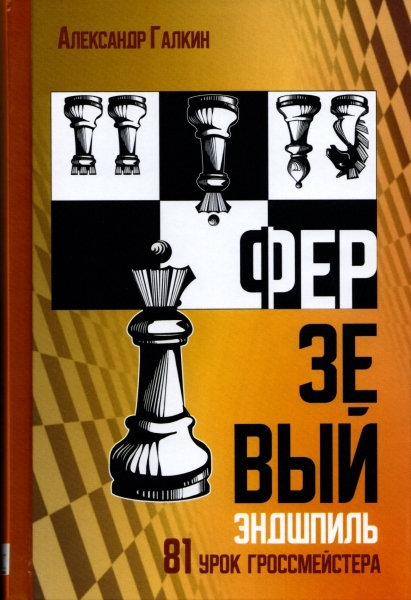
    The book by grandmaster and experienced coach Alexander Galkin is  the final link in a series of publications by the author, directed  to study the classical endgame using examples of modern games   grandmasters. This time the subject of the study – light piece endgames. Clarification of the methodology for working on this stage of the game, as well as the main features and methods of playing such endings. Examples  taken from the practice of modern grandmasters and dated back to 2020-2023. The author offers the reader the most recent and unique information. The material is structured in such a way that the reader can get the maximum  benefit from studying the examples offered by the author  queen endings and its  other derivatives. The book is aimed at advanced chess players, is useful for coaches and can be recommended to a wide range of chess fans

    18.33 $
  • more

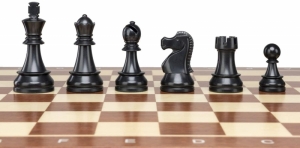
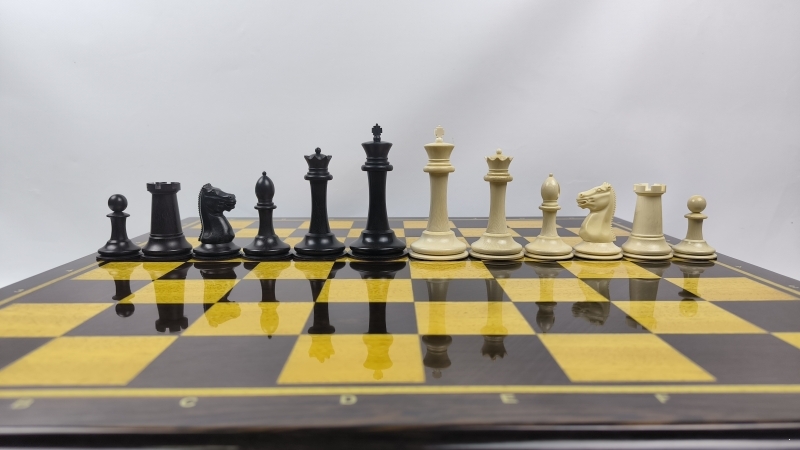
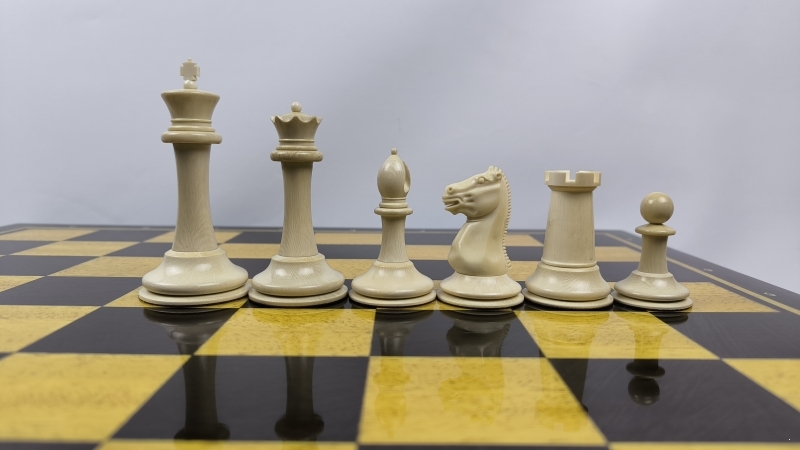
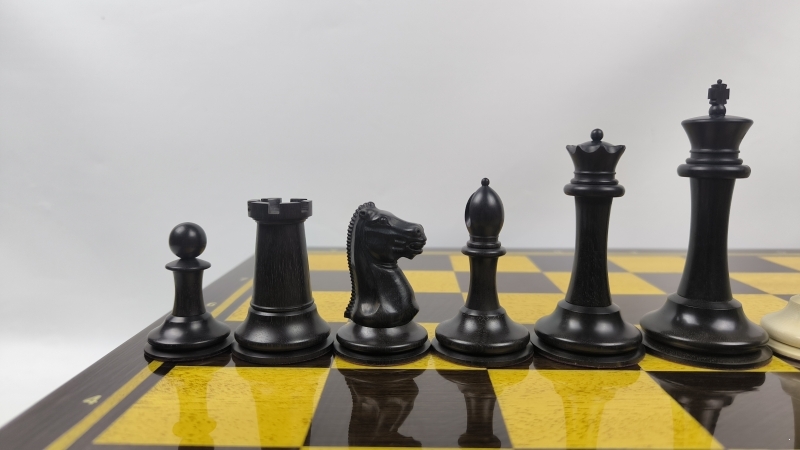
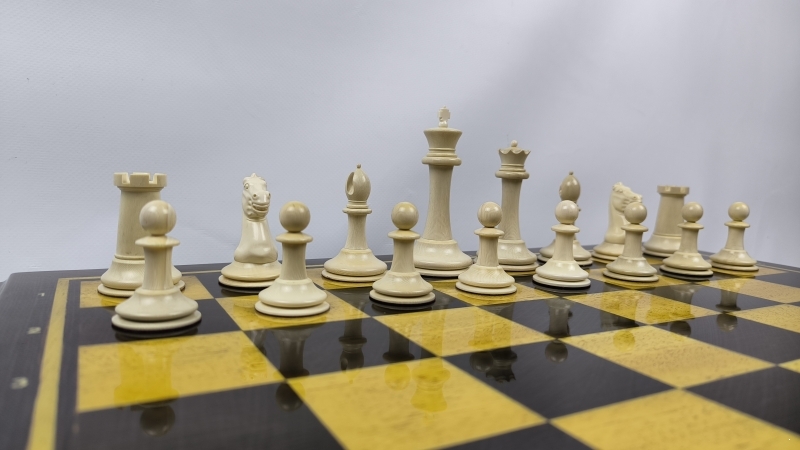
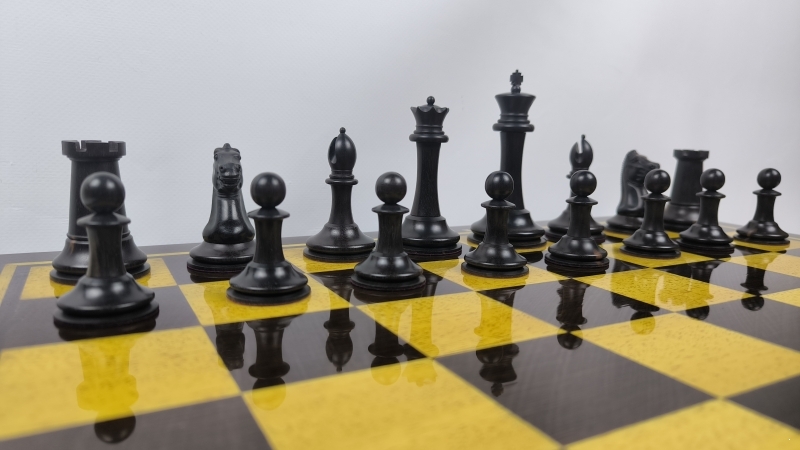
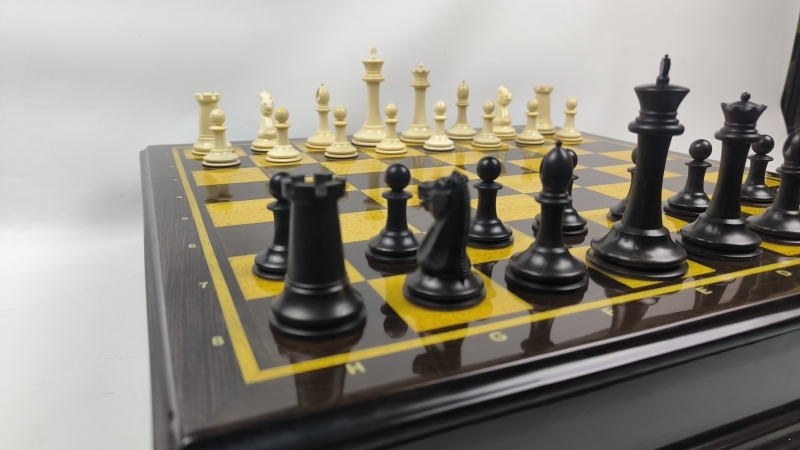
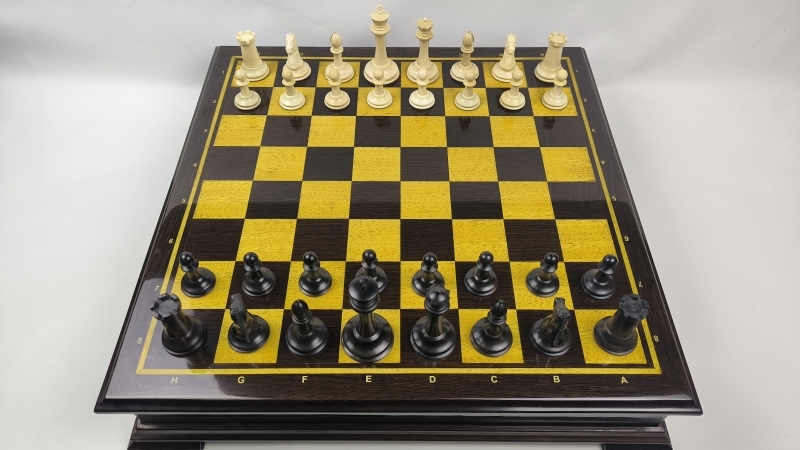
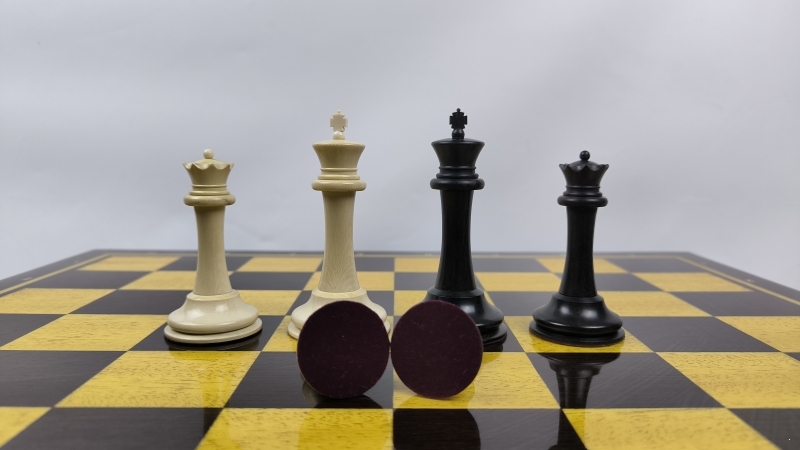
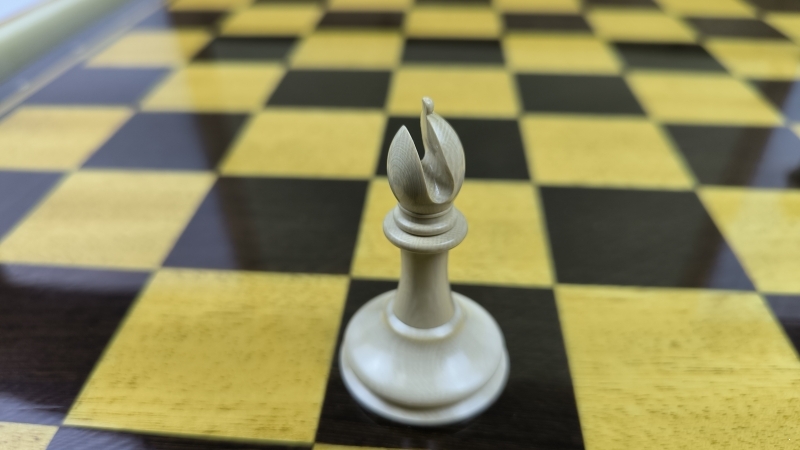
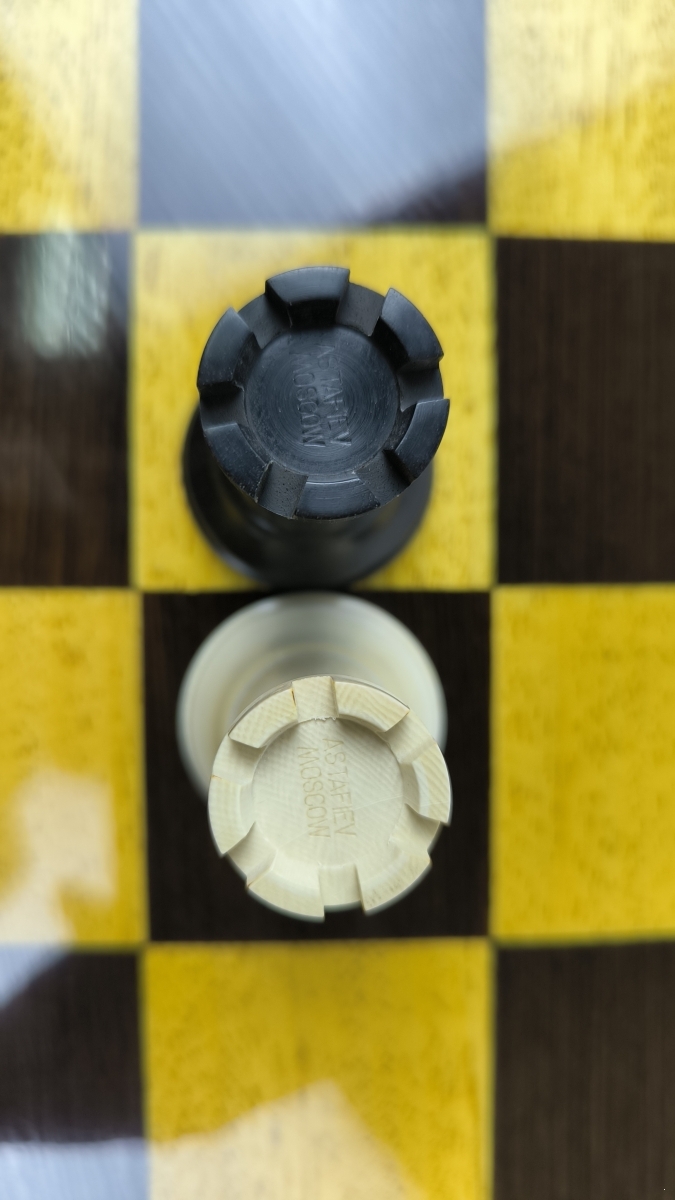
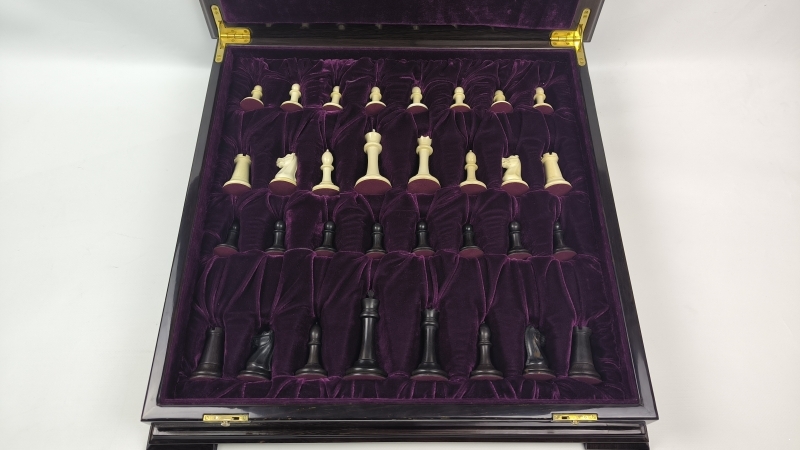
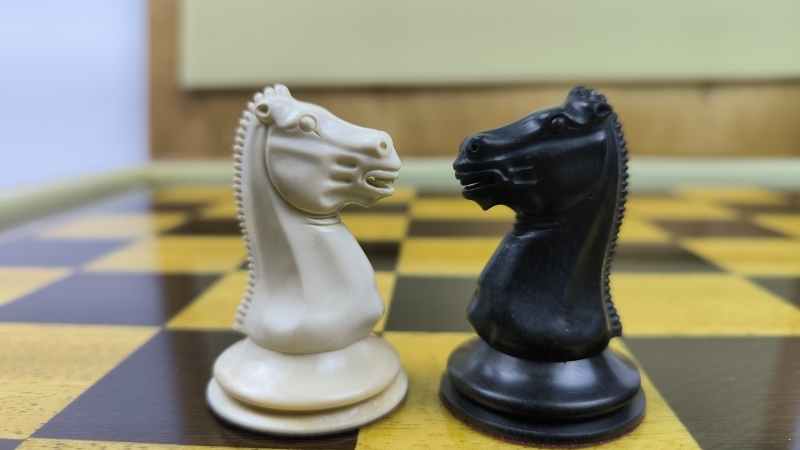
Chess made of mammoth bone and ebony. Staunton.
Description:

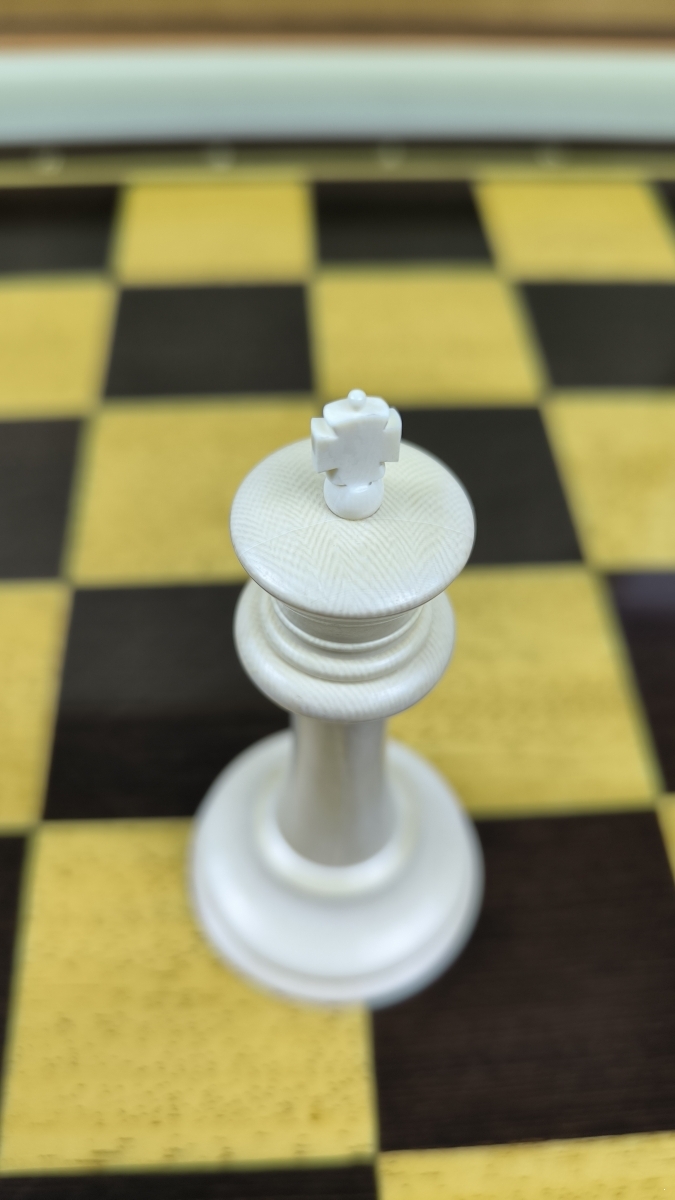
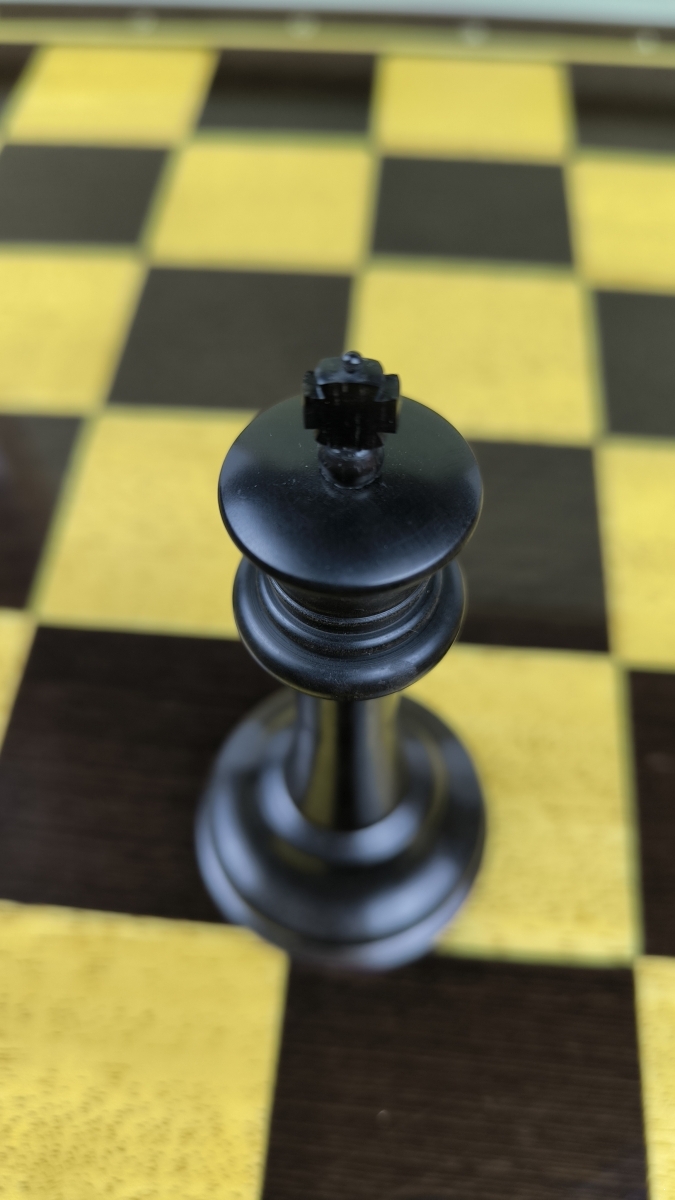
The white figures are made of mammoth bone. In order to eliminate the staining of figures with black paint, the manufacturer decided to use an equally luxurious material for black figures - ebony in its natural and natural form. 

Ebony is a dense black-brown hardwood that comes from several species of the genus Diospyros. This wood is used to make chess pieces because of its strength, fine texture and mirror shine when polished. It is noteworthy that ebony wood sinks in water due to its high density. Ebony is considered to be precious and one of the most expensive types of wood

The sizes of the shapes:

King: Height - 10.3cm Base diameter - 5 cm

A pawn: Height - 5 cm Base diameter - 3.5 cm

Horse: Height - 6 cm Base diameter - 4 cm

Rook: Height - 5.7cm Base diameter - 4 cm

Elephant: Height - 6.6cm Base diameter - 4 cm

Queen: Height - 8.5 cm Base diameter - 4 cm

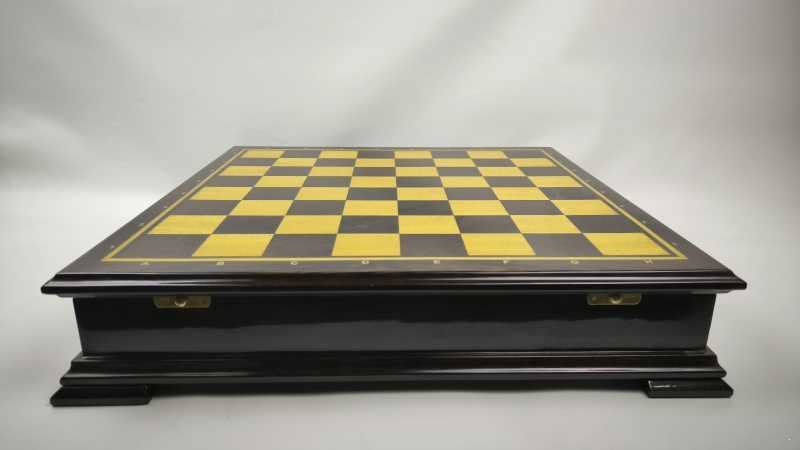
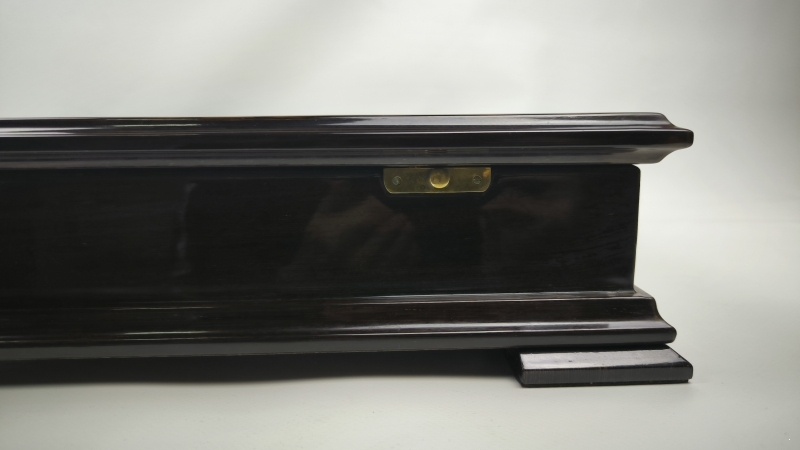
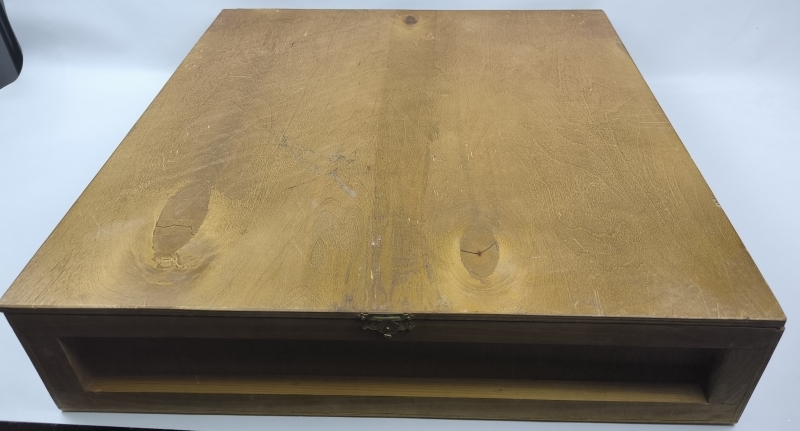
Board size: 52.5x52.5x11 cm

The size of the playing field is 46x46 cm

The size of the game cage is 5.5 cm

The size of the shipping case: 63x59x14 cm

These chess sets represent exactly the first model of the Staunton design of 1849.

Staunton is a standard chess piece design created in the mid-19th century by Nathaniel Cook. This chess design got its name in honor of the famous English chess player Howard Staunton, who lived in the 19th century. The FIDE organization recommends Staunton chess for competitions held under its auspices. Until the middle of the 19th century, every country in Europe where chess tournaments were held had its own traditional standards for chess piece designs (Barleycorn, Calver, Selenus, St. George, Lund, Regence, etc.), which was undoubtedly very inconvenient during international competitions. Nathaniel Cook registered Staunton chess on March 1, 1849, however, in the same year the rights to this chess design passed to John Jacquet, who was the brother of Nathaniel Cook's wife and owned John Jaques of London, specializing in the manufacture and sale of sports equipment. The first set of chess designed by Staunton went on sale on September 8, 1849. At the same time, the periodical "The Illustrated London News", well-known at that time, printed an advertising article stating that Howard Staunton himself was one of the creators of this wonderful design of chess pieces.

There is a version that the famous chess player wrote the article, as he subsequently actively contributed to the promotion of this chess set on the market. Howard Staunton's facsimile signature was displayed under the cover of the chessboards of the first Staynton sets, and one of his books was attached to the set for free as an advertisement. However, there is an assumption that the real author of the Staunton design is John Jacquet, and Cook only registered it for himself and subsequently attracted Howard Staunton to promote chess on the market. In 1940, German aircraft bombed the John Jaques of London factory. Historical sketches and drawings of Staunton chess pieces burned down in the fire. The first Staunton chess sets were carved from ivory or hardwoods (for example, boxwood). Later, they began to be created from mammoth tusks and various valuable tree species such as wenge, ebony, boxwood, etc.


To leave comments, sign in or register on the site.
There are no comments on this record yet.