menu
top sales
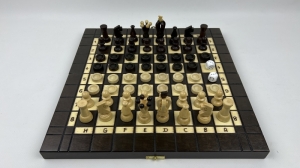
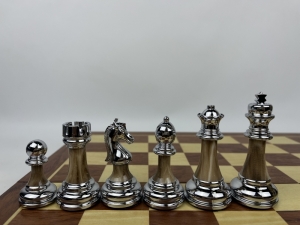
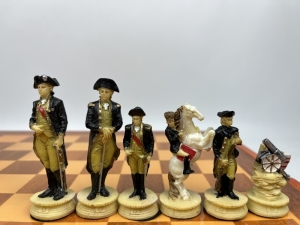
  • The size of the board when folded is 35x17.5 cm. The size of the board when unfolded is 35x35 cm. Cage size is 3x3 cm  King height 6.6 cm. Base diameter 2.2 cm. Pawn height 3.1 cm. Base diameter 2 cm. Backgammon - checker 2.1 cm. Weight 830 g. Includes backgammon chips and dice Chess board and backgammon chips can be used to play checkers Manufacturer Poland

    148.00 $
  • Author:
    Yanvarev

    Igor Yanvarev "Tactical Mastery of a Chess Player. Volume 2. Basics of Calculation Techniques". Andrey Elkov Publishing House, Moscow, 2025 - 392 p. Before you is the second book from the three-volume work by International Master I.K. Yanvarev, a famous trainer, author of the fundamental work "The Old Indian Played by Tigran Petrosian" (2010), which received recognition from readers and was republished abroad. The three-volume work is united by a common idea - tactics and combinations in chess. In fact, this is a turnkey textbook, it explains everything from scratch to an advanced level. The second volume is devoted to the basics of calculation techniques, such topics as the tactical "spectrum" of a position, concentration of attention, inclusion of imagination are considered, the "tree of variations" is interpreted in a new way, the practical component is emphasized - the economy of calculation. A separate chapter allows the reader to assess their ability to calculate variations and outline ways to eliminate weaknesses. Each chapter ends with a large number of carefully selected examples for independent solution. Unlike other similar publications, the author examines chess tactics as a single whole, in combination with strategy and elements of psychology. It is based on the original author's methodology, which has proven itself well when working with chess players of various qualifications. Excellently selected examples, a clear logical structure and consistency in the presentation simplify the understanding of the material. For a wide range of chess fans.

    19.00 $
  • Author:
    Bogdanovich

    50.00 $
  • Author:
    Gezalyan

    International Master Tibor Karolyi and FIDE Master Tigran Gozalyan have prepared a major work (in two volumes) about the life and work of the 9th world chess champion Tigran Petrosyan (he held the title from 1963 to 1969).  Volume II (1963-1984) tells about Petrosyan's victory in the 1963 world title match over Mikhail Botvinnik, about the grandiose two-match confrontation with Boris Spassky in 1966 and 1969, about all his candidates' matches after losing the title – against Bobby Fischer, Viktor Korchnoi and other world-class opponents. All tournaments and matches of the second half of Petrosian's chess career are presented, up to his last performances in 1983. The authors subjected 175 complete games and fragments to an in-depth analysis (using modern computers). Not all of them have been deeply studied and commented on before, but even then the book provides a significantly improved analysis. Among Petrosyan’s opponents – world champions and contenders Kasparov, Karpov, Fischer, Spassky, Tal, Smyslov, Botvinnik, Korchnoi and Bronstein, as well as Timman, Larsen, Reshevsky, Belyavsky, Polugaevsky, Portisch, Romanishin and many others. Special attention is paid to his coaches – Alexey Suetin and Igor Zaitsev. 

    50.00 $
  • Author:
    Kapengut

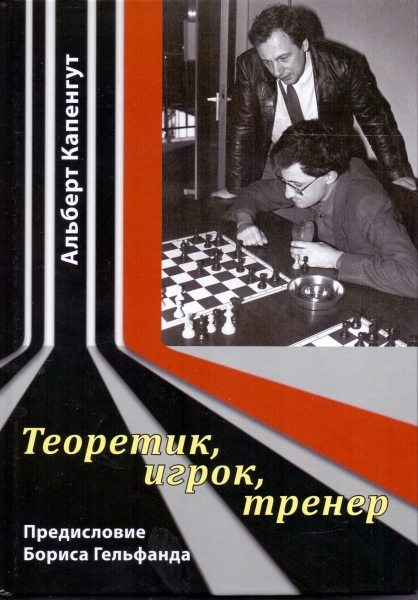
    An outstanding theorist and successful coach shares his memories of communication and cooperation with Mikhail Tal, Anatoly Karpov, Isaac Boleslavsky, Elena Akhmylovskaya and other outstanding chess players. Separate large chapter – a story about many years of work with Boris Gelfand: over these years (1980-1993) the student went from a 12-year-old candidate for master to the holder of the 3rd rating in the world. Albert Kapengut – winner of 6 gold medals at the World Student Olympics, seven-time champion of Belarus, participant in the individual and team championships of the USSR among men, champion of the USSR as part of the Burevestnik team. The book includes 70 games commented in detail by the author, a careful study of which will help the reader not only better understand popular opening schemes, but also get a taste for serious analytical work. “My story is not so much about a career, although “you can’t erase words from a song,” but about memorable situations, often funny, sometimes absurd, and dotted about people I met along the way, sometimes with touches of biography, prompting readers to become interested in more complete information.” ;" (A. Kapengut). For a wide range of chess lovers.

    43.33 $
  • Author:
    Zhuravlev

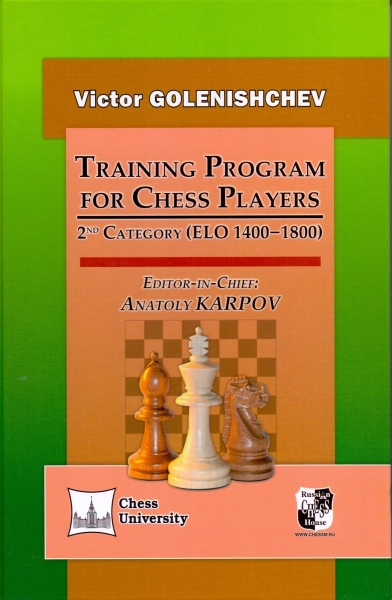
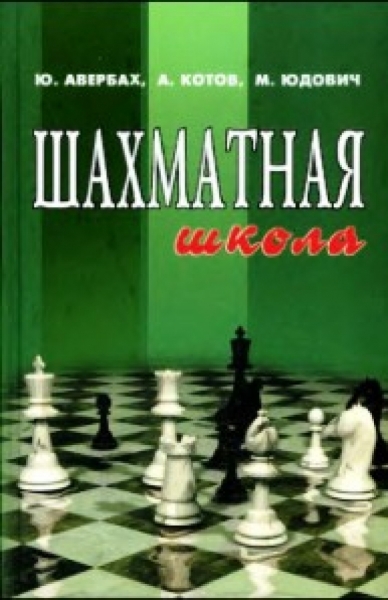
    This tutorial is addressed to those who want to learn to play chess on their own and improve further. The lesson-based method of presentation, as well as numerous exercises, contribute to the consistent assimilation of the rules and laws that form the basis of the chess game. The book contains extensive educational material, which is presented to the reader in accordance with modern pedagogical principles. The purpose of this manual is to train chess players of the III category (rating up to 1800). The textbook can also be used for classes in groups - it covers the material of existing programs of the first year of study in children's and youth chess schools.

    23.33 $
  • Author:
    Eive

    The corpus of this textbook includes two significant works by the world chess champion, scientist and prominent teacher Max Euwe — "Self‑help chess game", created in collaboration with G. Den-Hertog, and "Chess Lessons". The first work is designed for beginners, the second for more experienced chess players. The book is a real chess tutorial in the true sense of the word. This is expressed not only in the appropriate distribution of the material and the method of presentation, designed to awaken the initiative of the student, but also in numerous practical exercises offered to the reader after explaining each new concept or technique.The textbook primarily attracts the methodology of presentation of the material, the principles of which will be useful for coaches and teachers of chess sections and circles. For a wide range of chess fans.

    25.00 $
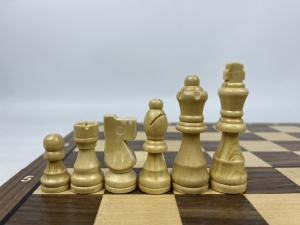
  • Chess was invented in the 5th century AD in India and spread throughout the world. The uniqueness of this game is that it still covers the minds of everyone - from young to old! Chess combines elements of science and sports. They develop logic, perseverance, attentiveness, analytical thinking and memory.  Checkers is a fun, dynamic and relatively simple game. Every country in the world has it. It is comparatively easier to find a partner here than in chess. Backgammon – one of the oldest known board games. It is known that it came to us from the East. First, you need to master the basic techniques, so that later you can boldly apply various tricks during the game.  Cage length: 4.5 cm. King height: 8.8cm King base diameter: 2.8 cm The length and width of the field when unfolded: 44 X 44 cm. Material: wood Country of origin: China.

    84.48 $
  • Made in Holland. Chess computer "Centaur" easy to use. You can easily install any language. Using the touch panel  40x40 cm (cell size 48 x 48 mm) you can easily move the figures. The sensors will record strokes. The board has a capacious rechargeable internal battery. The uniqueness of the computer is that it quickly adapts to  your playing strength (from beginner to grandmaster) so that you have the right opponent. Centaur will help you analyze the game so as not to make the same mistakes and improve your chess skill. Please note, computer is not compatible to connect to your PC or online chess. The set includes USB cable and DGT electronic chess pieces . Height of the king is 86mm.  

    1553.60 $
  • Author:
    Bezgodov

    The youngest first–grader in the USSR, the world champion among young men, a participant in the candidates tournament at the age of 19 - Boris Spassky's rise was rapid. And then fate gave the brilliant chess player a test of strength: he stumbled twice at the decisive moment and remained beyond the threshold of interzonal tournaments ... Only ten years after his first great success, Spassky managed to pass all the qualifying tests and earn the right to a match for the crown, but he failed to defeat the Iron Tigran Petrosian the first time. It took three more years of super–efforts: by Sisyphus he rose again to the foot of Olympus and did not miss a second chance - in 1969 he became the Tenth king of chess! An essay about the life of Boris Vasilyevich and his sporting path full of ups and downs was written by Dmitry Oleynikov, Candidate of Historical Sciences, curator of the Chess Museum of the Chess Federation of Russia. 70 beautiful and instructive games of Spassky were commented on by the champion of Russia in 1993, the famous author and theorist grandmaster Alexey Bezgodov, as well as grandmaster Dmitry Kryakvin and FIDE master Steve Giddins. The preface was written by the 14th world champion Vladimir Kramnik. For a wide range of chess fans.

    21.67 $
  • more

САМООЗДОРОВЛЕНИЕ

  • book

    16.00 $

    RUB

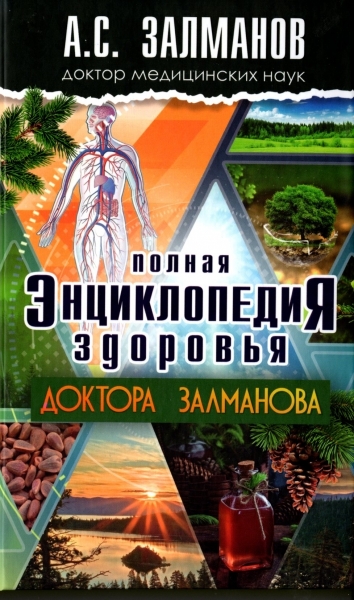
    White thick offset paper 80 gr. This encyclopedia contains all the main works of A. S. Zalmanov, an outstanding scientist, three times Doctor of Medicine (Russia, Germany, Italy), General of the Medical Service: "The Secret Wisdom of the Human Organism", "The Miracle of Life", "Thousands of Ways to Recovery". His books are a lively, figurative and emotional conversation with the reader about the natural defenses of the body and ways to stimulate them, a passionate speech against the widespread and often unjustified use of antibiotics and chemotherapeutic agents for any reason, which often have a detrimental effect on the body. The core idea of ​​the published works of the outstanding doctor and scientist is the "wisdom of the body", its ability to self-regulate as self-healing in case of various "breakdowns". Influenced by the works of A. Krogh, who received the Nobel Prize in Medicine for his work on the physiology of capillaries, Zalmanov created his own concept based on his vast experience in healing numerous patients with chronic diseases. Treatment according to Zalmanov primarily consists of reviving capillaries. He proved that capillary therapy can be used not only for treatment, but also for prevention of aging. His ideas about the leading role of capillaries in the body and the need to restore impaired capillary blood flow are more relevant than ever before today. The method of capillary therapy he developed and the recipes for white, yellow and mixed turpentine baths have helped many, many thousands of patients. Foreword by Academician of the USSR Academy of Medical Sciences and the USSR Academy of Sciences V. N. Chernigovsky.