menu
top sales
  • Author:
    Franco

    In his new book, grandmaster Zenon Franco deeply analyzes the 69 instructive victories of the 11th world champion Robert Fischer. The book is not overloaded with options, the emphasis – with detailed explanations in a move-by-move style, creating an ideal platform for learning chess. In the "reference" At points in each game, the reader is offered test questions, which helps both the practical study of key techniques of the chess game and the reliable assimilation of acquired knowledge. Questions and answers engage the reader in the learning process and help him track his growth in chess strength. The appendix provides a critical analysis of the unsatisfactory translation of Robert Fisher's famous book “My 60 Memorable Games.”

    23.33 $
  • Author:
    Franco

    The book by grandmaster and experienced chess coach Zenon Franco includes 36 instructive attacking games and is divided into four chapters - the king in the center, one-sided castling, opposite-sided castling, and attack-defense-counterattack. Before each game, the opponents are introduced, and a brief description of the events that took place in it is given. Based on the results of the struggle in the game, lessons that are useful to learn from what has been read are listed in a concise form. The book is not overloaded with variations, the emphasis is on detailed explanations in the "move by move" format, which creates an ideal platform for studying chess. At the "support" points of each game, the reader is offered test questions, which helps both the practical study of key chess techniques and the reliable assimilation of the acquired knowledge. Questions and answers involve the reader in the learning process and help him track the growth of his chess strength. For a wide range of chess fans.

    19.00 $
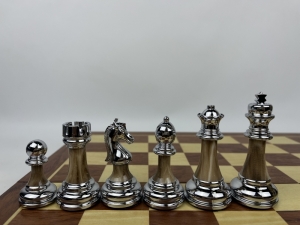
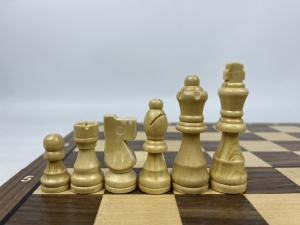
  • The size of the board when folded is 46x23x5 cm. The size of the board when unfolded is 35x35 cm. Cage size is 4.6x4.6 cm  The height of the king is 10 cm. The diameter of the base is 3 cm. Pawn height 5.5 cm. Base diameter 2.8 cm. Weight 1380 g. ART 123 Manufacturer Poland

    183.15 $
  • A limited edition of the most famous electronic chess clock. Design & quot; under the tree & quot ;. Released for the 25th anniversary of the DGT. & Nbsp; These watches are used in all major tournaments, world championships and World Cups, World Chess Olympiads. Installation of any time controls, including Fisher and Bronstein controls (with added time). & Nbsp;

    237.50 $
  • The size of the board when folded is 35x17.5 cm. The size of the board when unfolded is 35x35 cm. Cage size is 3x3 cm  King height 6.6 cm. Base diameter 2.2 cm. Pawn height 3.1 cm. Base diameter 2 cm. Backgammon - checker 2.1 cm. Weight 830 g. Includes backgammon chips and dice Chess board and backgammon chips can be used to play checkers Manufacturer Poland

    148.00 $
  • Author:
    Bologan

    The 2nd edition, revised and supplemented, of the popular monograph, which is dedicated to one of the most combat modern debuts – the Old Indian defense. The author meticulously builds the entire defensive line of black (including on the territory of "adjacent" openings, such as the English beginning or the London system), explains standard plans and tactical techniques, offers a number of novelties in current schemes. Carefully selected positions for the solution will help the reader to consolidate the acquired knowledge. The book is addressed to chess players of any level, since the laws of Old Indian are the same for both amateurs and super grandmasters.

    21.67 $
  • Author:
    Zhuravlev

    This tutorial is addressed to those who want to learn to play chess on their own and improve further. The lesson-based method of presentation, as well as numerous exercises, contribute to the consistent assimilation of the rules and laws that form the basis of the chess game. The book contains extensive educational material, which is presented to the reader in accordance with modern pedagogical principles. The purpose of this manual is to train chess players of the III category (rating up to 1800). The textbook can also be used for classes in groups - it covers the material of existing programs of the first year of study in children's and youth chess schools.

    23.33 $
  • Author:
    Kasparov

    41.67 $
  • Author:
    Bologan

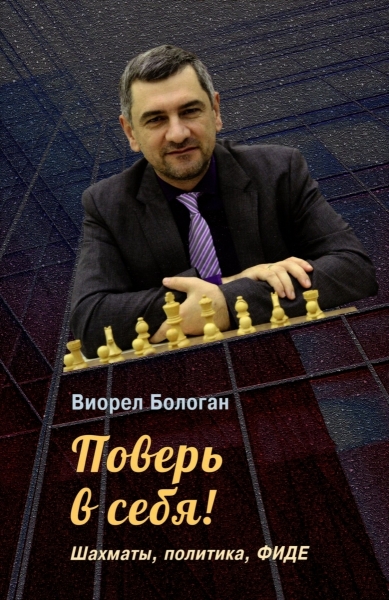
    «The idea of continuing the autobiographical book “Steps” has been in the air almost since the moment it was written. Despite the bullet point at the end of the book in the form of a victory over Magnus Carlsen, my chess career continued for another full 14 years, and the subsequent stormy socio-political career is only gaining momentum.” (V. Bologan).  The book contains 75 games commented in detail and a number of fragments. A frank story about the life and professional path, about cooperation with the leading grandmasters and coaches of the world (among them - A. Karpov, G. Kasparov, Yu. Polgar, Zhu Chen, R. Ponomarev, A. Shirov, A. Morozevich, A. Onischuk, A. Ryazantsev, E. Inarkiev, M. Al-Mudakhka, M. Dvoretsky, M. Podgaets, V. Chebanenko, Z. Lanka and others), about political activities in the Parliament of Moldova and about work in FIDE are complemented by numerous photographs.   For a wide range of chess lovers.

    36.67 $
  • Author:
    Fisher

    15.00 $
  • more

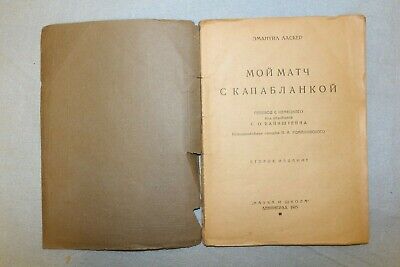
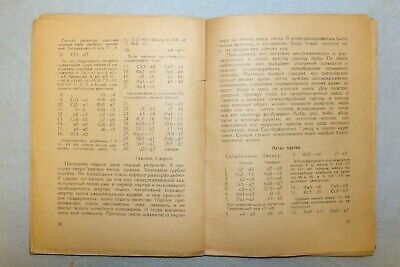
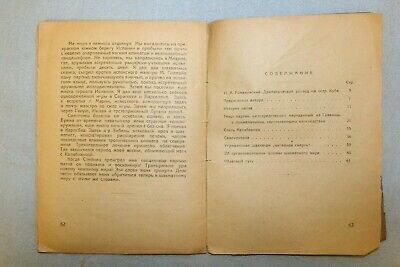
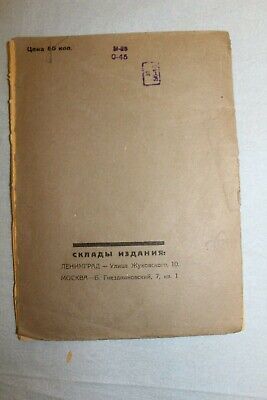
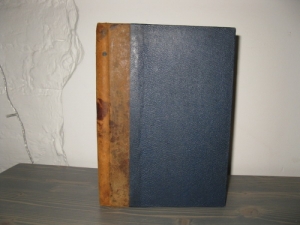
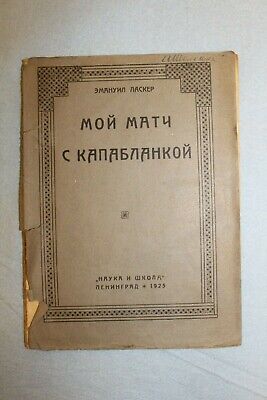
Soviet Vintage Chess Book: My Game with Capablanca. E. Lasker. 1925
28 $

RUB

Description:

Author: E. Lasker

Title: My Game with Capablanca

Published: Leningrad, 1925

Binding: Softback

Language: Russian

Pages: 64

Emanuel Lasker — German chess player and mathematician, representative of the positional school, the second world chess champion (won this title from Steinitz in 1894 and lost to Capablanca in 1921). Lasker kept the title of world champion for 27 years, which is a record achievement for chess. Even after losing the title, he continued to perform at the highest level until he was 68 years old.


Lasker had a universal style of play, but his strongest sides were considered positional flair and endgame. Many biographers and researchers call Lasker the discoverer of the psychological approach to chess: it is believed that Lasker was often ready to go to the deterioration of its position to direct the game in an inconvenient direction for a particular opponent. This point of view is popular even now, although some experts consider it a mistake and explains Lasker's achievements with a deep understanding of chess and the ability to assess the pros and cons of a particular continuation of the party.


Throughout his chess career, Lasker repeatedly stopped performing for several years to study mathematics and philosophy. Lasker defended his doctoral thesis in mathematics in 1901, and his main achievement in mathematics was a theorem called by his name and the name of Emmy Noether, which generalized Lasker's original result. In addition, Lasker published several philosophical works and literary works.


To leave comments, sign in or register on the site.
There are no comments on this record yet.