menu
top sales
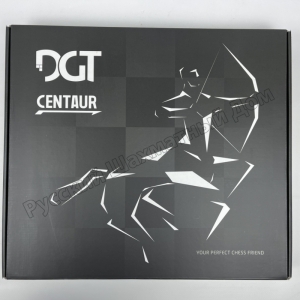
  • Made in Holland. Chess computer "Centaur" easy to use. You can easily install any language. Using the touch panel  40x40 cm (cell size 48 x 48 mm) you can easily move the figures. The sensors will record strokes. The board has a capacious rechargeable internal battery. The uniqueness of the computer is that it quickly adapts to  your playing strength (from beginner to grandmaster) so that you have the right opponent. Centaur will help you analyze the game so as not to make the same mistakes and improve your chess skill. Please note, computer is not compatible to connect to your PC or online chess. The set includes USB cable and DGT electronic chess pieces . Height of the king is 86mm.  

    1553.60 $
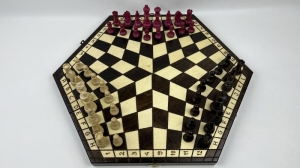
  • Unique chess for 3 players. Such chess will appeal to any person who chooses something new and appreciates original things. Manufacturer MADON-CHESS (Poland) Chessboard size: 46.5x54x2.5cm (unfolded) King height: 7.7cm King base diameter (cm): 3  Pawn height (cm): 3.6 Pawn base diameter (cm): 2.1 Presence of weighting agent: no Weight: 1311 g. Wood used for the chessboard: beech, birch Wood used for figures: hornbeam, beech  Intermediate chess for three is ideal entertainment for friends. The chess store presents to customers a unique set from a Polish manufacturer. If you are planning to buy a medium chess set for three in Moscow, pay attention to the set MADON-CHESS.   The main advantages of a chess set for three are reasonable cost and workmanship. The chess pieces are made of beech and oak of the highest quality. The chessboard is not inferior in quality: it is based on birch and beech.  The set consists of chess in three colors.  The chessboard has a compact size and is convenient to store on a shelf. Inside the board there are three separate compartments for storing pieces. For convenience and to keep products intact, the board is equipped with a soft lining.

    214.50 $
  • Magnetic road chess: folding board-case made of artificial leather, tablet-figures with a convex image. Wallet size 19x22 cm. The playing field is 15.5 x 15.5 cm. Cell 2x2 cm.

    51.72 $
  • Author:
    Getmanchuk

    16.67 $
  • Author:
    Vysotsky

    20.00 $
  • Author:
    Zhuravlev

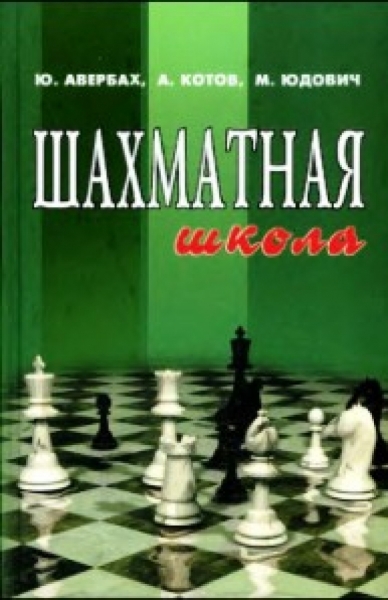
    This tutorial is addressed to those who want to learn to play chess on their own and improve further. The lesson-based method of presentation, as well as numerous exercises, contribute to the consistent assimilation of the rules and laws that form the basis of the chess game. The book contains extensive educational material, which is presented to the reader in accordance with modern pedagogical principles. The purpose of this manual is to train chess players of the III category (rating up to 1800). The textbook can also be used for classes in groups - it covers the material of existing programs of the first year of study in children's and youth chess schools.

    23.33 $
  • Author:
    Fisher

    15.00 $
  • Author:
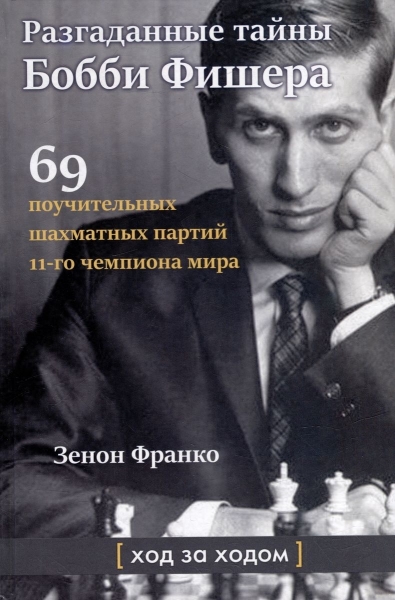
    Franco

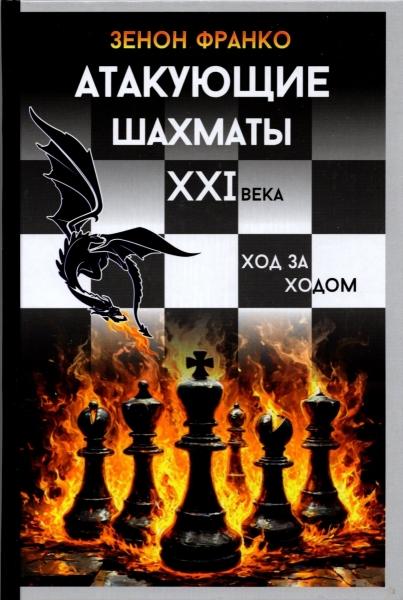
    In his new book, grandmaster Zenon Franco deeply analyzes the 69 instructive victories of the 11th world champion Robert Fischer. The book is not overloaded with options, the emphasis – with detailed explanations in a move-by-move style, creating an ideal platform for learning chess. In the "reference" At points in each game, the reader is offered test questions, which helps both the practical study of key techniques of the chess game and the reliable assimilation of acquired knowledge. Questions and answers engage the reader in the learning process and help him track his growth in chess strength. The appendix provides a critical analysis of the unsatisfactory translation of Robert Fisher's famous book “My 60 Memorable Games.”

    23.33 $
  • Author:
    Galkin

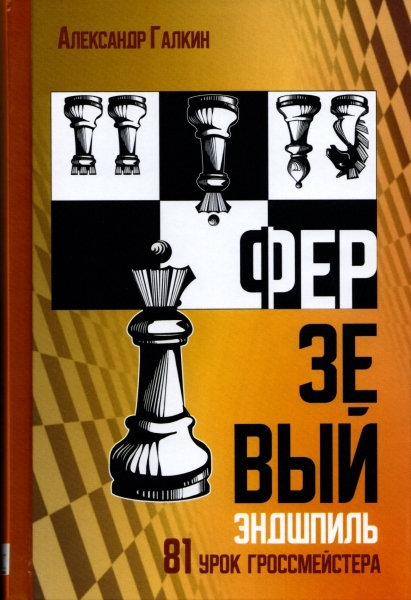
    The book by grandmaster and experienced coach Alexander Galkin is  the final link in a series of publications by the author, directed  to study the classical endgame using examples of modern games   grandmasters. This time the subject of the study – light piece endgames. Clarification of the methodology for working on this stage of the game, as well as the main features and methods of playing such endings. Examples  taken from the practice of modern grandmasters and dated back to 2020-2023. The author offers the reader the most recent and unique information. The material is structured in such a way that the reader can get the maximum  benefit from studying the examples offered by the author  queen endings and its  other derivatives. The book is aimed at advanced chess players, is useful for coaches and can be recommended to a wide range of chess fans

    18.33 $
  • Author:
    Gezalyan

    International Master Tibor Karolyi and FIDE Master Tigran Gozalyan have prepared a major work (in two volumes) about the life and work of the 9th world chess champion Tigran Petrosyan (he held the title from 1963 to 1969).  Volume II (1963-1984) tells about Petrosyan's victory in the 1963 world title match over Mikhail Botvinnik, about the grandiose two-match confrontation with Boris Spassky in 1966 and 1969, about all his candidates' matches after losing the title – against Bobby Fischer, Viktor Korchnoi and other world-class opponents. All tournaments and matches of the second half of Petrosian's chess career are presented, up to his last performances in 1983. The authors subjected 175 complete games and fragments to an in-depth analysis (using modern computers). Not all of them have been deeply studied and commented on before, but even then the book provides a significantly improved analysis. Among Petrosyan’s opponents – world champions and contenders Kasparov, Karpov, Fischer, Spassky, Tal, Smyslov, Botvinnik, Korchnoi and Bronstein, as well as Timman, Larsen, Reshevsky, Belyavsky, Polugaevsky, Portisch, Romanishin and many others. Special attention is paid to his coaches – Alexey Suetin and Igor Zaitsev. 

    50.00 $
  • more

Lessons of skill. New analyzes of old batches
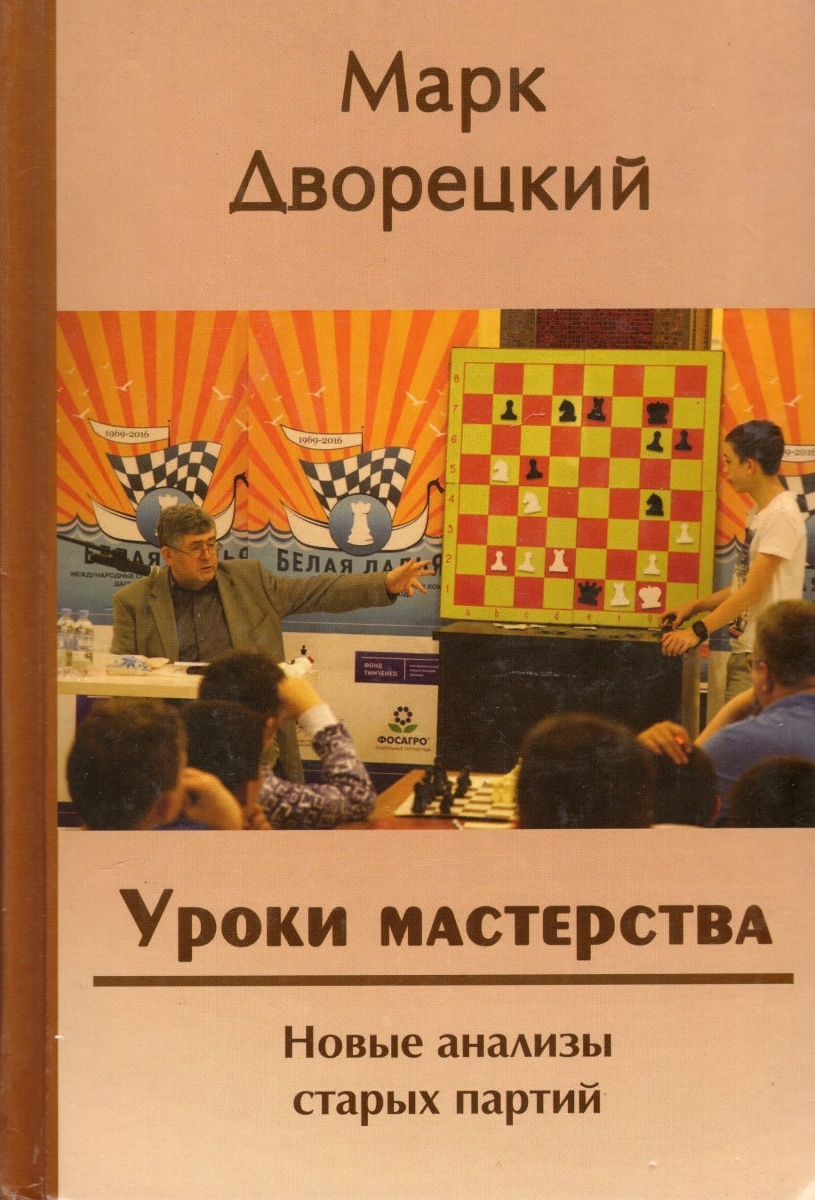
Publisher: Russian chess Federation

paper book

30 $

RUB

Description:

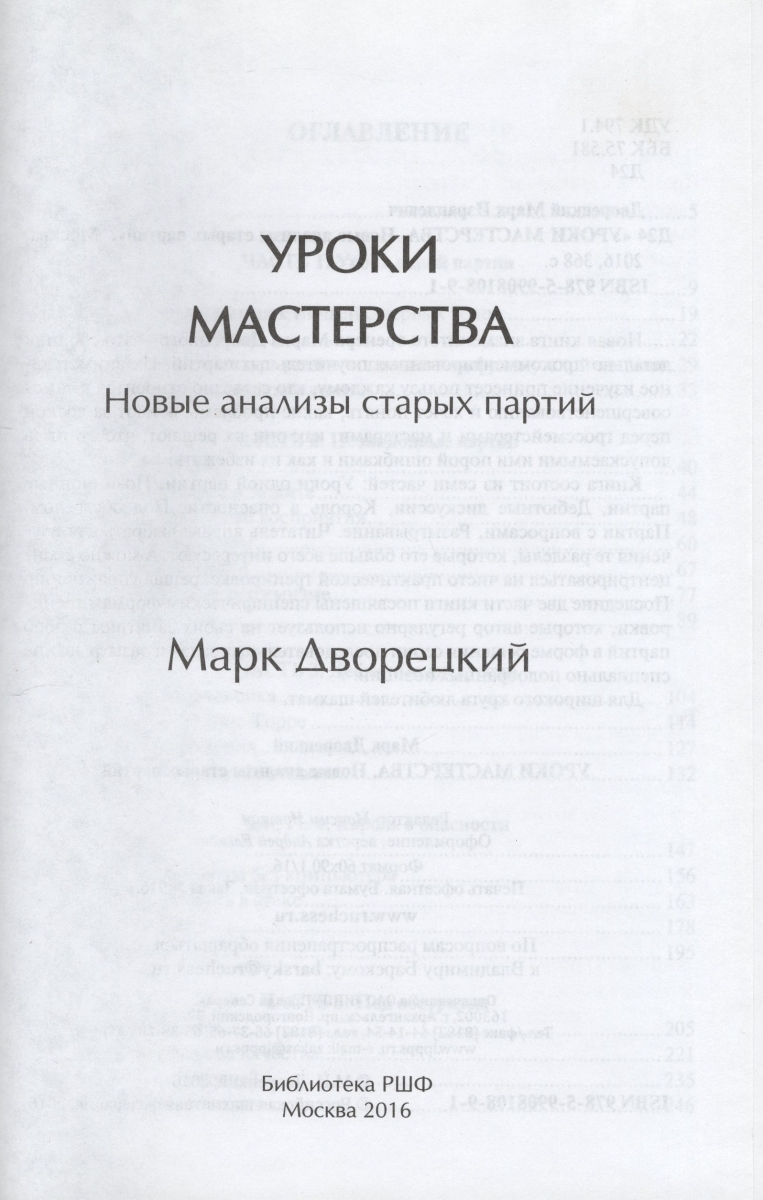
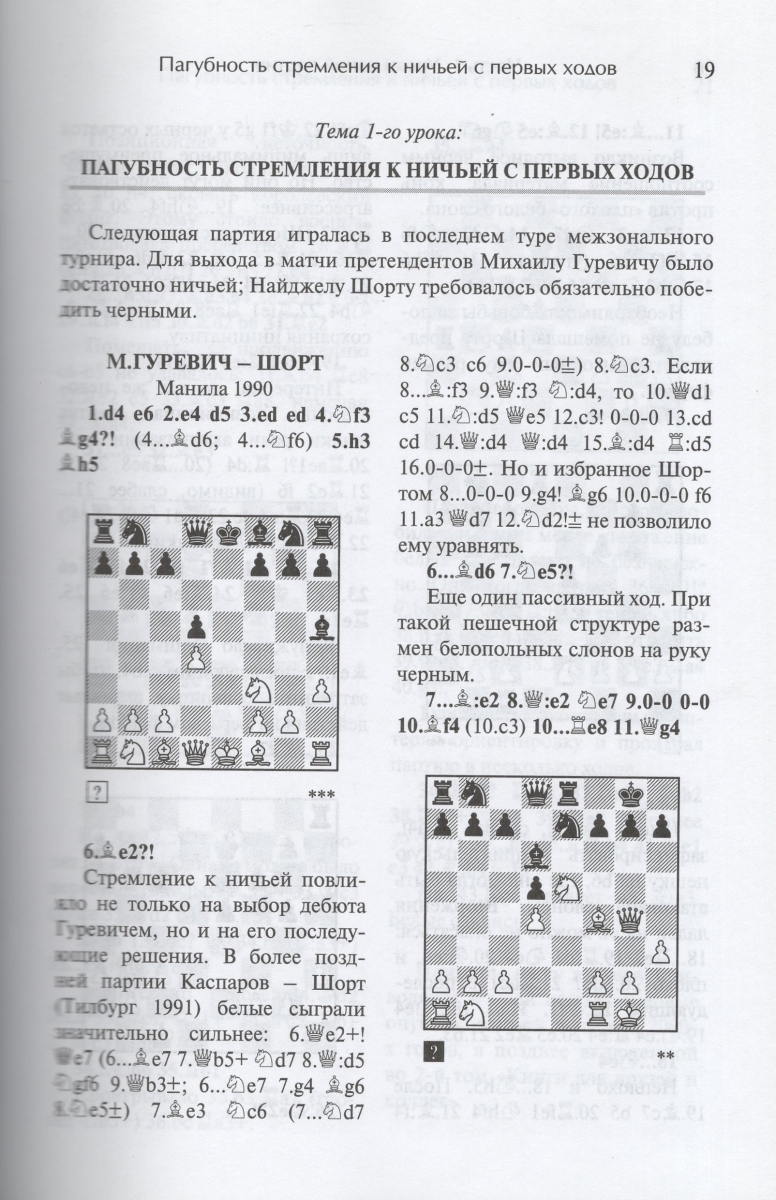
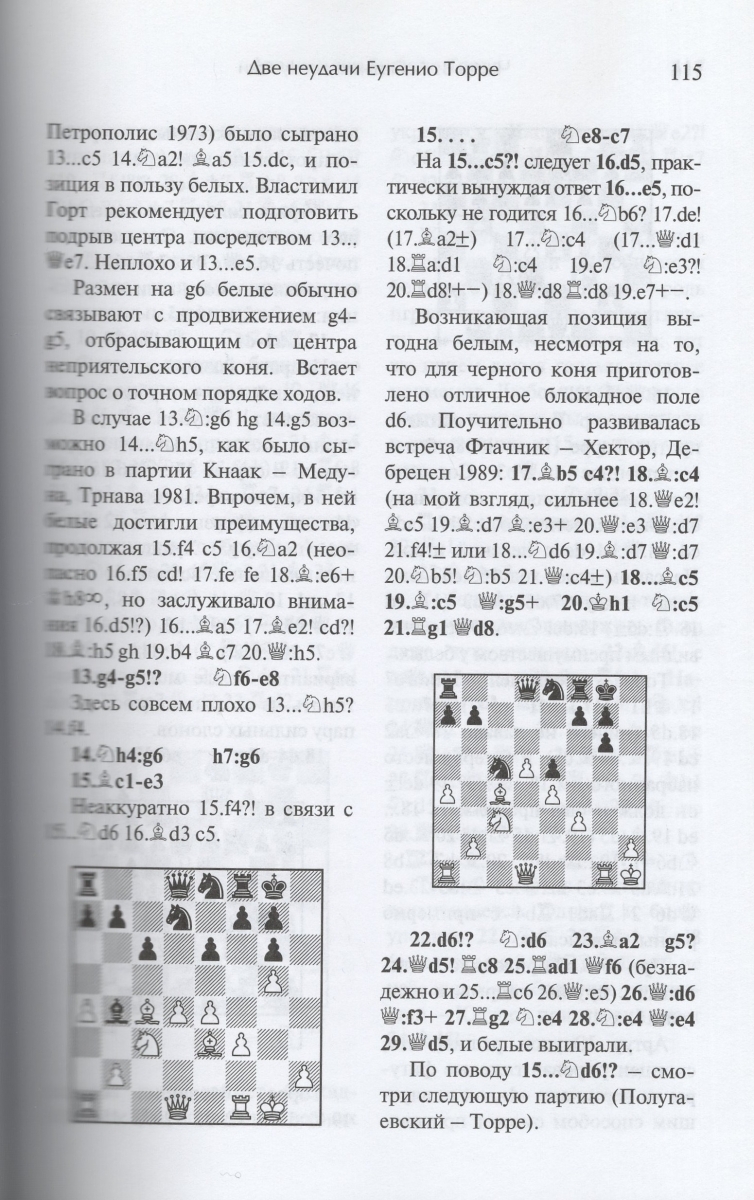
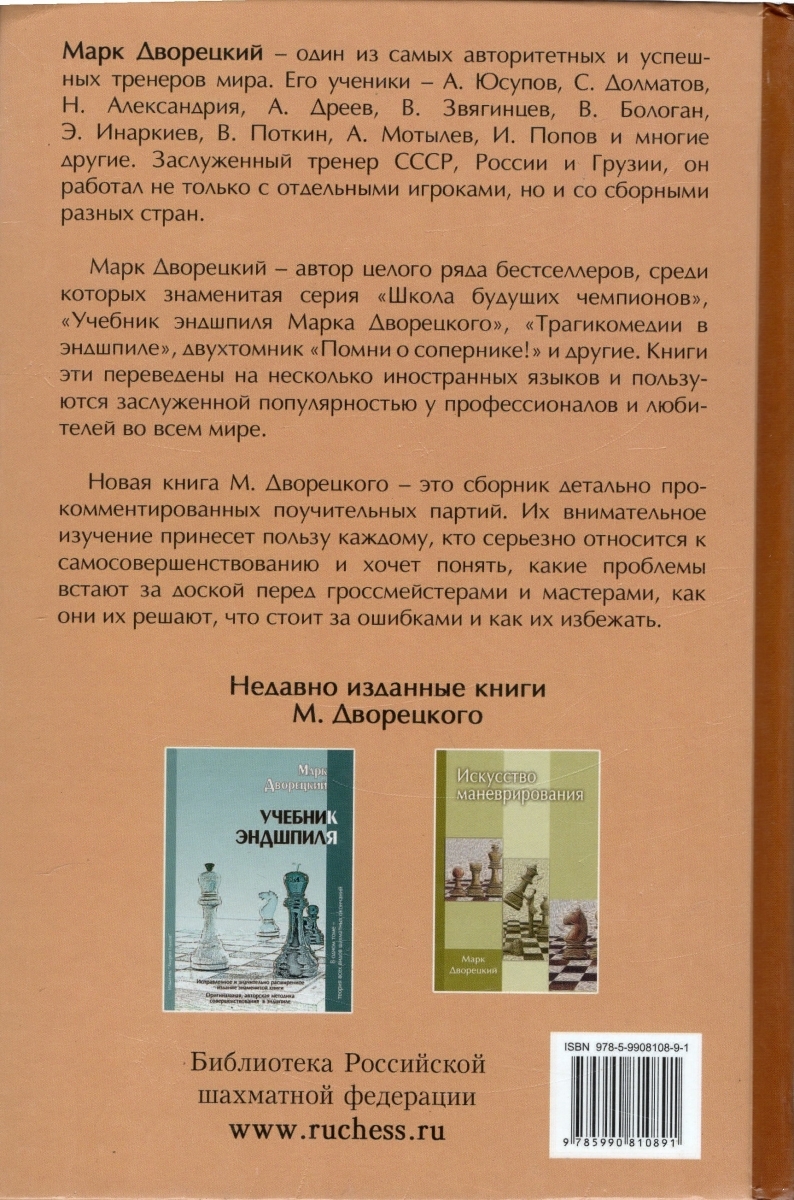
The new book of the famous coach Mark Dvoretsky & ndash; this is a collection of detailed commentaries on instructive parties. Their careful study will benefit everyone who is serious about self-improvement and wants to understand what problems arise behind the board in front of grandmasters and masters, how they solve them, what is behind the mistakes they make at times and how to avoid them. The book consists of seven parts: Lessons of one party, Positional parties, Debut discussions, King in danger, Under fire, Parties with questions, Playing. The reader has the right to choose those sections that interest him most. And you can concentrate on a purely practical training, solving the exercises. The last two parts of the book are devoted to the specific forms of training that the author regularly uses in his classes: analyzing games in the form of solving a series of sequential tasks and playing out specially selected positions.


To leave comments, sign in or register on the site.
There are no comments on this record yet.