menu
top sales
  • Author:
    Karoii

    50.00 $
  • Author:
    Zhuravlev

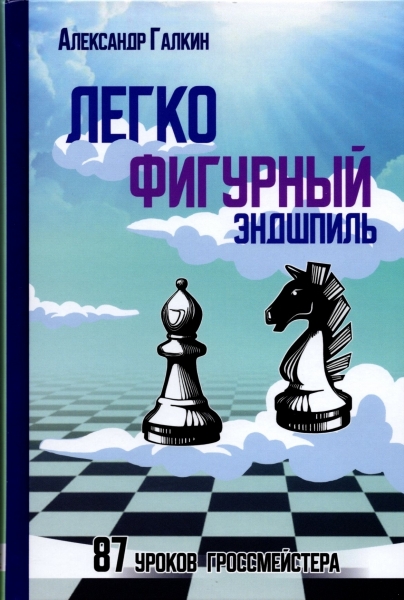
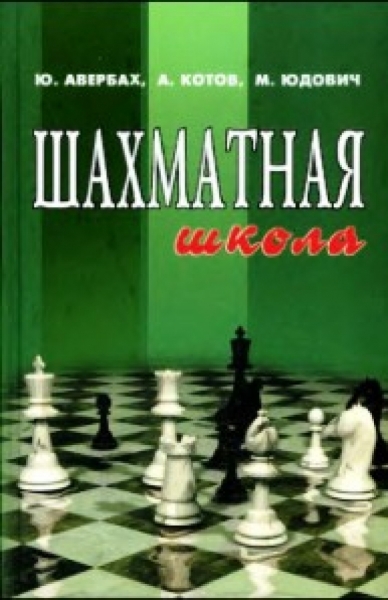
    This tutorial is addressed to those who want to learn to play chess on their own and improve further. The lesson-based method of presentation, as well as numerous exercises, contribute to the consistent assimilation of the rules and laws that form the basis of the chess game. The book contains extensive educational material, which is presented to the reader in accordance with modern pedagogical principles. The purpose of this manual is to train chess players of the III category (rating up to 1800). The textbook can also be used for classes in groups - it covers the material of existing programs of the first year of study in children's and youth chess schools.

    23.33 $
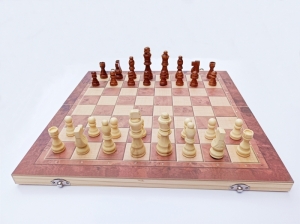
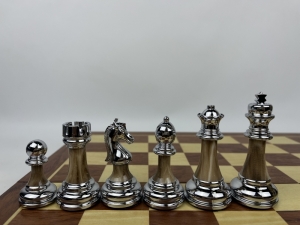
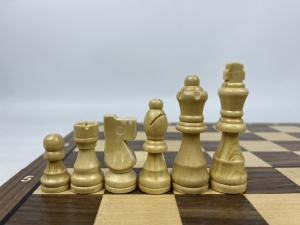
  • The size of the board when folded is 35x17.5 cm. The size of the board when unfolded is 35x35 cm. Cage size is 3x3 cm  King height 6.6 cm. Base diameter 2.2 cm. Pawn height 3.1 cm. Base diameter 2 cm. Backgammon - checker 2.1 cm. Weight 830 g. Includes backgammon chips and dice Chess board and backgammon chips can be used to play checkers Manufacturer Poland

    148.00 $
  • Author:
    Franco

    In his new book, grandmaster Zenon Franco deeply analyzes the 69 instructive victories of the 11th world champion Robert Fischer. The book is not overloaded with options, the emphasis – with detailed explanations in a move-by-move style, creating an ideal platform for learning chess. In the "reference" At points in each game, the reader is offered test questions, which helps both the practical study of key techniques of the chess game and the reliable assimilation of acquired knowledge. Questions and answers engage the reader in the learning process and help him track his growth in chess strength. The appendix provides a critical analysis of the unsatisfactory translation of Robert Fisher's famous book “My 60 Memorable Games.”

    23.33 $
  • Author:
    Franco

    The book by grandmaster and experienced chess coach Zenon Franco includes 36 instructive attacking games and is divided into four chapters - the king in the center, one-sided castling, opposite-sided castling, and attack-defense-counterattack. Before each game, the opponents are introduced, and a brief description of the events that took place in it is given. Based on the results of the struggle in the game, lessons that are useful to learn from what has been read are listed in a concise form. The book is not overloaded with variations, the emphasis is on detailed explanations in the "move by move" format, which creates an ideal platform for studying chess. At the "support" points of each game, the reader is offered test questions, which helps both the practical study of key chess techniques and the reliable assimilation of the acquired knowledge. Questions and answers involve the reader in the learning process and help him track the growth of his chess strength. For a wide range of chess fans.

    19.00 $
  • Author:
    Kapengut

    An outstanding theorist and successful coach shares his memories of communication and cooperation with Mikhail Tal, Anatoly Karpov, Isaac Boleslavsky, Elena Akhmylovskaya and other outstanding chess players. Separate large chapter – a story about many years of work with Boris Gelfand: over these years (1980-1993) the student went from a 12-year-old candidate for master to the holder of the 3rd rating in the world. Albert Kapengut – winner of 6 gold medals at the World Student Olympics, seven-time champion of Belarus, participant in the individual and team championships of the USSR among men, champion of the USSR as part of the Burevestnik team. The book includes 70 games commented in detail by the author, a careful study of which will help the reader not only better understand popular opening schemes, but also get a taste for serious analytical work. “My story is not so much about a career, although “you can’t erase words from a song,” but about memorable situations, often funny, sometimes absurd, and dotted about people I met along the way, sometimes with touches of biography, prompting readers to become interested in more complete information.” ;" (A. Kapengut). For a wide range of chess lovers.

    43.33 $
  • Author:
    Galkin

    16.67 $
  • Author:
    Kalinichenko

    The vast majority of opening guides are written for adult readers. This book is also devoted to the theory but it is junior. The structure of the book is simple and attractive: openings are examined using examples from actual games, each of which is presented in the form of a lesson with its own name. Several such lessons form an opening theme, and the examination of each theme concludes with exercises. In each opening, attention is drawn to its characteristic tactical and strategic ideas of combinations for independent solution strictly corresponds to the opening theme. Written in clear and easy language, the book is furnished with a large number of diagrams. Colored explanatory arrows on the diagrams and the selection of individual pages with a colored background make the book easier to understand. Regular work solve two problems: deepen the student's knowledge and develop his tactical vision, thus improving his skill and results.

    28.80 $
  • Author:
    Kasparov

    41.67 $
  • Author:
    Chernyshov

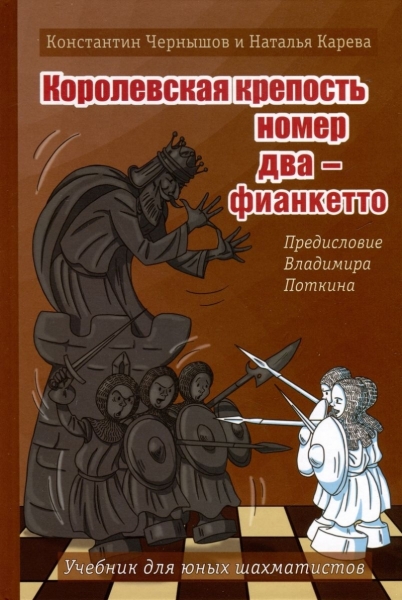
    The authors continue to study typical opening and middlegame positions. Royal Fortress No. 2 has pawns on squares f7, g6, h7 (or f2, g3, h2), and they are usually joined by another defender – bishop on g7 (g2). This formation is called fianchetto, it is found in many popular openings, such as the Catalan Opening, King's Indian Defense, Grunfeld Defense and a number of others.  The authors analyze in detail the techniques of attack, defense and counterattack. Most examples – from the creativity of modern chess players (for example, a separate chapter is dedicated to the strongest Russian grandmaster Ian Nepomniachtchi); they are complemented by parts that have become a classical heritage. The book contains about 300 positions for independent solution, so it is not only a textbook, but also a solid problem book. Grandmaster Konstantin Chernyshov, head of the Interregional Grandmaster School in Kostroma, and his daughter International Master Natalya Kareva – experienced coaches, whose students include grandmasters and masters, champions of Russia and Europe among juniors.  The book is addressed to young chess players and their mentors. 

    20.00 $
  • more

Germany

Книги издательства:

  • book
    (на нем.яз.). Шахматы и математика на множестве примеров.
  • book
    Тема - конгресс композиторов в Пуле 1997.
  • book
    (in English). Biography, all surviving parties, tables, and other reference materials in an elegantly designed volume (about 300 pages) Notes in the style of an Informant.
  • book
    Germany.
  • book
    (in German). a) volume 1 (Kotov) b) volume 2 (Koblenz)
  • book
    (in German). a) volume 1 (Kotov) b) volume 2 (Koblenz)
  • book
    Collection of articles (including archival) of 10 world champions from Capablanca to Karpov.
  • book
    Germany.
  • book

    10.37 $

    (in German). a) Volume 1 (Koblenz) (b) Volume 2 (Cats)
  • book

    (on it) Collection of test games (points for correct moves).

  • book

    15.55 $

    (in German). In the amount of about 750 pages. Unlike the Russian 5-volume, the focus on the training side.
  • book

    15.55 $

    on him.yaz.). In the amount of about 750 pages. Unlike the Russian 5-volume, the focus on the training side.
  • book

    17.96 $

    (in German). a) Volume 1 (Koblenz) (b) Volume 2 (Cats)
  • book

    30.06 $

    (in German). A book worthy of attention both in content and in design. A lot of new and little-known material.
  • book

    38.00 $

    The Colle-Koltanowski System with d4, Nf3, e3, Bd3, c3, 0-0, Nbd2 is very popular among club players. White builds up a kind of & bdquo; fortress & ldquo ;, but at the same time prepares to hand out some blows himself, e.g. the typical bishop sacrifice on h7. In other cases he can rely on the characteristic queenside pawn majority and go for the endgame. This is a book about a typical & bdquo; amateur opening & ldquo ;, but nevertheless Bronznik refuses to go for the transfigured & ldquo; Winning with & ldquo; approach. He does a very thorough research and shows that, in fact, in many lines the best moves are still untested - when many believe that in our computer age everything can be found in the omniscient databases. Fascinating are Bronznik & rsquo; s analysis of the various sacrifices on the kingside (Bxh7 +, Bxh6 and so on), clear and fundamental is his explanation of the positional themes. Due to the blend of basic things with advanced material this book should be useful for average players, as well as for masters. Originating from Ukraine and now living in Stuttgart (Germany), IM Valerij Bronznik is working as a chess teacher. & Nbsp; His first book about the Chigorin Defense (published in German language in 2001) was much acclaimed. But especially in terms of teaching methods this one is even better

  • book

    54.70 $

    In hardly any other opening does the second player get so many chances for an early initiative as in the Chigorin Defense 1.d4 d5 2.c4 Nc6. Among its practitioners are A. Morozevich and I. Miladinovic, as well as various other strong grandmasters. Nevertheless, for a long time the Chigorin Defense had a dubious reputation. Only the success of the players just mentioned, combined with the appearance of the first German edition of this book in 2001 gradually changed this. This now thoroughly updated essential work on the Chigorin offers 115 games scrutinised in detail, explains all the strategic principles and therefore creates a solid theoretical basis for the defense. The author is a Ukrainian IM who now lives in Stuttgart / Germany. This book founded his reputation as a respected theoretician. “The contents are first-class and the author has put a tremendous amount of work into the book. Material is drawn from nearly all possible sources and the author has added an abundance of original analysis, improvements, and sug-gestions of his own. ” (Carsten Hansen on Chesscafe, Checkpoint May 2005) “It will not only become the Chigorin Defense bible for many years to come, but it establishes the Chigorin as a sound defense deserving respect.” (John Watson, The Week in Chess, Book Reviews # 46)