 Русский
  Английский
Antiques VIP
-
330.00 $
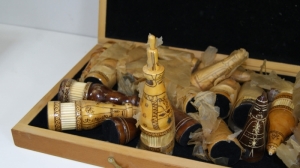
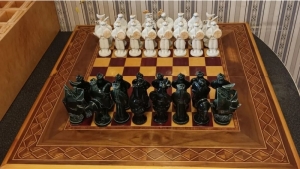
Pawn height 8.5 cm Diameter of the pawn base - 3.5 cm Height of the king - 14 cm The diameter of the king base is 3.5 cm Board size 50x50 Price in 1981 50 rubles 50 kopecks. ART P11
-
15000.00 $
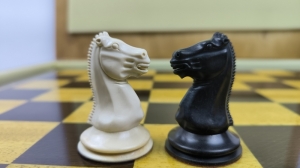
The white figures are made of mammoth bone. In order to eliminate the staining of figures with black paint, the manufacturer decided to use an equally luxurious material for black figures - ebony in its natural and natural form. Ebony is a dense black-brown hardwood that comes from several species of the genus Diospyros. This wood is used to make chess pieces because of its strength, fine texture and mirror shine when polished. It is noteworthy that ebony wood sinks in water due to its high density. Ebony is considered to be precious and one of the most expensive types of wood The sizes of the shapes: King: Height - 10.3cm Base diameter - 5 cm A pawn: Height - 5 cm Base diameter - 3.5 cm Horse: Height - 6 cm Base diameter - 4 cm Rook: Height - 5.7cm Base diameter - 4 cm Elephant: Height - 6.6cm Base diameter - 4 cm Queen: Height - 8.5 cm Base diameter - 4 cm Board size: 52.5x52.5x11 cm The size of the playing field is 46x46 cm The size of the game cage is 5.5 cm The size of the shipping case: 63x59x14 cm These chess sets represent exactly the first model of the Staunton design of 1849. Staunton is a standard chess piece design created in the mid-19th century by Nathaniel Cook. This chess design got its name in honor of the famous English chess player Howard Staunton, who lived in the 19th century. The FIDE organization recommends Staunton chess for competitions held under its auspices. Until the middle of the 19th century, every country in Europe where chess tournaments were held had its own traditional standards for chess piece designs (Barleycorn, Calver, Selenus, St. George, Lund, Regence, etc.), which was undoubtedly very inconvenient during international competitions. Nathaniel Cook registered Staunton chess on March 1, 1849, however, in the same year the rights to this chess design passed to John Jacquet, who was the brother of Nathaniel Cook's wife and owned John Jaques of London, specializing in the manufacture and sale of sports equipment. The first set of chess designed by Staunton went on sale on September 8, 1849. At the same time, the periodical "The Illustrated London News", well-known at that time, printed an advertising article stating that Howard Staunton himself was one of the creators of this wonderful design of chess pieces. There is a version that the famous chess player wrote the article, as he subsequently actively contributed to the promotion of this chess set on the market. Howard Staunton's facsimile signature was displayed under the cover of the chessboards of the first Staynton sets, and one of his books was attached to the set for free as an advertisement. However, there is an assumption that the real author of the Staunton design is John Jacquet, and Cook only registered it for himself and subsequently attracted Howard Staunton to promote chess on the market. In 1940, German aircraft bombed the John Jaques of London factory. Historical sketches and drawings of Staunton chess pieces burned down in the fire. The first Staunton chess sets were carved from ivory or hardwoods (for example, boxwood). Later, they began to be created from mammoth tusks and various valuable tree species such as wenge, ebony, boxwood, etc.
-
3250.00 $
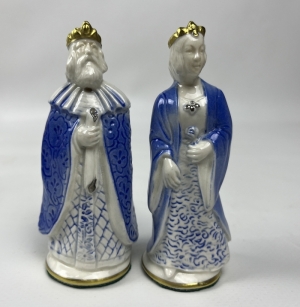
The wooden box has scuffs from time to time. The figures are in perfect condition. Overglaze polychrome painting, gilding. The brand of the Carl Enns porcelain manufactory. Chess "Lumberjacks". Zitzendorf. The same set is available at the Porcelain Chess Museum in St. Petersburg. Germany, 20th century. The first attempts to create porcelain production in Zitzendorf date back to the second half of the 18th century. In the 20th century, the manufactory underwent many difficulties and transformations and ceased to exist in 2012. The chivalrous theme The height of the king is 11 cm. The diameter of the base of the king is 4 cm Pawn height - 8.1 cm The diameter of the pawn base is 2.8 The size of the casket is 51.5 x 24.5 x 13.9 cm Art P14
-
2482.76 $
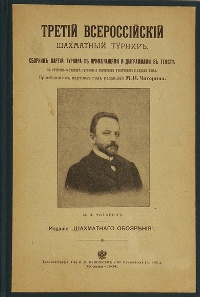
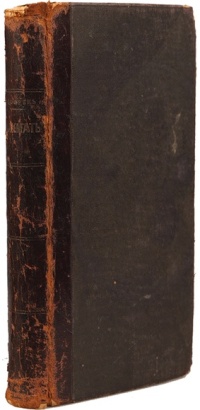
In possession of a calico cover with an illustrated publishing cover pasted over the front cover. In a good condition. All the games of the tournament (Kiev, 1903, I place - Chigorin) with the descriptions of the tours. Introductory article with the program and the conditions of the tournament. The last tournament is the triumph of the founder of the national chess school, one of the strongest chess players of the world of his time, Mikhail Ivanovich Chigorin (1850-1908). Rarity! The idea of organizing the 3rd All-Russian Chess Tournament appeared in the Kiev Chess Society in the summer of 1901, shortly after the 2nd All-Russia tournament, which took place in Moscow (in the Moscow Chess Club) from December 26, 1900 to January 14, 1901. But only that the founded Kiev Chess Society did not immediately reach the opportunity to begin the actual organization of the tournament, and the thought of it, barely appearing, subsided. However, after a year & mdash; in the summer of 1902 & mdash; the idea of the tournament was revived again in the Kiev Society and this time with more solid chances for its implementation. Adopted sympathetically everywhere, the idea of the tournament in Kiev found warm support in the Chess Review. This work with joint forces went so successfully that by the end of 1902 it became clear that there was a full opportunity to organize a tournament. PHOTO PHOTO
-
4347.83 $
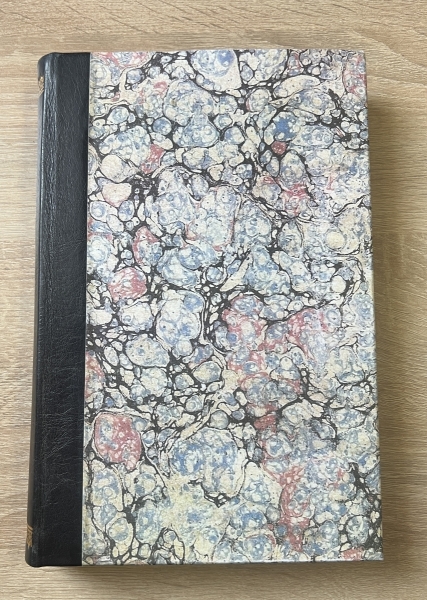
The first two annual sets of the famous Chigorin magazine & quot; Chess Piece & quot; 1876-1877 This magazine was published from 1876 to 1881. These are two sets of the first two years of publication in one book. & nbsp; 1876: 1-4 of 4 journals 1877: 1-12 of 12 journals
-
Convoy with the signature of M. Chigorin. Chess. Chess Review. Chess Game Basics Art - (eb) Chigorin
5237.54 $
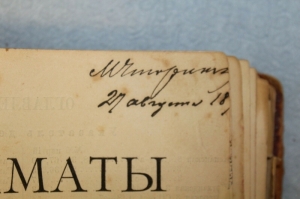
The convoy is signed by Mikhail Chigorin. 1. Chess. 1891 issue: 1-32 Edited by M. Chigorin. Full annual set 2. Monthly magazine & quot; Chess Review & quot; 1893 No. 26-29 August-October 3. Capablanca. & quot; Chess Game Basics & rdquo; Published: Leningrad 1924 & nbsp; & nbsp;
-
518.21 $
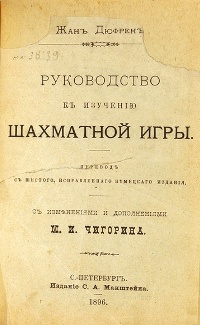
In a modern composite proprietary binding. In a good condition. Annexes to the management of the chess game Jean Dufren. I. Additions of M.I. Chigorin. Ii. Selected games played at the international chess tournaments of Nuremberg in 1896 and Budapest of the same year, and at the Berlin International Chess Congress of 1897 / Notes by Z. Tarrasch. Jean Dufren - a famous German chess master and chess writer, a student of the uncrowned world champion Adolf Andersen. This book was actually created in collaboration with one of the strongest chess players in the world of his time, Mikhail Ivanovich Chigorin (1850-1908). Rarity. PHOTO PHOTO
-
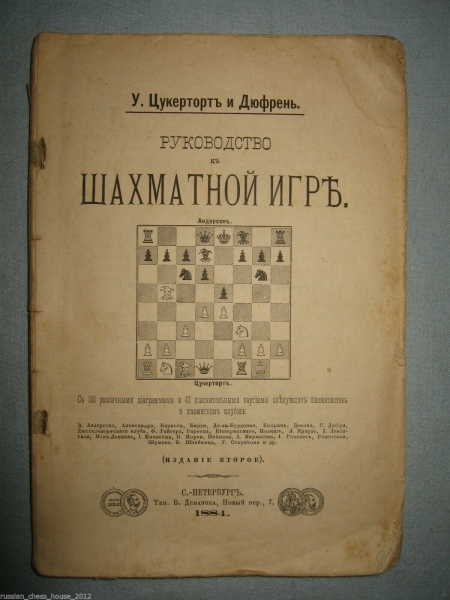
471.40 $
With 120 different diagrams and 42 explanatory games of the following chess players and chess clubs. Second edition St. Petersburg, V.Demakov Printing House, 1884 & nbsp; & nbsp; No binding Traces of fluid on the pages Small handwritten notes on the pages
-
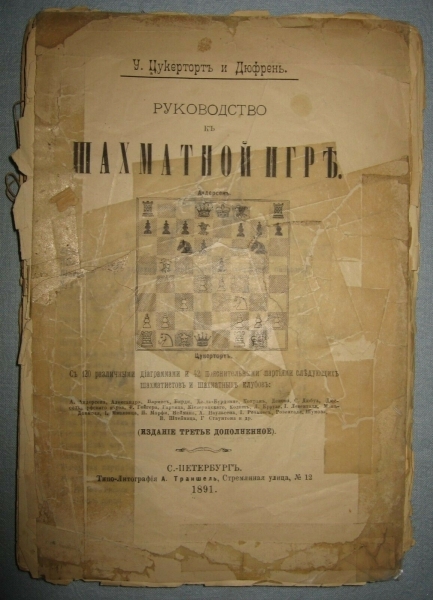
301.16 $
Publisher: V. Demakov printing house, St. Petersburg Condition: satisfactory. No cover: the book fell apart. Traces of fluid on the pages. Handwritten notes on the pages. The book pages are glued with tape. (See & nbsp; photo)
-
From the sixth German edition. No. 53 according to the Sakharov catalog.
.jpg)
.jpg)
.jpg)
.jpg)
.jpg)
.jpg)
-
 The life of a chess player in the system. Memories of the grandmaster
Author:
The life of a chess player in the system. Memories of the grandmaster
Author:
Averbah 45.00 $ -
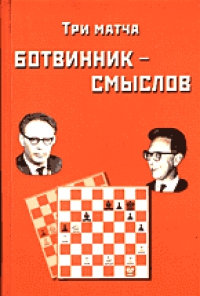 Три матча Ботвинник-Смыслов
Author:
Три матча Ботвинник-Смыслов
Author:
Botvinnik 45.00 $ -
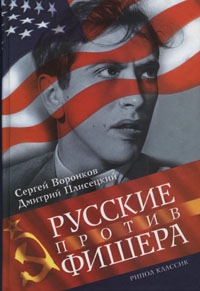 Russians vs Fisher
Author:
Russians vs Fisher
Author:
Voronkov 65.00 $ -
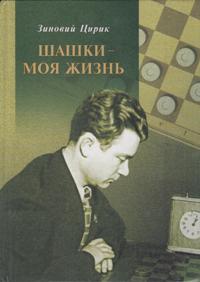 Checkers is my life
Author:
Checkers is my life
Author:
Ciric 87.50 $ -
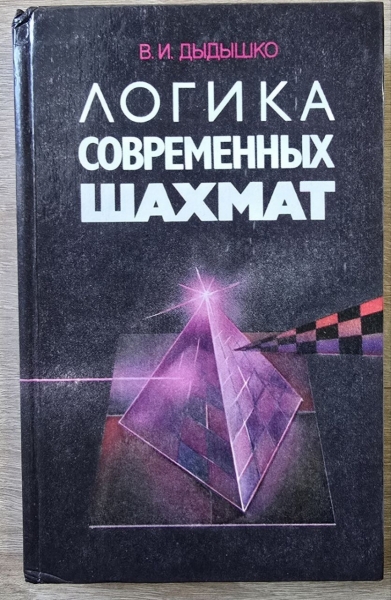 The logic of modern chess
Author:
The logic of modern chess
Author:
Dydyshko 72.50 $ -
 Siegbert Tarrasch. The Queen
Author:
Siegbert Tarrasch. The Queen
Author:
Tarrash 72.50 $ -
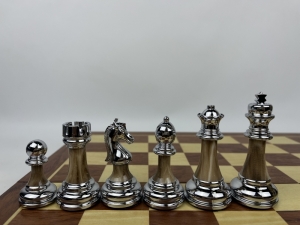 High quality acrylic metal heavy chess pieces with wooden board
202.50 $
High quality acrylic metal heavy chess pieces with wooden board
202.50 $
-
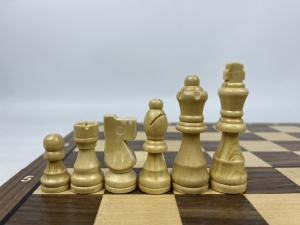 Wooden magnetic Staunton chess with a lock (silver)
56.25 $
Wooden magnetic Staunton chess with a lock (silver)
56.25 $
-
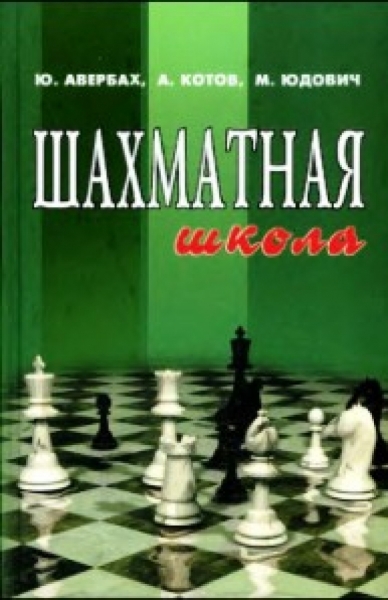 Chess school
Author:
Chess school
Author:
Averbah 15.00 $ -
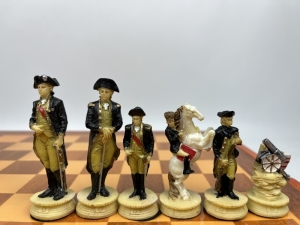 The chess set of The Chessmen. US war - Great Britain
325.00 $
The chess set of The Chessmen. US war - Great Britain
325.00 $