menu
top sales
  • Author:
    Franco

    The book by grandmaster and experienced chess coach Zenon Franco includes 36 instructive attacking games and is divided into four chapters - the king in the center, one-sided castling, opposite-sided castling, and attack-defense-counterattack. Before each game, the opponents are introduced, and a brief description of the events that took place in it is given. Based on the results of the struggle in the game, lessons that are useful to learn from what has been read are listed in a concise form. The book is not overloaded with variations, the emphasis is on detailed explanations in the "move by move" format, which creates an ideal platform for studying chess. At the "support" points of each game, the reader is offered test questions, which helps both the practical study of key chess techniques and the reliable assimilation of the acquired knowledge. Questions and answers involve the reader in the learning process and help him track the growth of his chess strength. For a wide range of chess fans.

    19.00 $
  • Author:
    Kostrov

    Hundreds of thousands of novice chess players have held in their hands the solution books of “1000 chess problems” for the 1st, 2nd and 3rd years of study. These collections became winners of the “Chess Vseobuch of Russia” competition. We decided to combine our three books into one so that the future grandmaster would have more opportunities for improvement and choice of material. It will also be easier for students and coaches to regulate the speed of the material. In the first parts of our book, novice chess players will get acquainted with all possible types of checkmates. Then, future grandmasters will learn to deliver magnificent double blows with a queen and a knight, promote a pawn to a queen. Studying according to this solution book, you will also master the pin, learn to cover yourself from the enemy's pieces, block the enemy's forces, destroy the most reliable fortresses, distract and entice his royal majesty and much more. Work with the book as with a textbook, and do not forget to write down the solutions under each diagram! The correct solutions are at the end of the book. For the widest range of chess fans.

    15.75 $
  • Author:
    Fine

    In the vast ocean of chess literature there are relatively few books about the endgame, and only a few of them can be considered true chess classics. And the most outstanding among the classics — Reuben Fine's book "Basic Chess Endings". Reuben Fine (1914−1993) was for a long time one of the best chess players in the world. As an author, Fine showed himself to be an excellent analyst who understood the full depth and peculiarities of the endgame. Having studied various types of standard positions, Fine established useful rules for practical play and proved himself to be an experienced teacher who, using skillfully chosen examples, was able to teach the reader all the necessary lessons and introduce him to the basic ideas of the endgame. Many generations of chess players in different countries of the world keep copies of “Basic Chess Endings”. For example, Mikhail Botvinnik considered Fine's work the most worthy of all that had ever been written on endgame theory.

    35.00 $
  • Author:
    Bezgodov

    The youngest first–grader in the USSR, the world champion among young men, a participant in the candidates tournament at the age of 19 - Boris Spassky's rise was rapid. And then fate gave the brilliant chess player a test of strength: he stumbled twice at the decisive moment and remained beyond the threshold of interzonal tournaments ... Only ten years after his first great success, Spassky managed to pass all the qualifying tests and earn the right to a match for the crown, but he failed to defeat the Iron Tigran Petrosian the first time. It took three more years of super–efforts: by Sisyphus he rose again to the foot of Olympus and did not miss a second chance - in 1969 he became the Tenth king of chess! An essay about the life of Boris Vasilyevich and his sporting path full of ups and downs was written by Dmitry Oleynikov, Candidate of Historical Sciences, curator of the Chess Museum of the Chess Federation of Russia. 70 beautiful and instructive games of Spassky were commented on by the champion of Russia in 1993, the famous author and theorist grandmaster Alexey Bezgodov, as well as grandmaster Dmitry Kryakvin and FIDE master Steve Giddins. The preface was written by the 14th world champion Vladimir Kramnik. For a wide range of chess fans.

    21.67 $
  • Author:
    Eive

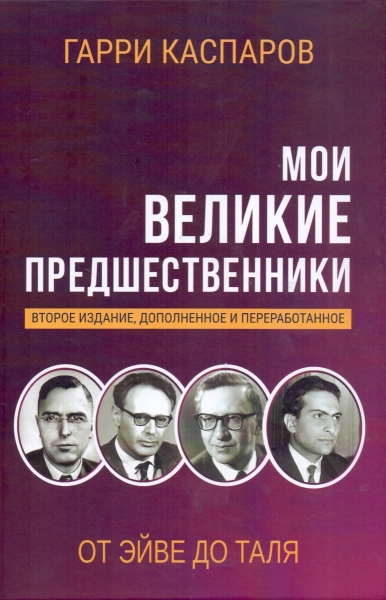
    The corpus of this textbook includes two significant works by the world chess champion, scientist and prominent teacher Max Euwe — "Self‑help chess game", created in collaboration with G. Den-Hertog, and "Chess Lessons". The first work is designed for beginners, the second for more experienced chess players. The book is a real chess tutorial in the true sense of the word. This is expressed not only in the appropriate distribution of the material and the method of presentation, designed to awaken the initiative of the student, but also in numerous practical exercises offered to the reader after explaining each new concept or technique.The textbook primarily attracts the methodology of presentation of the material, the principles of which will be useful for coaches and teachers of chess sections and circles. For a wide range of chess fans.

    25.00 $
  • Author:
    Blokh

    The answer book of an international grandmaster and an experienced coach (among whose students is A. Grischuk) Bloch's Maxim contains over 1200 combinations from practical games and specially compiled examples. All tasks are characterized by intense struggle, in which the goal is achieved by single moves. The book is intended for both young and adult amateurs, and for masters. The arrangement of examples by topic allows you to use the book not only as a task book, but also as a textbook. Of particular interest are over two hundred specially compiled by the author overstressed positions in which white wins the only way during the course of white, and black wins during the course of black. These examples, as well as over 50 fragments from the parties of the author and his students, are published for the first time.

    21.67 $
  • Author:
    Kalinichenko

    The vast majority of opening guides are written for adult readers. This book is also devoted to the theory but it is junior. The structure of the book is simple and attractive: openings are examined using examples from actual games, each of which is presented in the form of a lesson with its own name. Several such lessons form an opening theme, and the examination of each theme concludes with exercises. In each opening, attention is drawn to its characteristic tactical and strategic ideas of combinations for independent solution strictly corresponds to the opening theme. Written in clear and easy language, the book is furnished with a large number of diagrams. Colored explanatory arrows on the diagrams and the selection of individual pages with a colored background make the book easier to understand. Regular work solve two problems: deepen the student's knowledge and develop his tactical vision, thus improving his skill and results.

    28.80 $
  • Author:
    Chandler

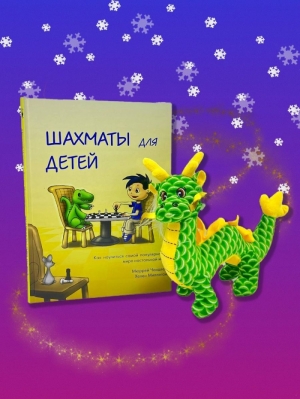
    The set consists of the book Chandler M. Chess for Children (gift edition) and the hero of this book - Marty the dragon (Dragon is the symbol of 2024). LEARN CHESS with the Very Big Dragon Marty! Using this entertaining book, your child will quickly and easily learn to play chess – the world's most popular strategy game that develops logical thinking. The rules are explained clearly and clearly, step by step, from scratch. The lessons reinforce the fun conversations between the boy Petya and his favorite dragon Marty, who calls himself the Very Big Dragon. In many countries, chess is recognized as a useful means of developing creative thinking in children. Although they are considered a complex and even mysterious game, the rules are quite simple. It doesn't take long to understand how the pieces move, and even a five-year-old child can enjoy chess. And children really like to beat their friends and relatives! Enlarged format (210x290 mm) The cute green dragon, the symbol of 2024, symbolizing strength, generosity, courage and endurance, is the hero of the book, which explains the rules of the chess game. The dragon has a suction cup, and you can use it to hang the toy on a glossy surface, on a window or refrigerator. Made of soft fabric,  has a height of 20 cm and a length of 26 cm.

    27.33 $
  • Author:
    Vysotsky

    20.00 $
  • Author:
    Golenishchev

    Like other titles in the Training Program for Chess Players series, this volume is both an excellent textbook for independent study and a powerful training aid for chess coaches. In the view of many experts, no better work of this kind has ever been written. coach and Master of Sport. Golenishchev's programs are still considered. critically important and are successfully employed in chess schools. His teaching methods remain popular in Russia and around the world. Supervised by Editor-in-Chief and former Karpov, this new edition of Golenishchev's classic work is updated to include important games from the recent high-level chess competitions, reflecting modern approaches to the game. OPENING Fragment 1 OPENING Fragment 2

    30.00 $
  • more

Antiques VIP

  • book

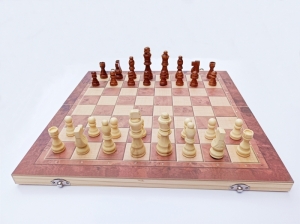
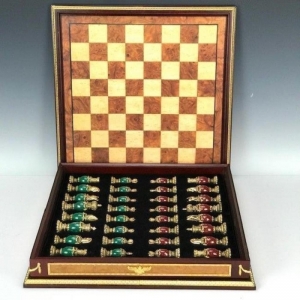
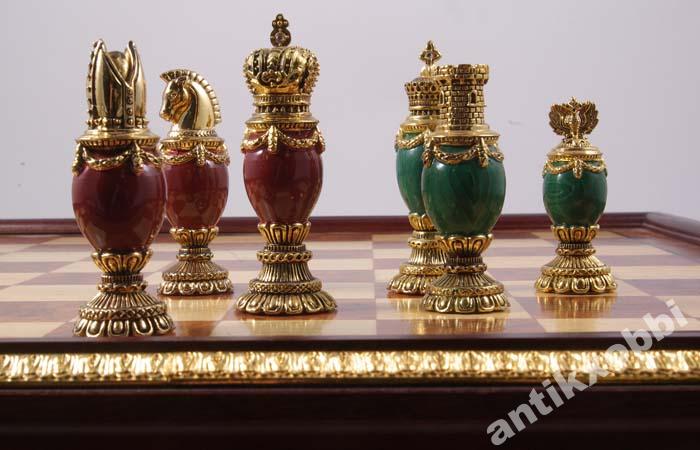
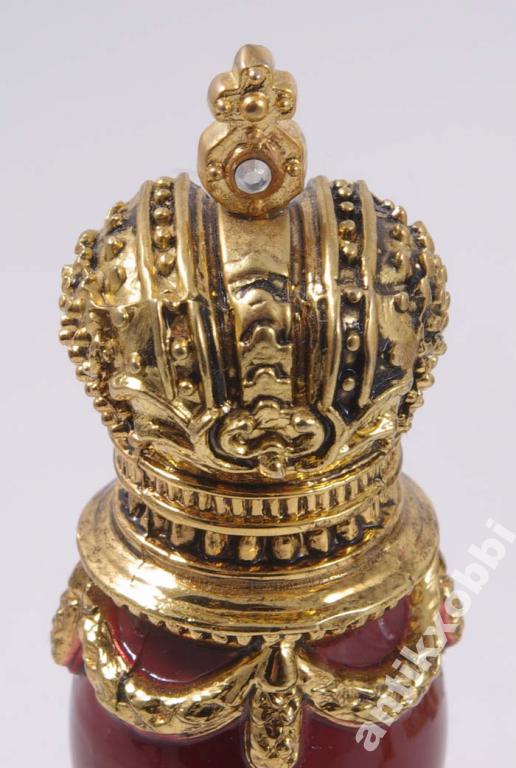
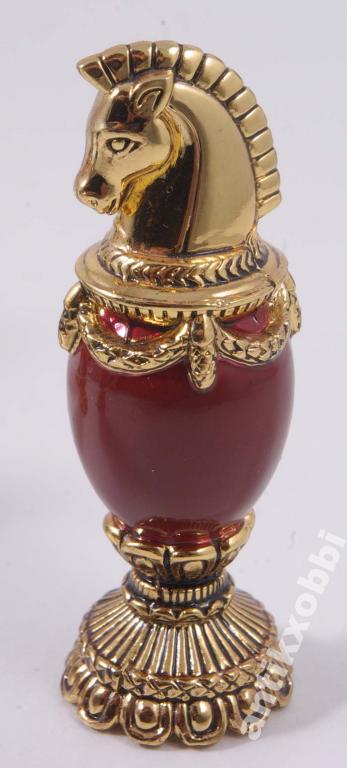
    France, Faberge, mahogany, cherry, metal, chrysoprase, agate, gilding 24k, pawn height - 6 cm, king height - 8.5 cm, box - 42х42х8 cm, middle of the 20th century. The product is stored in the original box with the logo "Faberge" ("House of Faberge") in the form of an embossed gold emblem of the Russian Empire; accompanied by a certificate of authenticity "Faberge".  The design of the chess field is based on the refined and expensive combination of red and cherry wood, which gives the product a special chic and emphasizes the noble style.  Figures from chrysoprase and agate are covered with gilding. Molded metal elements of the figures are decorated with spectacular embossed ornaments.  Chess "Faberge" - this is a true work of art, which embodied a unique experience and knowledge, the highest skill of execution, impeccable style, attention to every detail and the magnificent quality of the Fabergé house!  A unique gift for a man - tactics and a strategist!  A superbly executed set of chess will complement the interior of any cabinet in an original way, adding respectability, refinement and nobility to it! Photo1 Photo2 Photo3 Photo4 Photo5 Photo6 Photo7

  • book

    "Kuznetsovsky porcelain". The circulation was only a few pieces! Painting "salt". The size of the board is 66х66 cm The cell size is 8x8 cm The height of the king is 17 cm Wooden plank. SEE LARGE PHOTOS: PHOTO PHOTOS PHOTO p>

  • book

    4137.94 $

    RUB

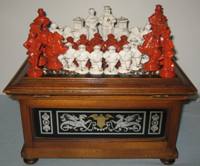
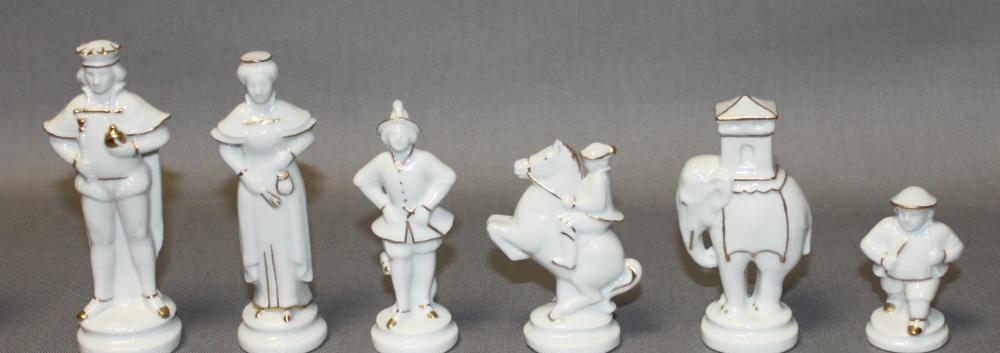
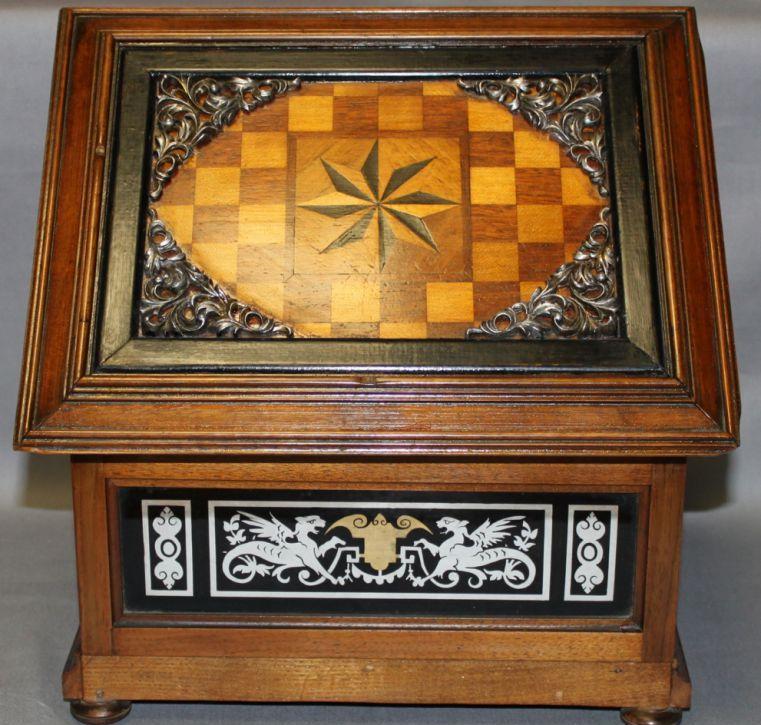
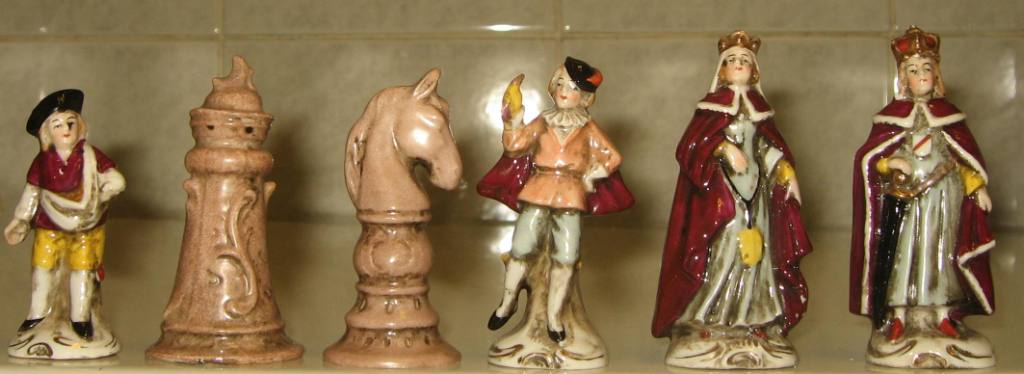
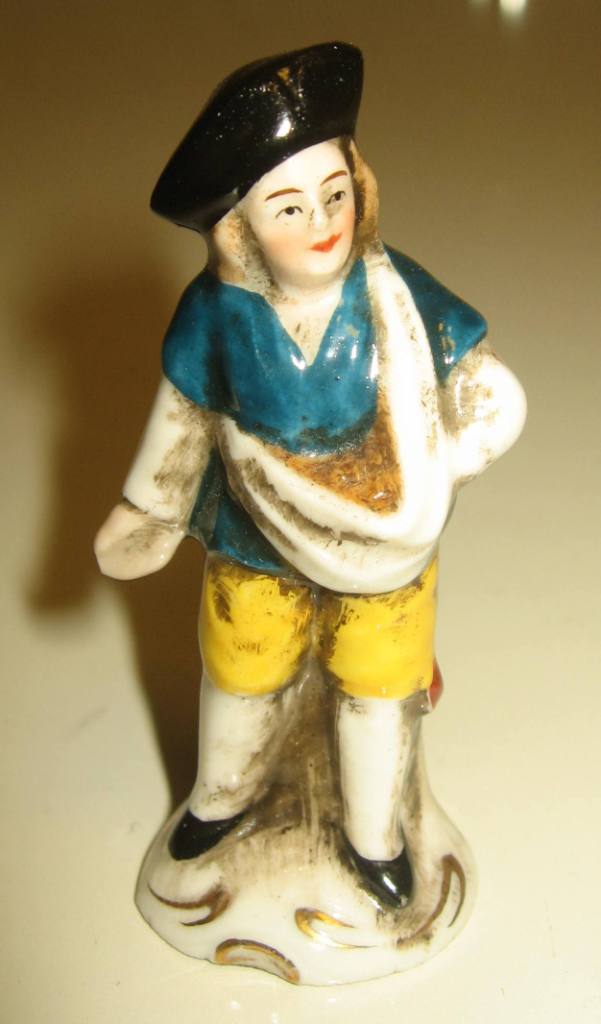
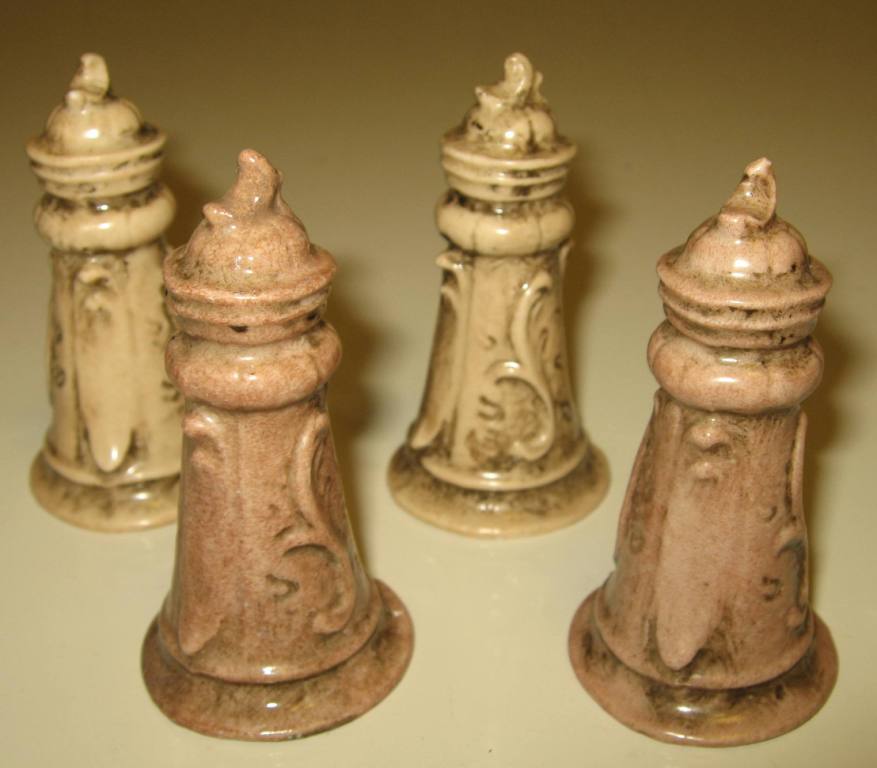
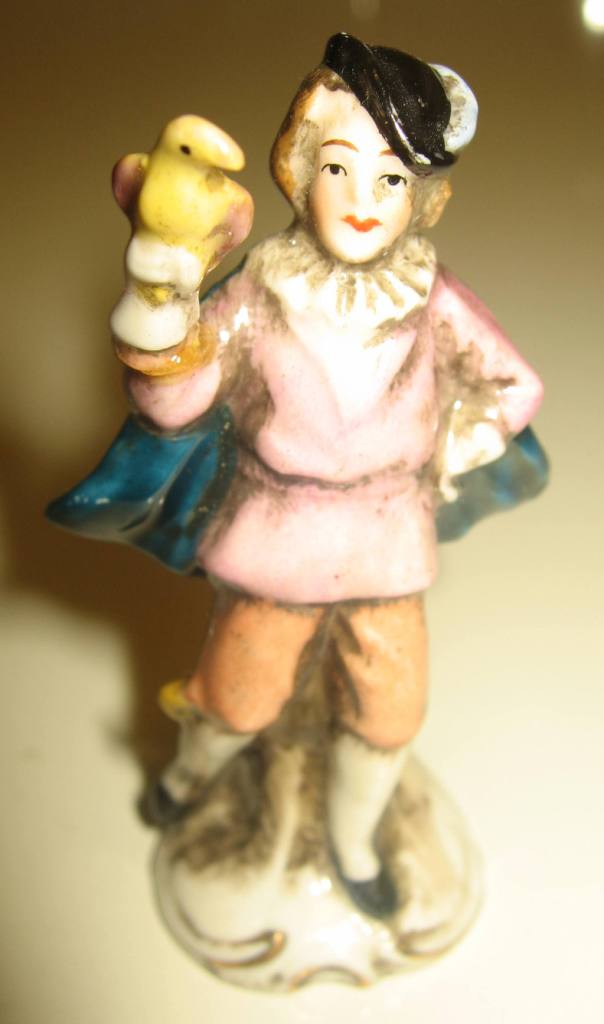
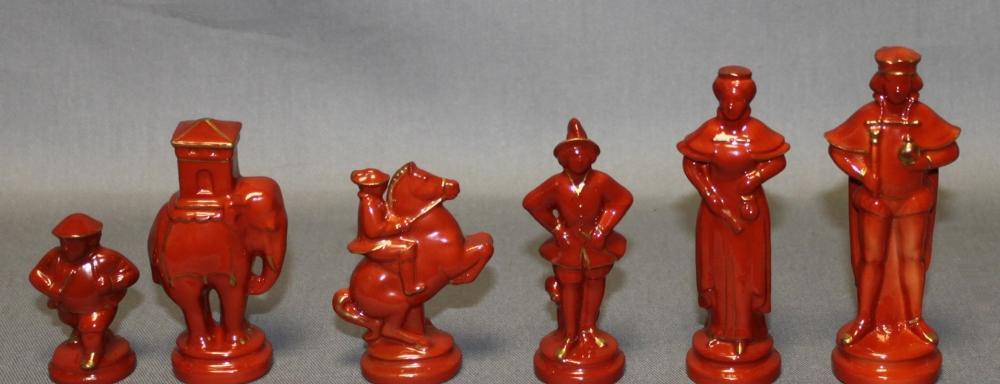
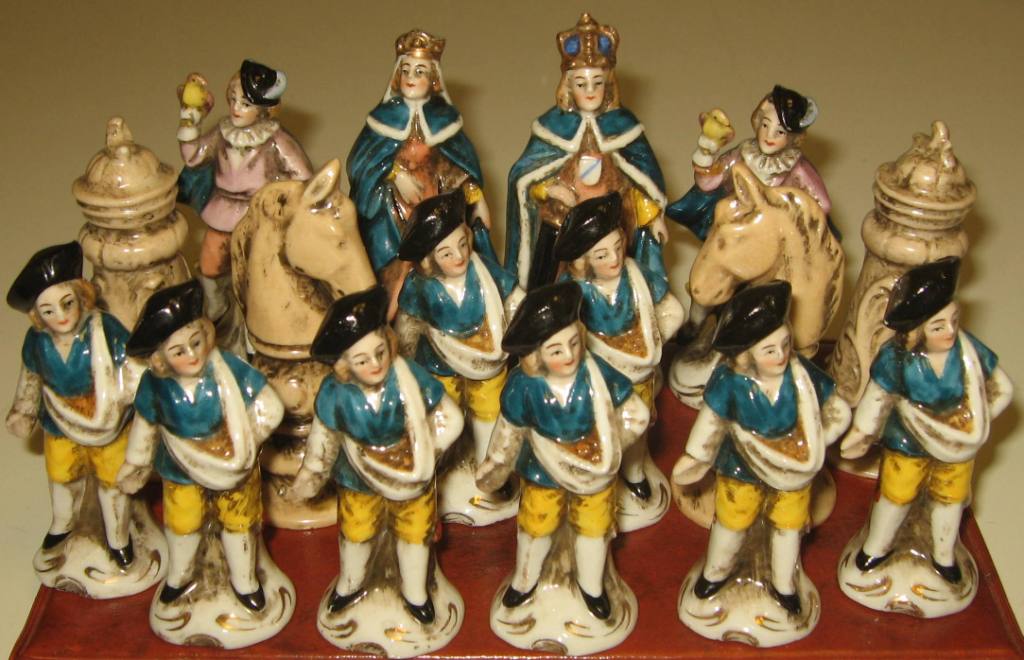
    Germany, production of the mid-20th century. Chess pieces made of porcelain in the old style. Artistic casket for storage. The figures are red-brown and white with golden decorative lines. The height of the king is 9.7 cm; pawn-4.8 cm. A complete set of figures from porcelain in the historical style (medieval drawings). On the casket ornaments from various materials. Above checkered pattern in checkerboard pattern. Extremely rare.  Chess from the tusk of a mammoth  Chess from the tusk of a mammoth  Chess from the tusk of a mammoth

  • book

    3103.45 $

    RUB

    The height of the king is 8.5 cm Base diameter 3.3  Chess Chess  Chess Chess Chess  Chess Chess  Chess Chess < a data-title = "Chess" data-lightbox = "image" href = "http://www.chesm.ru/upload/shop5/11.JPG">  Chess  Chess

  • book

    261.72 $

    RUB

    The height of the king is 11.5 cm The height of the pawn is 5 cm Diameter of the base 3.5 cm Board size 59x59 cm The size of the playing field 42x42 cm ART-P5

  • book

    1220.69 $

    RUB

    Workshop A.E. Karpov. There is a certificate with autographed A.E. Karpov. The products are made of boxwood and oak. The register number is D16. The height of the king is 8 cm. The size is 44x44 cm.   It's very Russian chess. Each of the figures - a kind of stylized Vanka-Vstanka, personifying features of a national character - inflexibility and perseverance. The favorite toy of the kids turned out to be very handy on the chess board - it never falls (for this, a personal weight stabilizer was developed for each figure), so that even the defeated king will never be defeated. All the figures of the "Invincible" are made by hand from the most exotic and valuable species of wood. Noble materials played with new colors on the chessboard. The official analogue costs 65.000r: http://www.karpovchess.ru/index-category-20-open-20-id-66.html   PHOTO PHOTO PHOTO PHOTO PHOTO PHOTO PHOTO PHOTO PHOTO

  • book

    3413.80 $

    RUB

    The size of the board is 36x36 cm, The height of the king is 10 cm.

  • book

    15000.00 $

    RUB

    The white figures are made of mammoth bone. In order to eliminate the staining of figures with black paint, the manufacturer decided to use an equally luxurious material for black figures - ebony in its natural and natural form.  Ebony is a dense black-brown hardwood that comes from several species of the genus Diospyros. This wood is used to make chess pieces because of its strength, fine texture and mirror shine when polished. It is noteworthy that ebony wood sinks in water due to its high density. Ebony is considered to be precious and one of the most expensive types of wood The sizes of the shapes: King: Height - 10.3cm Base diameter - 5 cm A pawn: Height - 5 cm Base diameter - 3.5 cm Horse: Height - 6 cm Base diameter - 4 cm Rook: Height - 5.7cm Base diameter - 4 cm Elephant: Height - 6.6cm Base diameter - 4 cm Queen: Height - 8.5 cm Base diameter - 4 cm Board size: 52.5x52.5x11 cm The size of the playing field is 46x46 cm The size of the game cage is 5.5 cm The size of the shipping case: 63x59x14 cm These chess sets represent exactly the first model of the Staunton design of 1849. Staunton is a standard chess piece design created in the mid-19th century by Nathaniel Cook. This chess design got its name in honor of the famous English chess player Howard Staunton, who lived in the 19th century. The FIDE organization recommends Staunton chess for competitions held under its auspices. Until the middle of the 19th century, every country in Europe where chess tournaments were held had its own traditional standards for chess piece designs (Barleycorn, Calver, Selenus, St. George, Lund, Regence, etc.), which was undoubtedly very inconvenient during international competitions. Nathaniel Cook registered Staunton chess on March 1, 1849, however, in the same year the rights to this chess design passed to John Jacquet, who was the brother of Nathaniel Cook's wife and owned John Jaques of London, specializing in the manufacture and sale of sports equipment. The first set of chess designed by Staunton went on sale on September 8, 1849. At the same time, the periodical "The Illustrated London News", well-known at that time, printed an advertising article stating that Howard Staunton himself was one of the creators of this wonderful design of chess pieces. There is a version that the famous chess player wrote the article, as he subsequently actively contributed to the promotion of this chess set on the market. Howard Staunton's facsimile signature was displayed under the cover of the chessboards of the first Staynton sets, and one of his books was attached to the set for free as an advertisement. However, there is an assumption that the real author of the Staunton design is John Jacquet, and Cook only registered it for himself and subsequently attracted Howard Staunton to promote chess on the market. In 1940, German aircraft bombed the John Jaques of London factory. Historical sketches and drawings of Staunton chess pieces burned down in the fire. The first Staunton chess sets were carved from ivory or hardwoods (for example, boxwood). Later, they began to be created from mammoth tusks and various valuable tree species such as wenge, ebony, boxwood, etc.

  • book

    The size of the field is 13x13 cm. The height of the king is 3 cm. PHOTO PHOTO PHOTO

  • book

    The painting was written by a wonderful Russian artist Galina Ivanovna Satonina. She was the repeated champion of Tataria in chess, and her paintings, which have won all-Union fame, depict the wonderful chess life of people, figures, fantastic positions, emotions that can not be expressed in words, but in her works they are easily recognizable. Exhibitions of her works were demonstrated in Moscow, Leningrad, Kiev, Voronezh and other cities of our country. Cardboard, oil, nabryzg. http://www.kazved.ru/article/20647.aspx http://www.64.ru/old/2000/11/nov23.html

  • book

    827.59 $

    RUB

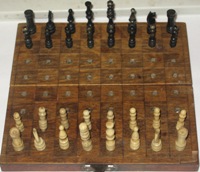
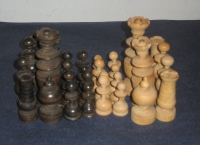
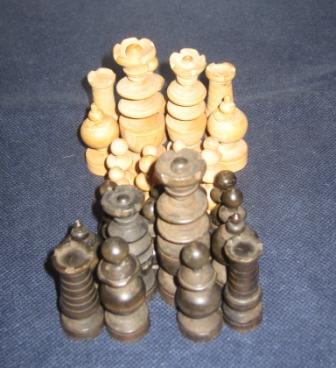
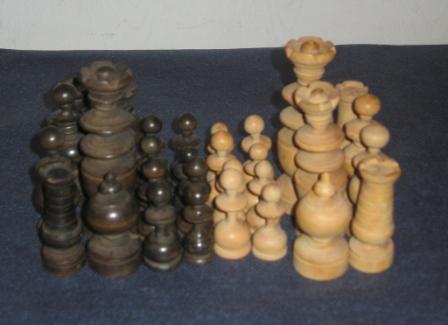
    Chessmen. Boxwood (boox wood). France. XIX century. The height of the pieces: pawns - 35 mm, king - 75 mm. Full set (32 pieces). Photo1 Photo2

  • book

    Art w. King height - 9 cm. Fine handmade. PHOTO PHOTO PHOTO