menu
top sales
  • Author:
    Eive

    The corpus of this textbook includes two significant works by the world chess champion, scientist and prominent teacher Max Euwe — "Self‑help chess game", created in collaboration with G. Den-Hertog, and "Chess Lessons". The first work is designed for beginners, the second for more experienced chess players. The book is a real chess tutorial in the true sense of the word. This is expressed not only in the appropriate distribution of the material and the method of presentation, designed to awaken the initiative of the student, but also in numerous practical exercises offered to the reader after explaining each new concept or technique.The textbook primarily attracts the methodology of presentation of the material, the principles of which will be useful for coaches and teachers of chess sections and circles. For a wide range of chess fans.

    25.00 $
  • Author:
    Galkin

    The book by grandmaster and experienced coach Alexander Galkin is dedicated to the strongest piece on the chessboard – to the queen. Using the example of episodes from games of modern grandmasters (the vast majority of games date back to 2020-2023) and his own grandmaster practice, the author tries to generalize, and in some places even clarify the methodology for understanding and playing queen endings, as well as other types of endgames with the presence of queens ) On the desk. The book presents various ratios of material – “queen against queen”, “queen and minor piece against queen and minor piece”, “queen and rook against queen and rook”, “queen against two rooks”, “queen against rook and pawns”, “ queen against a rook and a minor piece”, “two queens against two queens” – practically the entire spectrum of encountered endgames of this type. The material is structured in such a way that the reader can get maximum benefit from studying the examples of queen endings and its other derivatives offered by the author. The book is aimed at advanced chess players, is useful for coaches and can be recommended to a wide range of chess fans.

    18.33 $
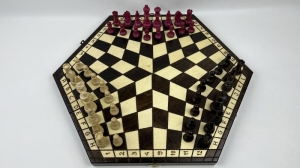
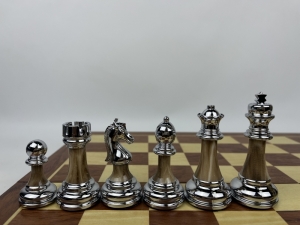
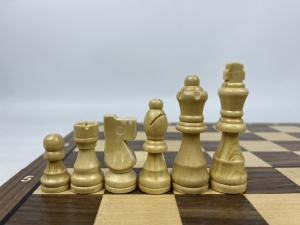
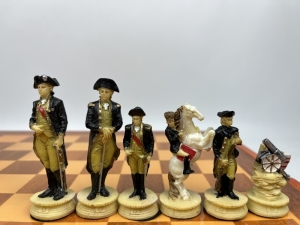
  • The size of the board when folded is 46x23x5 cm. The size of the board when unfolded is 35x35 cm. Cage size is 4.6x4.6 cm  The height of the king is 10 cm. The diameter of the base is 3 cm. Pawn height 5.5 cm. Base diameter 2.8 cm. Weight 1380 g. ART 123 Manufacturer Poland

    183.15 $
  • Magnetic road chess: folding board-case made of artificial leather, tablet-figures with a convex image. Wallet size 19x22 cm. The playing field is 15.5 x 15.5 cm. Cell 2x2 cm.

    51.72 $
  • The size of the board when folded is 35x17.5 cm. The size of the board when unfolded is 35x35 cm. Cage size is 3x3 cm  King height 6.6 cm. Base diameter 2.2 cm. Pawn height 3.1 cm. Base diameter 2 cm. Backgammon - checker 2.1 cm. Weight 830 g. Includes backgammon chips and dice Chess board and backgammon chips can be used to play checkers Manufacturer Poland

    148.00 $
  • Author:
    Galkin

    The book by grandmaster and experienced coach Alexander Galkin is  the final link in a series of publications by the author, directed  to study the classical endgame using examples of modern games   grandmasters. This time the subject of the study – light piece endgames. Clarification of the methodology for working on this stage of the game, as well as the main features and methods of playing such endings. Examples  taken from the practice of modern grandmasters and dated back to 2020-2023. The author offers the reader the most recent and unique information. The material is structured in such a way that the reader can get the maximum  benefit from studying the examples offered by the author  queen endings and its  other derivatives. The book is aimed at advanced chess players, is useful for coaches and can be recommended to a wide range of chess fans

    18.33 $
  • Author:
    Franco

    In his new book, grandmaster Zenon Franco deeply analyzes the 69 instructive victories of the 11th world champion Robert Fischer. The book is not overloaded with options, the emphasis – with detailed explanations in a move-by-move style, creating an ideal platform for learning chess. In the "reference" At points in each game, the reader is offered test questions, which helps both the practical study of key techniques of the chess game and the reliable assimilation of acquired knowledge. Questions and answers engage the reader in the learning process and help him track his growth in chess strength. The appendix provides a critical analysis of the unsatisfactory translation of Robert Fisher's famous book “My 60 Memorable Games.”

    23.33 $
  • Author:
    Getmanchuk

    16.67 $
  • Author:
    Chernyshov

    The authors continue to study typical opening and middlegame positions. Royal Fortress No. 2 has pawns on squares f7, g6, h7 (or f2, g3, h2), and they are usually joined by another defender – bishop on g7 (g2). This formation is called fianchetto, it is found in many popular openings, such as the Catalan Opening, King's Indian Defense, Grunfeld Defense and a number of others.  The authors analyze in detail the techniques of attack, defense and counterattack. Most examples – from the creativity of modern chess players (for example, a separate chapter is dedicated to the strongest Russian grandmaster Ian Nepomniachtchi); they are complemented by parts that have become a classical heritage. The book contains about 300 positions for independent solution, so it is not only a textbook, but also a solid problem book. Grandmaster Konstantin Chernyshov, head of the Interregional Grandmaster School in Kostroma, and his daughter International Master Natalya Kareva – experienced coaches, whose students include grandmasters and masters, champions of Russia and Europe among juniors.  The book is addressed to young chess players and their mentors. 

    20.00 $
  • Author:
    Kalinichenko

    The vast majority of opening guides are written for adult readers. This book is also devoted to the theory but it is junior. The structure of the book is simple and attractive: openings are examined using examples from actual games, each of which is presented in the form of a lesson with its own name. Several such lessons form an opening theme, and the examination of each theme concludes with exercises. In each opening, attention is drawn to its characteristic tactical and strategic ideas of combinations for independent solution strictly corresponds to the opening theme. Written in clear and easy language, the book is furnished with a large number of diagrams. Colored explanatory arrows on the diagrams and the selection of individual pages with a colored background make the book easier to understand. Regular work solve two problems: deepen the student's knowledge and develop his tactical vision, thus improving his skill and results.

    28.80 $
  • more

miscellanea

  • book

    3.14 $

    RUB

    The official text of the Chess Code of the USSR (1981), which sets out the rules of chess games, the preparation and conduct of competitions, games by correspondence, chess composition with all the necessary applications (chess notation and recording of games; tables for playing members of the Society of the Blind; Additions and changes to the Rules of a chess game for competitions in lightning speed; Rules of simultaneous play sessions.

  • book

    6.54 $

    RUB

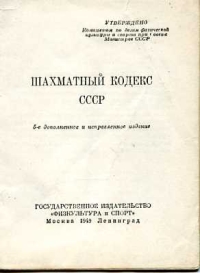
    The USSR Chess Code addresses the issues of judging and organizing competitions, the work of the judiciary. This edition has been harmonized in many matters with the rules of the game approved by FIDE (International Chess Federation). The publication is designed for organizers of competitions, coaches, judges, for a wide range of chess players.

  • book

    3.41 $

    RUB

    This edition has been brought into line with the rules of the game, approved by FIDE (in particular, the discrepancies between the rules adopted in the USSR and the international rules of the game by correspondence were eliminated). For the first time, rules on a chess composition are included in the USSR Chess Code.

  • book

    8.38 $

    RUB

    The USSR Chess Code addresses the issues of judging and organizing competitions, the work of the judiciary. This edition has been harmonized in many matters with the rules of the game approved by FIDE (International Chess Federation). The publication is designed for organizers of competitions, coaches, judges, for a wide range of chess players.

  • book

    3.14 $

    RUB

    The USSR Chess Code contains the Rules for the Game of Chess, the Rules of Competition, the Rules of the Game of Correspondence (correspondence competitions), the Rules of Chess Composition (composing and solving problems and etudes), as well as the appendices. In this edition of the Code, the rules of the game of chess fully comply with the rules of the International Chess Federation (FIDE), and the notes develop them, helping the judges to make the right decisions in those cases that are not specified in the articles of the code.

  • book

    16.55 $

    RUB

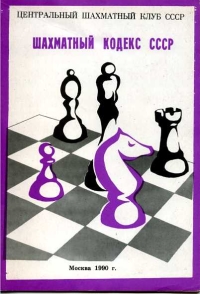
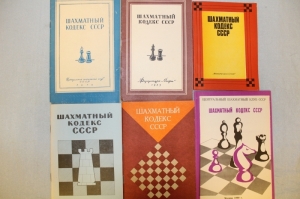
    6 editions from different years Chess Code of the USSR 1. 1953, Moscow, 32 pages 2. 1959, Moscow, 44. Edition 8 3. 1969, Moscow, 46 pages. Edition 9 4. 1978, Irkutsk, 64 pages. Edition10 5. 1981, Moscow, 66 pages. Edition 11 6. 1990, Moscow, 18 pages. Edition 12

  • book

    146.57 $

    RUB

  • book

    19.34 $

    RUB

    The reference book covering the entire content of chess.

  • book

    25.00 $

    RUB

    For the first time in the history of Russian literature, a chess encyclopedia created by two well-known Russian chess historians and writers Isaac and Vladimir Linder is offered to the attention of readers. Combining the reference and encyclopedic principle with liveliness of presentation, the authors sought to present this ancient game as a cultural field that has become one of the phenomena of modern civilization. The book contains many illustrations from the personal archives of the authors and is intended for a wide range of readers.

  • book

    18.20 $

    RUB

    From the history of chess competitions, mainly to the world championship.