menu
top sales
  • Author:
    Zhuravlev

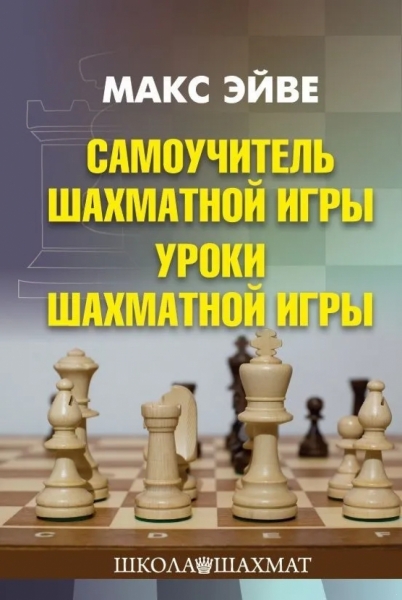
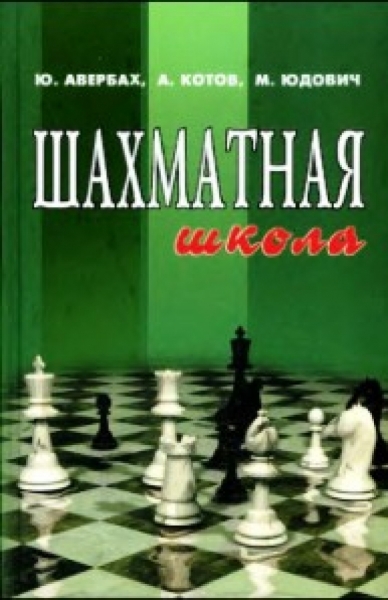
    This tutorial is addressed to those who want to learn to play chess on their own and improve further. The lesson-based method of presentation, as well as numerous exercises, contribute to the consistent assimilation of the rules and laws that form the basis of the chess game. The book contains extensive educational material, which is presented to the reader in accordance with modern pedagogical principles. The purpose of this manual is to train chess players of the III category (rating up to 1800). The textbook can also be used for classes in groups - it covers the material of existing programs of the first year of study in children's and youth chess schools.

    23.33 $
  • Author:
    Chernyshov

    The authors continue to study typical opening and middlegame positions. Royal Fortress No. 2 has pawns on squares f7, g6, h7 (or f2, g3, h2), and they are usually joined by another defender – bishop on g7 (g2). This formation is called fianchetto, it is found in many popular openings, such as the Catalan Opening, King's Indian Defense, Grunfeld Defense and a number of others.  The authors analyze in detail the techniques of attack, defense and counterattack. Most examples – from the creativity of modern chess players (for example, a separate chapter is dedicated to the strongest Russian grandmaster Ian Nepomniachtchi); they are complemented by parts that have become a classical heritage. The book contains about 300 positions for independent solution, so it is not only a textbook, but also a solid problem book. Grandmaster Konstantin Chernyshov, head of the Interregional Grandmaster School in Kostroma, and his daughter International Master Natalya Kareva – experienced coaches, whose students include grandmasters and masters, champions of Russia and Europe among juniors.  The book is addressed to young chess players and their mentors. 

    20.00 $
  • Author:
    Chandler

    The set consists of the book Chandler M. Chess for Children (gift edition) and the hero of this book - Marty the dragon (Dragon is the symbol of 2024). LEARN CHESS with the Very Big Dragon Marty! Using this entertaining book, your child will quickly and easily learn to play chess – the world's most popular strategy game that develops logical thinking. The rules are explained clearly and clearly, step by step, from scratch. The lessons reinforce the fun conversations between the boy Petya and his favorite dragon Marty, who calls himself the Very Big Dragon. In many countries, chess is recognized as a useful means of developing creative thinking in children. Although they are considered a complex and even mysterious game, the rules are quite simple. It doesn't take long to understand how the pieces move, and even a five-year-old child can enjoy chess. And children really like to beat their friends and relatives! Enlarged format (210x290 mm) The cute green dragon, the symbol of 2024, symbolizing strength, generosity, courage and endurance, is the hero of the book, which explains the rules of the chess game. The dragon has a suction cup, and you can use it to hang the toy on a glossy surface, on a window or refrigerator. Made of soft fabric,  has a height of 20 cm and a length of 26 cm.

    27.33 $
  • A limited edition of the most famous electronic chess clock. Design & quot; under the tree & quot ;. Released for the 25th anniversary of the DGT. & Nbsp; These watches are used in all major tournaments, world championships and World Cups, World Chess Olympiads. Installation of any time controls, including Fisher and Bronstein controls (with added time). & Nbsp;

    237.50 $
  • Author:
    Yanvarev

    Igor Yanvarev "Tactical Mastery of a Chess Player. Volume 2. Basics of Calculation Techniques". Andrey Elkov Publishing House, Moscow, 2025 - 392 p. Before you is the second book from the three-volume work by International Master I.K. Yanvarev, a famous trainer, author of the fundamental work "The Old Indian Played by Tigran Petrosian" (2010), which received recognition from readers and was republished abroad. The three-volume work is united by a common idea - tactics and combinations in chess. In fact, this is a turnkey textbook, it explains everything from scratch to an advanced level. The second volume is devoted to the basics of calculation techniques, such topics as the tactical "spectrum" of a position, concentration of attention, inclusion of imagination are considered, the "tree of variations" is interpreted in a new way, the practical component is emphasized - the economy of calculation. A separate chapter allows the reader to assess their ability to calculate variations and outline ways to eliminate weaknesses. Each chapter ends with a large number of carefully selected examples for independent solution. Unlike other similar publications, the author examines chess tactics as a single whole, in combination with strategy and elements of psychology. It is based on the original author's methodology, which has proven itself well when working with chess players of various qualifications. Excellently selected examples, a clear logical structure and consistency in the presentation simplify the understanding of the material. For a wide range of chess fans.

    19.00 $
  • Author:
    Kalinichenko

    This new book by the many-times world champion Anatoly Karpov and the author of more than fifty books, grandmaster Nikolay Kalinichenko, is devoted to one of the most complicated and strategically deep openings & mdash; the Queen's Gambit Declined. Using games played by the strongest grandmasters, it describes the interesting ideas which have appeared in the main development systems of this opening. Along with games from recent years, the book presents the most important encounters from the chess heritage. And of course, it includes games by Anatoly Karpov himself & mdash; a great expert on the Queen's Gambit, who generously shares with the reading his unique understanding of the concepts involved. The book is aimed at strong players, but it will also be of interest to a wide range of chess enthusiasts.

    36.00 $
  • Author:
    Kalinichenko

    The vast majority of opening guides are written for adult readers. This book is also devoted to the theory but it is junior. The structure of the book is simple and attractive: openings are examined using examples from actual games, each of which is presented in the form of a lesson with its own name. Several such lessons form an opening theme, and the examination of each theme concludes with exercises. In each opening, attention is drawn to its characteristic tactical and strategic ideas of combinations for independent solution strictly corresponds to the opening theme. Written in clear and easy language, the book is furnished with a large number of diagrams. Colored explanatory arrows on the diagrams and the selection of individual pages with a colored background make the book easier to understand. Regular work solve two problems: deepen the student's knowledge and develop his tactical vision, thus improving his skill and results.

    28.80 $
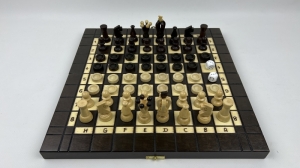
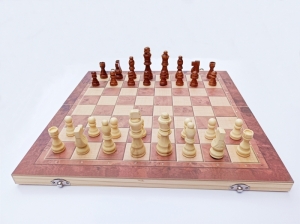
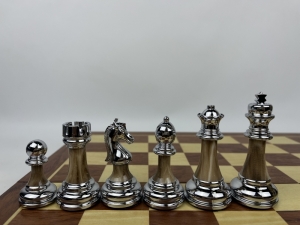
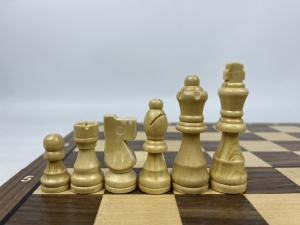
  • The size of the board when folded is 46x23x5 cm. The size of the board when unfolded is 35x35 cm. Cage size is 4.6x4.6 cm  The height of the king is 10 cm. The diameter of the base is 3 cm. Pawn height 5.5 cm. Base diameter 2.8 cm. Weight 1380 g. ART 123 Manufacturer Poland

    183.15 $
  • Made in Holland. Chess computer "Centaur" easy to use. You can easily install any language. Using the touch panel  40x40 cm (cell size 48 x 48 mm) you can easily move the figures. The sensors will record strokes. The board has a capacious rechargeable internal battery. The uniqueness of the computer is that it quickly adapts to  your playing strength (from beginner to grandmaster) so that you have the right opponent. Centaur will help you analyze the game so as not to make the same mistakes and improve your chess skill. Please note, computer is not compatible to connect to your PC or online chess. The set includes USB cable and DGT electronic chess pieces . Height of the king is 86mm.  

    1553.60 $
  • Author:
    Fine

    In the vast ocean of chess literature there are relatively few books about the endgame, and only a few of them can be considered true chess classics. And the most outstanding among the classics — Reuben Fine's book "Basic Chess Endings". Reuben Fine (1914−1993) was for a long time one of the best chess players in the world. As an author, Fine showed himself to be an excellent analyst who understood the full depth and peculiarities of the endgame. Having studied various types of standard positions, Fine established useful rules for practical play and proved himself to be an experienced teacher who, using skillfully chosen examples, was able to teach the reader all the necessary lessons and introduce him to the basic ideas of the endgame. Many generations of chess players in different countries of the world keep copies of “Basic Chess Endings”. For example, Mikhail Botvinnik considered Fine's work the most worthy of all that had ever been written on endgame theory.

    35.00 $
  • more

Books 1991-2023

  • book

    65.00 $

    RUB

    In the ninth volume of the series, Petersburg Grandmaster Alexander Khalifman continues his story about the methods of the struggle with whites against the Sicilian defense. The author examines a number of rare variants of the black game, as well as the main scheme in the Paulsen system.

  • book

    65.00 $

    RUB

    In the tenth volume, Petersburg grandmaster Alexander Khalifman talks about one of the most popular debut systems of recent times - the Chelyabinsk version of the Sicilian defense. The author proposes a number of new ideas, thanks to which white players can count on getting an advantage.

  • book

    62.06 $

    RUB

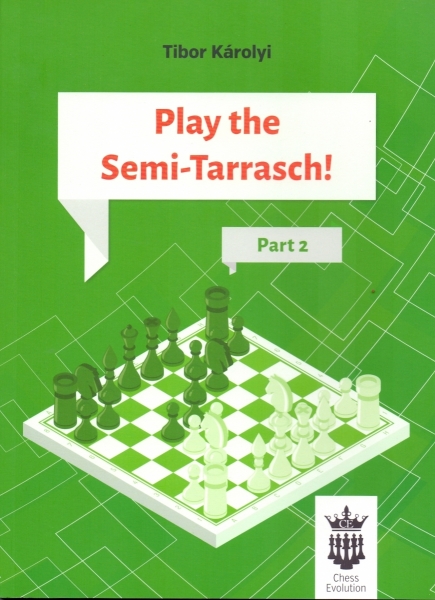
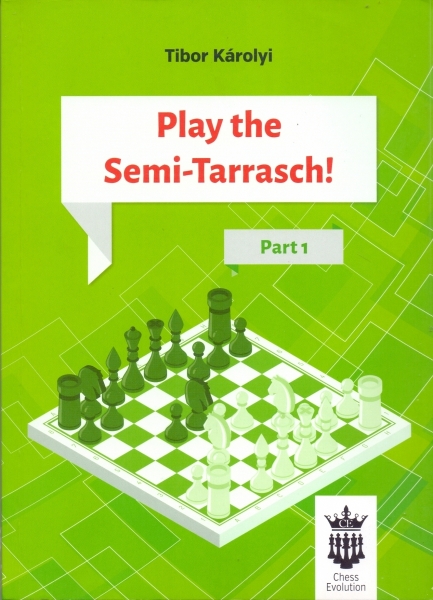
    Coated Paper Play & nbsp; the & nbsp; Semi - Tarrasch ! - & nbsp; Part & nbsp; 2 & nbsp; is now up-to-date release. This is the most frequently played tournament. Tibor K & opening opening in about about about about about about about Together with the first part, Tarrasch & nbsp; repertoire with black.

  • book

    62.06 $

    RUB

    Coated Paper. & quot; Play the Semi-Tarrasch! - Part 1 and Part 2 & quot; written by IM Tibor K & aacute; rolyi. The Semi-Tarrasch is one of the most popular openings. Tibor K & opening opening in about about about about about about about White e4, all the lines without e4. It’s Semi-Tarrasch. & nbsp;

  • book

    62.06 $

    RUB

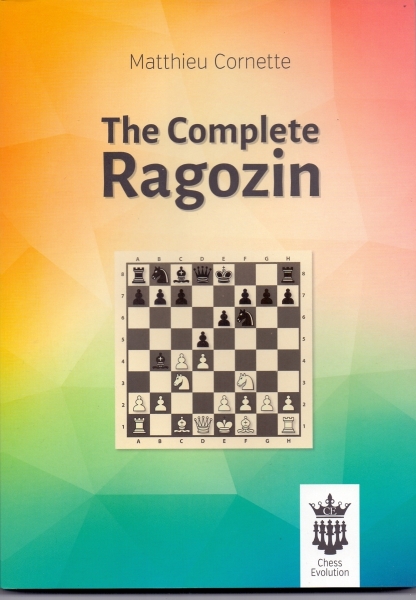
    Coated Paper. Matthieu Cornette shares his best theoretician of his life nowadays - The Ragozin defense. & nbsp; I was still amazed by this opening message. I love it and I love it; Relatively easy to play, with a good positional background, but for the chess literature. & quot; Matthieu Cornette.

  • book

    60.00 $

    RUB

    The modern protection of Philidor is a very strong, strategically rich debut with a wide variety of pawn structures, which can become your primary weapon in response to 1.e4. As a rule, White studies this protection in the last place, because they have enough urgent problems in other open and half-open principles, and meanwhile, the game of "general considerations" is contraindicated here. How many times has it been that the whites, lulled by the "timid" appearance of the rival, unwittingly relaxed, began to act superficially and reminisced only when their party was already inevitably rolling under the slope! It is no accident that the protection of Filidor included in its repertoire dozens of leading contemporary grandmasters, including representatives of the elite. The new work of the well-known journalist, international master Vladimir Barsky is both a textbook and a reference: to quickly include the new scheme in the repertoire, it is enough to study the Brief Overview and sample games, and the section "Step by Step" will help to penetrate deeper into the secrets of the debut.

  • book

    60.00 $

    RUB

    How to get the advantage of white in the "Spaniard"

  • book

    56.67 $

    RUB

    The universal weapon. 1. d4 d6 "is a modern, compact and well-thought-out debut repertoire for Black in response to almost any closed beginning.The basis of the book is two unique schemes: 2. c4 e5 and 2. Kf3 Cg4, where black seek from the very first moves to concretize the position, to force the opponent to play the move.If your arsenal already includes the modern protection of Philidor or the protection of Pirce-Ufimtsev, then this monograph will help to completely solve the problem of black color. The new work of the famous journalist and trainer, international master Vladimir Barsky is both a textbook and a reference book. To quickly include a new scheme in the repertoire, you just need to study the "Overview" and sample games, and to penetrate deeper into the secrets of the debut will help the section "Step by step"

  • book

    56.42 $

    RUB

    How to dumbfound the enemy. In English.

  • book

    54.70 $

    RUB

    In hardly any other opening does the second player get so many chances for an early initiative as in the Chigorin Defense 1.d4 d5 2.c4 Nc6. Among its practitioners are A. Morozevich and I. Miladinovic, as well as various other strong grandmasters. Nevertheless, for a long time the Chigorin Defense had a dubious reputation. Only the success of the players just mentioned, combined with the appearance of the first German edition of this book in 2001 gradually changed this. This now thoroughly updated essential work on the Chigorin offers 115 games scrutinised in detail, explains all the strategic principles and therefore creates a solid theoretical basis for the defense. The author is a Ukrainian IM who now lives in Stuttgart / Germany. This book founded his reputation as a respected theoretician. “The contents are first-class and the author has put a tremendous amount of work into the book. Material is drawn from nearly all possible sources and the author has added an abundance of original analysis, improvements, and sug-gestions of his own. ” (Carsten Hansen on Chesscafe, Checkpoint May 2005) “It will not only become the Chigorin Defense bible for many years to come, but it establishes the Chigorin as a sound defense deserving respect.” (John Watson, The Week in Chess, Book Reviews # 46)