menu
top sales
  • Author:
    Eive

    The corpus of this textbook includes two significant works by the world chess champion, scientist and prominent teacher Max Euwe — "Self‑help chess game", created in collaboration with G. Den-Hertog, and "Chess Lessons". The first work is designed for beginners, the second for more experienced chess players. The book is a real chess tutorial in the true sense of the word. This is expressed not only in the appropriate distribution of the material and the method of presentation, designed to awaken the initiative of the student, but also in numerous practical exercises offered to the reader after explaining each new concept or technique.The textbook primarily attracts the methodology of presentation of the material, the principles of which will be useful for coaches and teachers of chess sections and circles. For a wide range of chess fans.

    25.00 $
  • Author:
    Bogdanovich

    50.00 $
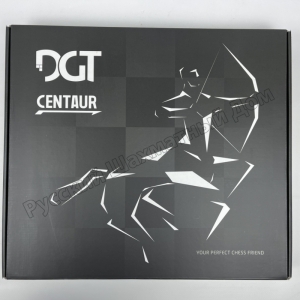
  • A limited edition of the most famous electronic chess clock. Design & quot; under the tree & quot ;. Released for the 25th anniversary of the DGT. & Nbsp; These watches are used in all major tournaments, world championships and World Cups, World Chess Olympiads. Installation of any time controls, including Fisher and Bronstein controls (with added time). & Nbsp;

    237.50 $
  • Author:
    Bezgodov

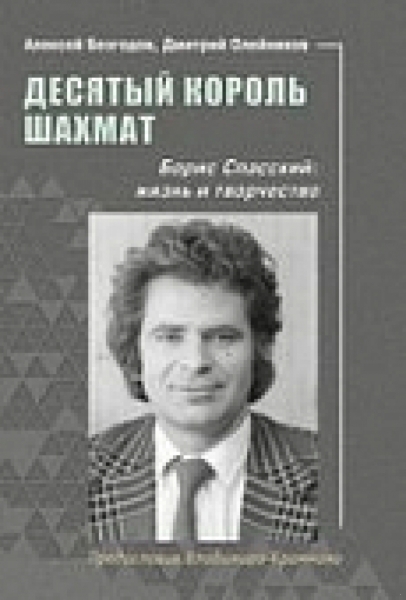
    The youngest first–grader in the USSR, the world champion among young men, a participant in the candidates tournament at the age of 19 - Boris Spassky's rise was rapid. And then fate gave the brilliant chess player a test of strength: he stumbled twice at the decisive moment and remained beyond the threshold of interzonal tournaments ... Only ten years after his first great success, Spassky managed to pass all the qualifying tests and earn the right to a match for the crown, but he failed to defeat the Iron Tigran Petrosian the first time. It took three more years of super–efforts: by Sisyphus he rose again to the foot of Olympus and did not miss a second chance - in 1969 he became the Tenth king of chess! An essay about the life of Boris Vasilyevich and his sporting path full of ups and downs was written by Dmitry Oleynikov, Candidate of Historical Sciences, curator of the Chess Museum of the Chess Federation of Russia. 70 beautiful and instructive games of Spassky were commented on by the champion of Russia in 1993, the famous author and theorist grandmaster Alexey Bezgodov, as well as grandmaster Dmitry Kryakvin and FIDE master Steve Giddins. The preface was written by the 14th world champion Vladimir Kramnik. For a wide range of chess fans.

    21.67 $
  • Author:
    Ezhov

    Grandmaster Carlos Torre – like a chess comet; his genius flashed dazzlingly and quickly went out in the chess firmament! He – the author of the most famous “mill” in the history of chess, the 2nd world champion Emanuel Lasker fell into its merciless millstones. The authors spoke about the life and work of the Mexican genius (the book contains 25 commentated games by K. Torre). Torre’s book “How a Chess Player is Formed” is presented, an essay by international master Yaroslav Prizant about Torre’s attack in modern practice. In the section "Play like Torre" – 36 instructive examples from his practice to solve. Finally, there is an interview with Carlos Torre, conducted by Gabriel Velasco in 1977. Working with the book will give readers not only aesthetic pleasure, but will also help improve their skills.

    18.33 $
  • Author:
    Yanvarev

    Igor Yanvarev "Tactical Mastery of a Chess Player. Volume 2. Basics of Calculation Techniques". Andrey Elkov Publishing House, Moscow, 2025 - 392 p. Before you is the second book from the three-volume work by International Master I.K. Yanvarev, a famous trainer, author of the fundamental work "The Old Indian Played by Tigran Petrosian" (2010), which received recognition from readers and was republished abroad. The three-volume work is united by a common idea - tactics and combinations in chess. In fact, this is a turnkey textbook, it explains everything from scratch to an advanced level. The second volume is devoted to the basics of calculation techniques, such topics as the tactical "spectrum" of a position, concentration of attention, inclusion of imagination are considered, the "tree of variations" is interpreted in a new way, the practical component is emphasized - the economy of calculation. A separate chapter allows the reader to assess their ability to calculate variations and outline ways to eliminate weaknesses. Each chapter ends with a large number of carefully selected examples for independent solution. Unlike other similar publications, the author examines chess tactics as a single whole, in combination with strategy and elements of psychology. It is based on the original author's methodology, which has proven itself well when working with chess players of various qualifications. Excellently selected examples, a clear logical structure and consistency in the presentation simplify the understanding of the material. For a wide range of chess fans.

    19.00 $
  • Magnetic road chess: folding board-case made of artificial leather, tablet-figures with a convex image. Wallet size 19x22 cm. The playing field is 15.5 x 15.5 cm. Cell 2x2 cm.

    51.72 $
  • Unique chess for 3 players. Such chess will appeal to any person who chooses something new and appreciates original things. Manufacturer MADON-CHESS (Poland) Chessboard size: 46.5x54x2.5cm (unfolded) King height: 7.7cm King base diameter (cm): 3  Pawn height (cm): 3.6 Pawn base diameter (cm): 2.1 Presence of weighting agent: no Weight: 1311 g. Wood used for the chessboard: beech, birch Wood used for figures: hornbeam, beech  Intermediate chess for three is ideal entertainment for friends. The chess store presents to customers a unique set from a Polish manufacturer. If you are planning to buy a medium chess set for three in Moscow, pay attention to the set MADON-CHESS.   The main advantages of a chess set for three are reasonable cost and workmanship. The chess pieces are made of beech and oak of the highest quality. The chessboard is not inferior in quality: it is based on birch and beech.  The set consists of chess in three colors.  The chessboard has a compact size and is convenient to store on a shelf. Inside the board there are three separate compartments for storing pieces. For convenience and to keep products intact, the board is equipped with a soft lining.

    214.50 $
  • Author:
    Zhuravlev

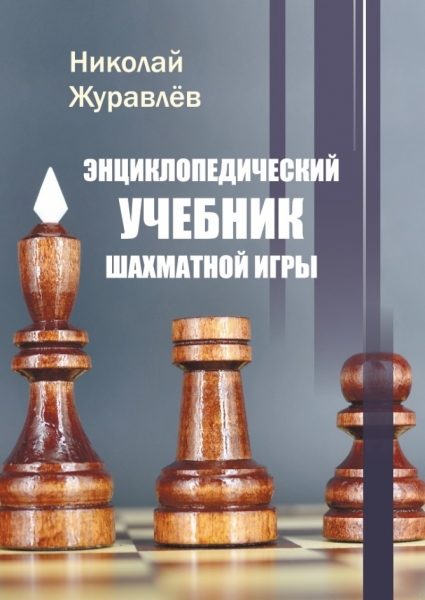
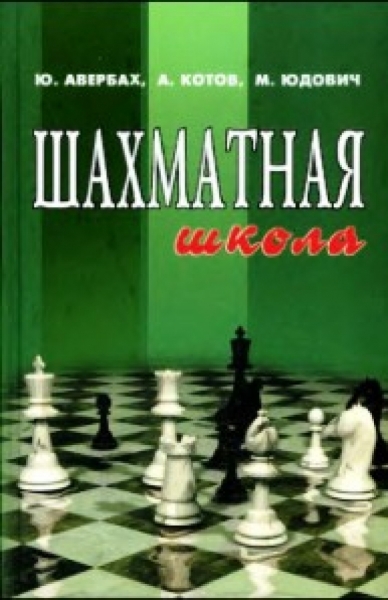
    This tutorial is addressed to those who want to learn to play chess on their own and improve further. The lesson-based method of presentation, as well as numerous exercises, contribute to the consistent assimilation of the rules and laws that form the basis of the chess game. The book contains extensive educational material, which is presented to the reader in accordance with modern pedagogical principles. The purpose of this manual is to train chess players of the III category (rating up to 1800). The textbook can also be used for classes in groups - it covers the material of existing programs of the first year of study in children's and youth chess schools.

    23.33 $
  • Author:
    Galkin

    16.67 $
  • more

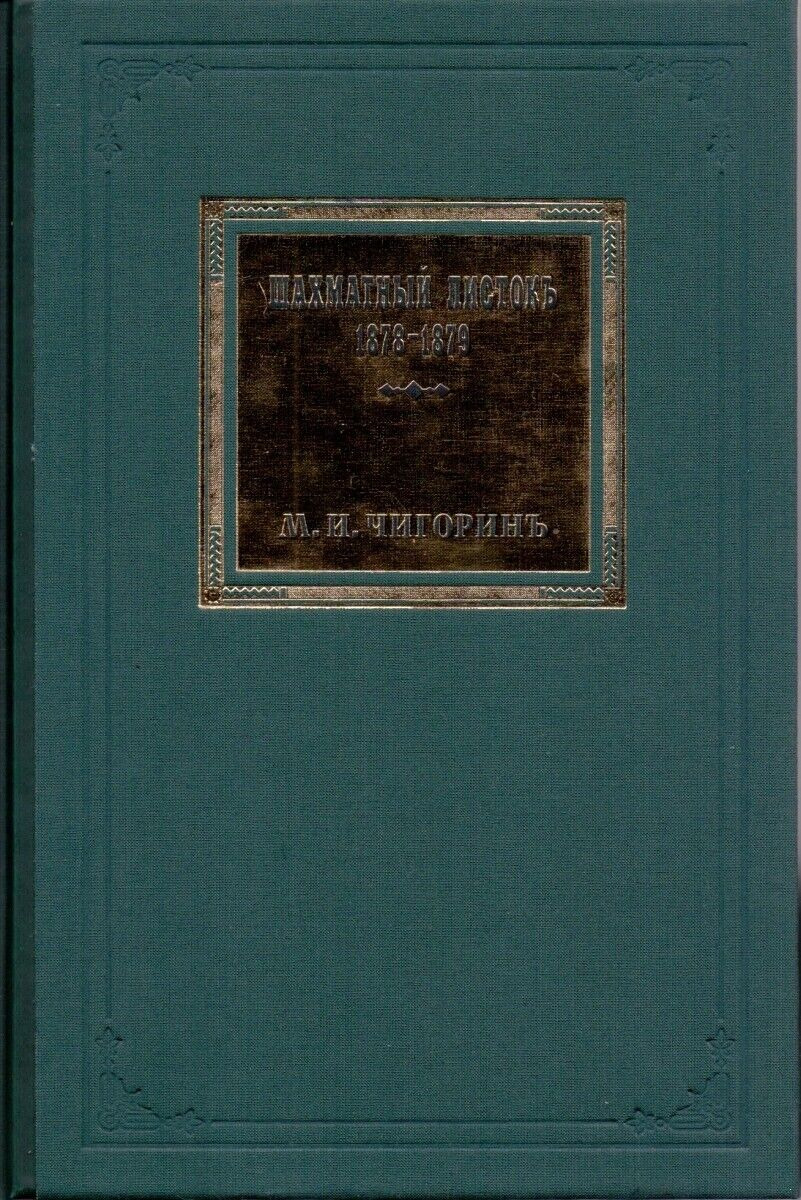
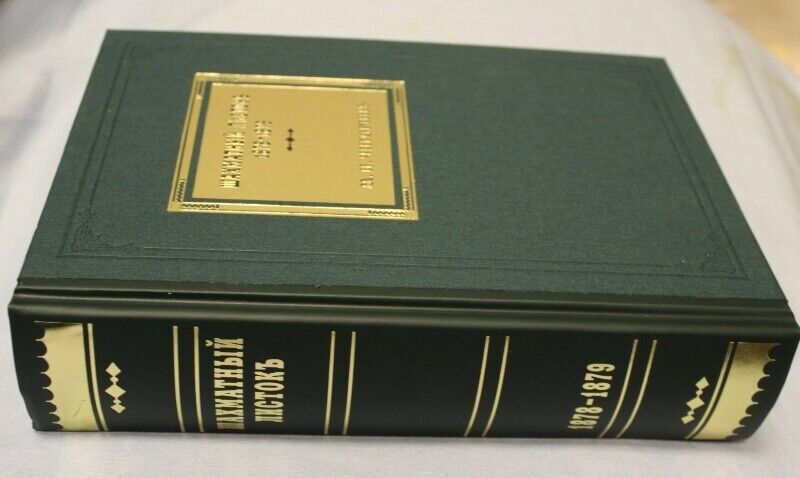
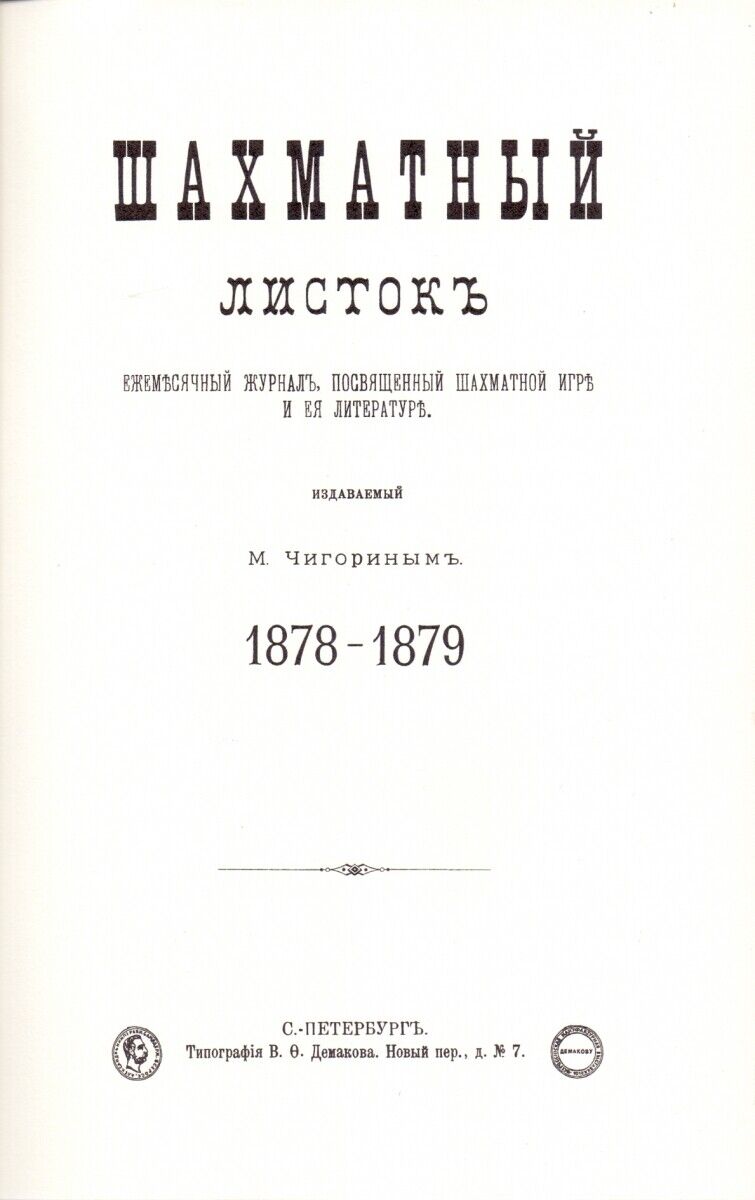
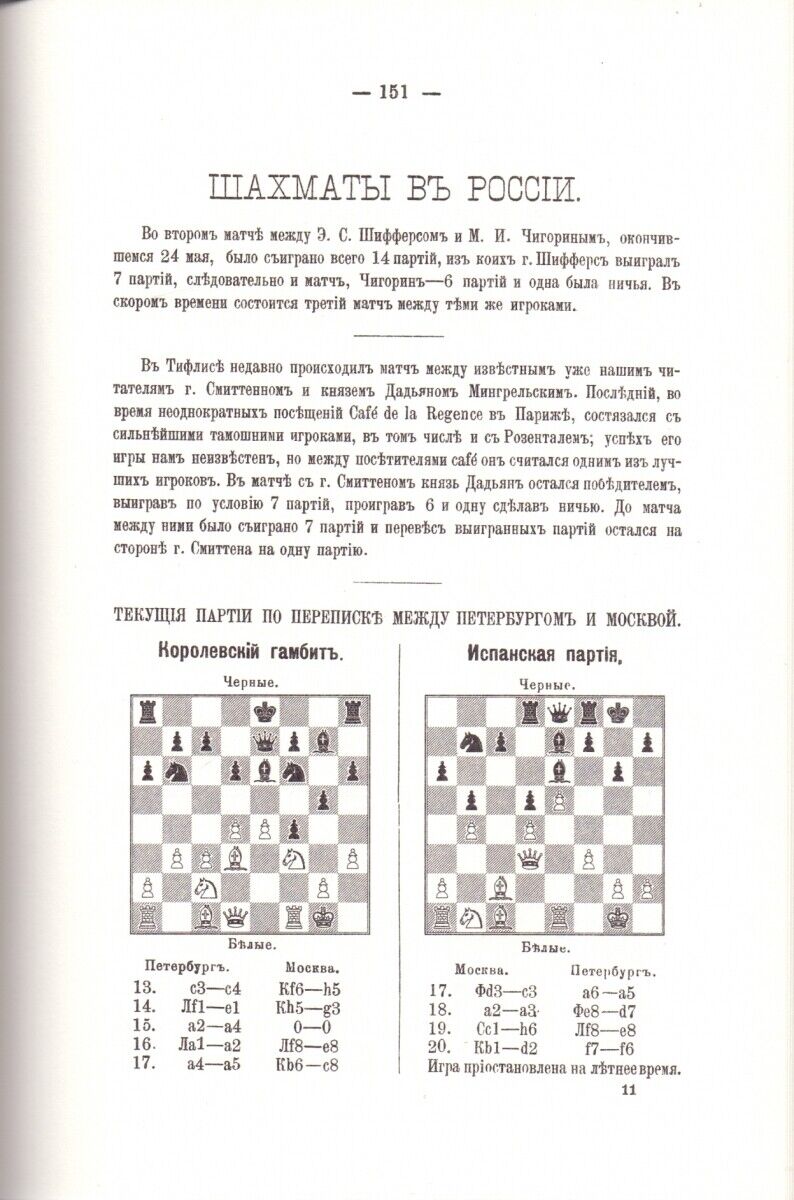
Chigorin's CHESS SHEET 1878-1879. VOLUME II. FACSIMILE GIFT EDITION.2019

50 $

RUB

Description:

The second volume includes two years: 1878-1879 (was published in 3 volumes)
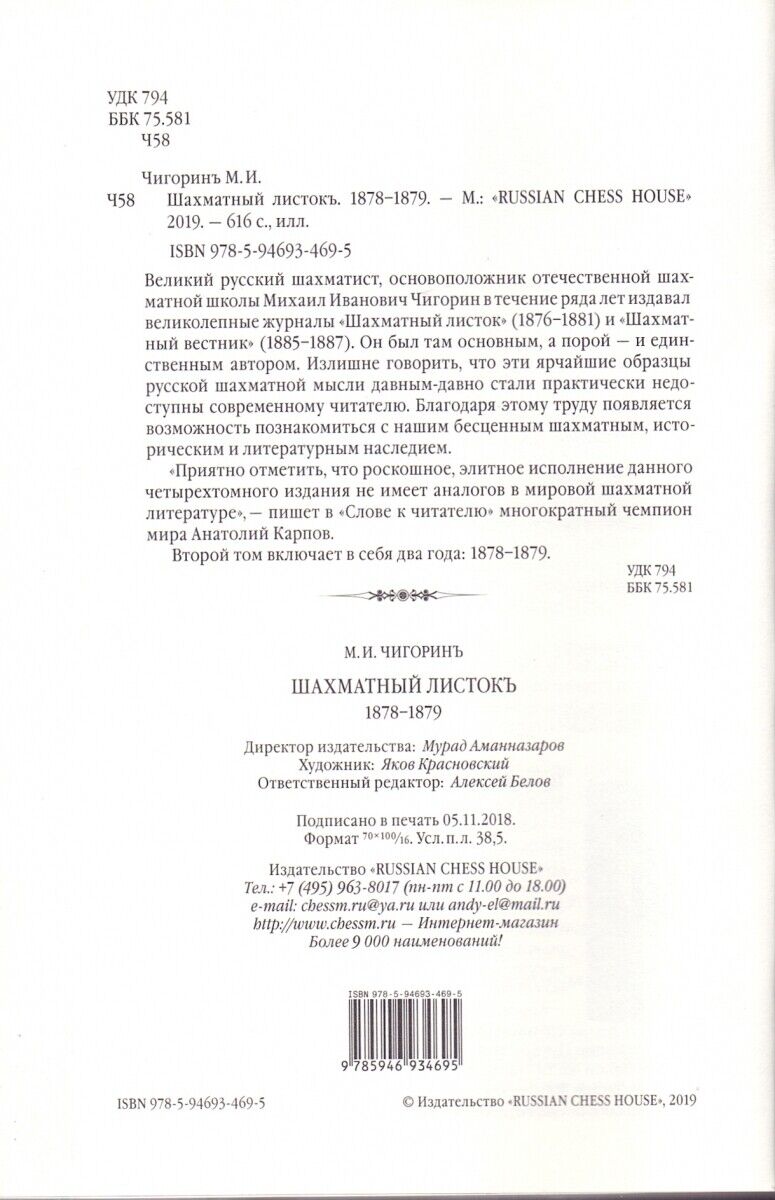
ISBN: 978-5-94693-469-5
Publisher: Russian Chess House
Author(s): Chigorin
Year of release: 2019
Language: Russian
Format: Enlarged
Pages: 616
Cover: Hardcover with gold and blind embossing, book marks , paper antique
Date: 2019

A monthly magazine dedicated to the game of chess and its literature. Published By M. Chigorin 1878-1879. St. Petersburg, Russia. Printing House Of V. O. Demakov.
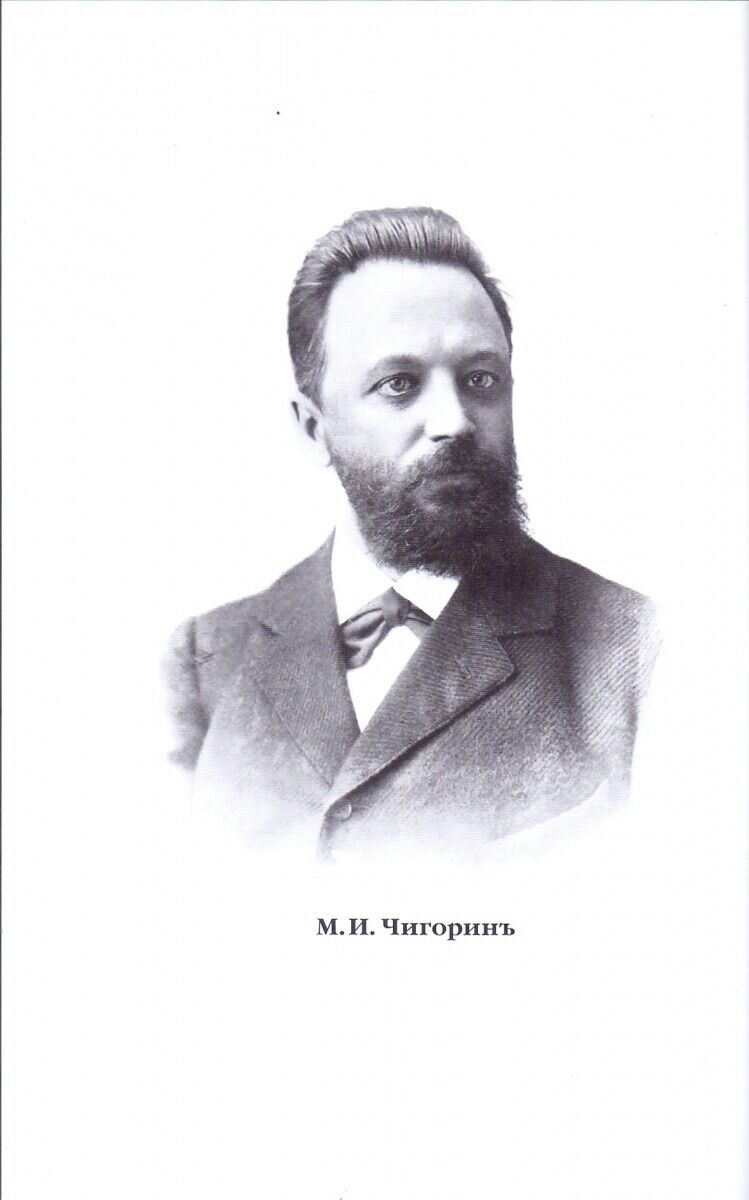
The great Russian chess player, the founder of the national chess school Mikhail Ivanovich Chigorin for ten years published the magnificent magazines "Chess leaf" (1876-1881) and "Chess Bulletin" (1885-1887). He was the main and sometimes the only author there. Needless to say, these most striking examples of Russian chess thought have long been virtually inaccessible to modern readers. Thanks to this work, it is possible to get acquainted with our priceless chess, historical and literary heritage.
"It is pleasant to note that the luxurious, elite performance of this three - volume edition has no analogues in the world chess literature, "writes multiple world champion Anatoly Karpov in" Word to the reader".
The second volume includes two years: 1878-1879.

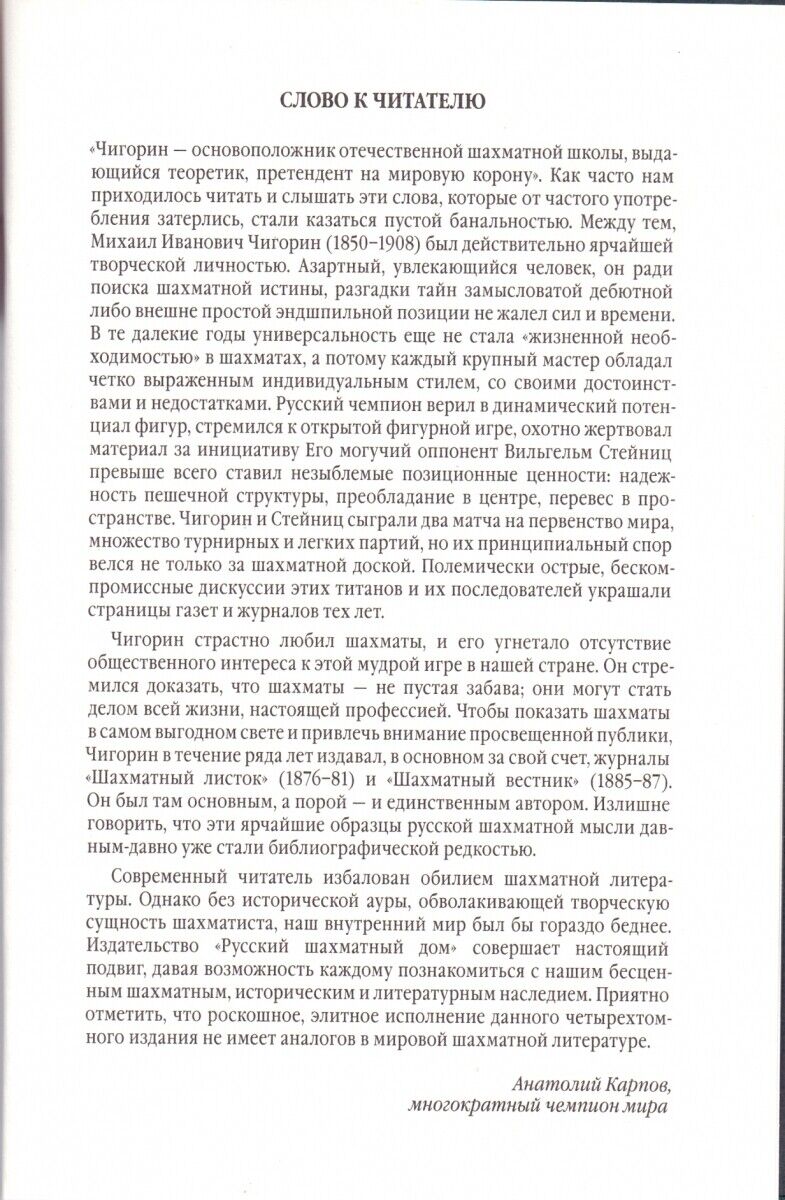
WORD TO THE READER

"Chigorin is the founder of the Russian chess school, an outstanding theorist, and a contender for the world crown." How often we had to read and hear these words, which from frequent use were lost, began to seem an empty banality. Meanwhile, Mikhail Ivanovich Chigorin (1850-1908) was really the brightest creative personality. A gambling, exciting person, he spared no effort and time to find the truth of chess, to solve the mysteries of an intricate opening or seemingly simple endgame position. In those early years, universality had not yet become a "vital necessity" in chess, and therefore every major master had a clearly defined individual style, with its own advantages and disadvantages. The Russian champion believed in the dynamic potential of figures, aspired to an open figure game, and willingly sacrificed material for initiative. His powerful opponent, Wilhelm Steinitz, put unshakable positional values above all else: the reliability of the pawn structure, the predominance in the center, the preponderance in space. Chigorin and Steinitz played two matches for the world championship, a lot of tournament and light games, but their fundamental dispute was not only at the chessboard. Polemically sharp, uncompromising discussions of these titans and their followers graced the pages of Newspapers and magazines of those years.

Chigorin passionately loved chess, and he was depressed by the lack of public interest in this wise game in our country. He wanted to prove that chess is not an empty sport; it can become a life's work, a real profession. To show chess in the most favorable light and attract the attention of an enlightened public, Chigorin for ten years published, mostly at his own expense, the magazines "Chess leaf" (1876-81) and "Chess Bulletin" (1885-87). He was the main and sometimes the only author there. Needless to say, these most striking examples of Russian chess thought have long since become a bibliographic rarity.

The modern reader is spoiled by an abundance of chess literature. However, without the historical aura that envelops the creative essence of the chess player, our inner world would be much poorer. The Russian chess house publishing house performs a real feat, giving everyone the opportunity to get acquainted with our priceless chess, historical and literary heritage. It is pleasant to note that the luxurious, elite performance of this four-volume edition has no analogues in the world chess literature.

Anatoly Karpov,
multiple world champion


The great Russian chess player, the founder of the national chess school Mikhail Ivanovich Chigorin for ten years published the magnificent magazines "Chess leaf" (1876-1881) and "Chess Bulletin" (1885-1887). He was the main and sometimes the only author there. Needless to say, these most striking examples of Russian chess thought have long been virtually inaccessible to modern readers. Thanks to this work, it is possible to get acquainted with our priceless chess, historical and literary heritage.

Brand New

To leave comments, sign in or register on the site.
There are no comments on this record yet.