menu
top sales
  • Author:
    Blokh

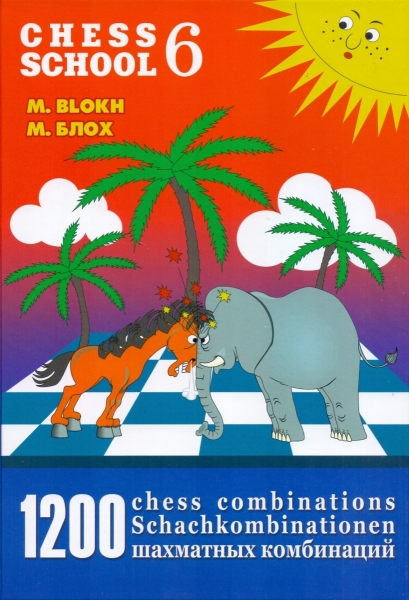
    The answer book of an international grandmaster and an experienced coach (among whose students is A. Grischuk) Bloch's Maxim contains over 1200 combinations from practical games and specially compiled examples. All tasks are characterized by intense struggle, in which the goal is achieved by single moves. The book is intended for both young and adult amateurs, and for masters. The arrangement of examples by topic allows you to use the book not only as a task book, but also as a textbook. Of particular interest are over two hundred specially compiled by the author overstressed positions in which white wins the only way during the course of white, and black wins during the course of black. These examples, as well as over 50 fragments from the parties of the author and his students, are published for the first time.

    21.67 $
  • Author:
    Kasparov

    41.67 $
  • Author:
    Kalinichenko

    The vast majority of opening guides are written for adult readers. This book is also devoted to the theory but it is junior. The structure of the book is simple and attractive: openings are examined using examples from actual games, each of which is presented in the form of a lesson with its own name. Several such lessons form an opening theme, and the examination of each theme concludes with exercises. In each opening, attention is drawn to its characteristic tactical and strategic ideas of combinations for independent solution strictly corresponds to the opening theme. Written in clear and easy language, the book is furnished with a large number of diagrams. Colored explanatory arrows on the diagrams and the selection of individual pages with a colored background make the book easier to understand. Regular work solve two problems: deepen the student's knowledge and develop his tactical vision, thus improving his skill and results.

    28.80 $
  • Author:
    Getmanchuk

    16.67 $
  • Author:
    Chernyshov

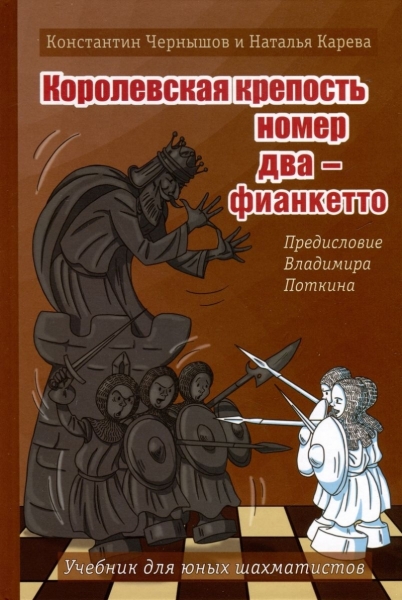
    The authors continue to study typical opening and middlegame positions. Royal Fortress No. 2 has pawns on squares f7, g6, h7 (or f2, g3, h2), and they are usually joined by another defender – bishop on g7 (g2). This formation is called fianchetto, it is found in many popular openings, such as the Catalan Opening, King's Indian Defense, Grunfeld Defense and a number of others.  The authors analyze in detail the techniques of attack, defense and counterattack. Most examples – from the creativity of modern chess players (for example, a separate chapter is dedicated to the strongest Russian grandmaster Ian Nepomniachtchi); they are complemented by parts that have become a classical heritage. The book contains about 300 positions for independent solution, so it is not only a textbook, but also a solid problem book. Grandmaster Konstantin Chernyshov, head of the Interregional Grandmaster School in Kostroma, and his daughter International Master Natalya Kareva – experienced coaches, whose students include grandmasters and masters, champions of Russia and Europe among juniors.  The book is addressed to young chess players and their mentors. 

    20.00 $
  • Author:
    Franco

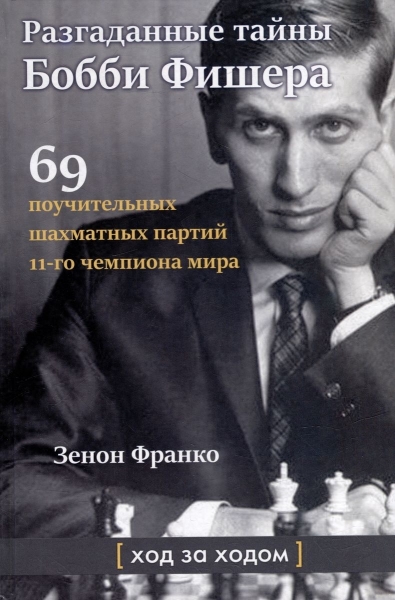
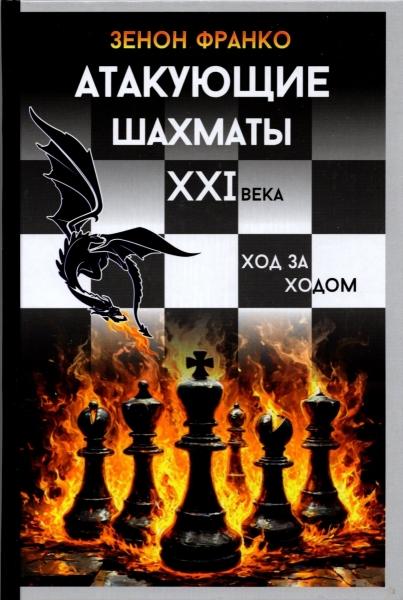
    The book by grandmaster and experienced chess coach Zenon Franco includes 36 instructive attacking games and is divided into four chapters - the king in the center, one-sided castling, opposite-sided castling, and attack-defense-counterattack. Before each game, the opponents are introduced, and a brief description of the events that took place in it is given. Based on the results of the struggle in the game, lessons that are useful to learn from what has been read are listed in a concise form. The book is not overloaded with variations, the emphasis is on detailed explanations in the "move by move" format, which creates an ideal platform for studying chess. At the "support" points of each game, the reader is offered test questions, which helps both the practical study of key chess techniques and the reliable assimilation of the acquired knowledge. Questions and answers involve the reader in the learning process and help him track the growth of his chess strength. For a wide range of chess fans.

    19.00 $
  • Author:
    Fine

    In the vast ocean of chess literature there are relatively few books about the endgame, and only a few of them can be considered true chess classics. And the most outstanding among the classics — Reuben Fine's book "Basic Chess Endings". Reuben Fine (1914−1993) was for a long time one of the best chess players in the world. As an author, Fine showed himself to be an excellent analyst who understood the full depth and peculiarities of the endgame. Having studied various types of standard positions, Fine established useful rules for practical play and proved himself to be an experienced teacher who, using skillfully chosen examples, was able to teach the reader all the necessary lessons and introduce him to the basic ideas of the endgame. Many generations of chess players in different countries of the world keep copies of “Basic Chess Endings”. For example, Mikhail Botvinnik considered Fine's work the most worthy of all that had ever been written on endgame theory.

    35.00 $
  • Author:
    Karoii

    50.00 $
  • A limited edition of the most famous electronic chess clock. Design & quot; under the tree & quot ;. Released for the 25th anniversary of the DGT. & Nbsp; These watches are used in all major tournaments, world championships and World Cups, World Chess Olympiads. Installation of any time controls, including Fisher and Bronstein controls (with added time). & Nbsp;

    237.50 $
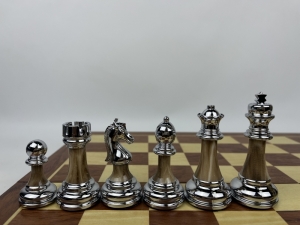
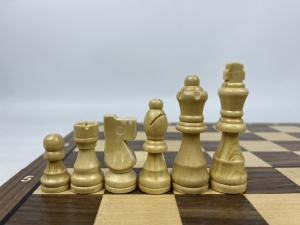
  • The size of the board when folded is 35x17.5 cm. The size of the board when unfolded is 35x35 cm. Cage size is 3x3 cm  King height 6.6 cm. Base diameter 2.2 cm. Pawn height 3.1 cm. Base diameter 2 cm. Backgammon - checker 2.1 cm. Weight 830 g. Includes backgammon chips and dice Chess board and backgammon chips can be used to play checkers Manufacturer Poland

    148.00 $
  • more

Art-Rodnik

Книги издательства:

  • book

    62.50 $

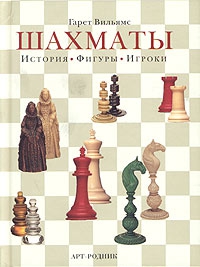
    The author of the book, Gareth Williams, examines the history of chess pieces, starting with the ancient cultures that existed in Asia and ending with modern chess that participate in competitions today. Most of the chess presented in the pages of this book dates back to the mid-18th century. Some of them come from ivory carving centers known at the time, such as Berkhampur in eastern India, Guangzhou in China, Dieppe in France or Kholmogory in Russia. These countries have developed their own schools, each with its own special plots, decorative motifs and methods of processing the material, which are usually passed down from generation to generation. The book will also introduce you to serious historical facts, interesting characters and fascinating details about the matches in which they participated.